
West Africa’s agrifood sector is growing steadily, driven by a young population and rapid urbanisation. Agriculture accounts for roughly 25% of GDP and 45% of jobs – an economic pillar that is pushing many SMEs to export their products internationally.
In 2024, despite weather disruptions, West Africa’s cereal harvest was estimated at 73.7 million tonnes, underlining the region’s potential. Yet for these SMEs, working through the maze of customs and logistics formalities remains a major challenge. Delays, unexpected costs and regulatory risks can all slow their momentum.
This guide is aimed at leaders of West African agrifood SMEs who want to optimise their export supply chain. It draws on recent data (2024–2025), concrete examples and practical advice to help you save time on export procedures while reducing risks related to customs and international transport.
Every recommendation is backed by reliable figures and first-hand accounts from entrepreneurs, to give a full picture of the logistics outsourcing solutions available to SMEs.
The sections below cover the main benefits of outsourcing certain operations: document optimisation, anticipating inspections, managing the unexpected, and pooling logistics resources. You will also find numerical comparisons, a chart and a table summarising the advantages of working with a freight forwarder. Use the links below to jump to each section:
- 1 – Document optimisation & compliance
- 2 – Anticipating customs checks
- 3 – Managing logistics emergencies
- 4 – Pooling resources between SMEs & cooperatives
- 5 – Costs, timelines & savings achieved
1 – Document optimisation & compliance
Between the administrative jargon, the endless forms and constantly shifting regulations, export paperwork can quickly overwhelm an SME. A wrong customs code or a missing document can hold up a container for days.
For example, a single incorrectly completed form can trigger a thorough inspection and penalties. By contrast, flawless documentation speeds up clearance. That is why streamlining administrative procedures is the first lever for saving time.
Working with a freight forwarder or customs broker makes this documentary side more reliable. These experts know the regulatory requirements of each destination: HS codes, phytosanitary certificates, rules of origin, and so on. They can put together a complete, compliant export file from the outset.
The result? Fewer back-and-forth exchanges with authorities and smoother border crossings. According to the UNCTAD, trade facilitation expertise can cut customs clearance times by up to 47% in some countries. That means nearly half the waiting time eliminated through optimised procedures.
For an SME, outsourcing customs formalities is not a luxury — it is a strategic choice. It avoids common pitfalls: missing attachments, data entry errors, or unawareness of a new rule.
A good freight forwarder typically offers tailored document checklists and trains your team on best practices. Every shipment is then prepared with rigour: detailed commercial invoice, packing list, required certificates, complete customs declaration, and so on. This upfront preparation significantly reduces the risk of hold-ups at the border.
2 – Anticipating customs checks
Random customs checks can cause lengthy delays if you are not prepared. In sub-Saharan Africa, customs authorities tend to carry out intrusive physical inspections of many containers, yet fewer than 3% of checks uncover genuine violations.
This means many inspections could be avoided with better risk assessment. An experienced freight forwarder helps your SME anticipate these checks through its knowledge of customs targeting criteria.
In practice, a freight forwarder will know, for example, that exporting a new food product to the EU is likely to trigger enhanced documentary scrutiny if a health certificate is missing. They will flag the required documents and applicable standards well in advance.
Working with a certified partner such as an Authorised Economic Operator (AEO) also often means lower inspection rates and faster customs passages. Companies and service providers with AEO status are considered reliable: their shipments are held up less frequently and they receive priority treatment during inspections.
Staying ahead also means monitoring regulatory changes. In 2025, several West African countries tightened controls on imported agrifood products for health reasons. Freight forwarders keep their SME clients informed as these developments unfold, preventing unpleasant surprises on arrival.
This proactive approach reduces the risk of goods being held for testing or re-inspection. Every day of customs delay carries a hidden cost: according to the World Bank, each additional day in transit raises the final cost of goods by 0.8% on average.
The chart below illustrates the cumulative impact of delays.
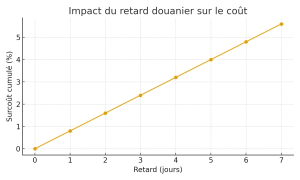
Figure 1 – Impact of customs delays on the cost of goods. Each day of delay adds approximately 0.8% to the final product cost.
3 – Managing logistics emergencies
Despite every precaution, unexpected situations arise: a dockers’ strike, a container missing its connection, or a last-minute regulatory requirement. For an SME, these logistics emergencies are hard to handle alone.
A freight forwarder’s responsiveness can be the difference between a minor setback and a costly crisis. Drawing on a network of partners — local agents, overseas forwarders, alternative carriers — they can quickly activate backup solutions.
For instance, if a consignment of perishable goods is held up at a port, the freight forwarder can urgently negotiate an accelerated inspection or temporary cold storage. Equally, if a delivery is critically late for your customer, they can charter express transport or reroute the cargo through a less congested hub. Their experience handling crisis situations — delays, blockages, strikes — brings real relief to the SME owner, who can focus on their core business while the expert resolves the problem.
One telling example is that of an Algerian importer in 2025: following a sudden regulatory change, hundreds of containers were immobilised in ports, clogging the supply chain. The result was that this entrepreneur had to pay more than 2.1 million dinars in demurrage charges for 8 containers held up for 3 weeks.
These charges, equivalent to roughly $14,000, could largely have been avoided with better upfront support and proactive crisis management. The example shows just how much delays and blockages can strain an SME’s cash flow, and confirms that in a crisis, working with a seasoned freight forwarder helps contain the financial and operational damage.
4 – Pooling resources between SMEs & cooperatives
Many small businesses hesitate to export because they lack sufficient volumes or logistics capacity. This is where resource pooling through cooperatives or exporter groups comes in. By joining forces, producers can share a single freight forwarder and ship their goods together, spreading the costs and complexity for each participant.
For example, a mango producers’ cooperative in Mali can fill a full container bound for Europe by combining the harvests of several farms.
The freight forwarder then organises the groupage: consolidating lots, shared documentation, and a single point of tracking. Each SME pays only its share of the container and related costs, rather than funding a costly partial shipment. This pooled approach also gives greater bargaining power when negotiating freight rates with shipping lines or airlines, thanks to the combined volumes.
On the paperwork side, the freight forwarder helps set up shared files for the group. They ensure that all members meet the same quality and compliance standards — packaging, labelling, health certifications — so that one participant cannot jeopardise the whole consignment.
Some West African cooperatives report having broken into new markets through this pooled model, whereas individually they would not have had the administrative or financial capacity to do so. There is real strength in numbers: by sharing a logistics provider and coordinating their shipments, SMEs reduce risks and gain efficiency at the international level.
5 – Costs, timelines & savings achieved
Outsourcing logistics does of course carry a cost (forwarder fees, file charges), but it is an investment that pays off quickly. Errors and delays in self-managed shipments typically cost far more. Between late-delivery penalties, unplanned port storage and missed sales opportunities, securing the supply chain is clearly in an SME’s interest.
African countries face the highest logistics costs in the world: on average, transport and transit charges account for 11.4% of goods’ value, compared with 6–7% in developed countries. This gap reflects the inefficiencies and added costs along the chain: infrastructure, procedures, formalities.
In this context, every saving counts. According to the World Bank, a landlocked country (with no sea access) can see freight costs rise by 50%, and every extra day at customs adds to the final bill. For West African SMEs, shaving a few days off transit time through a freight forwarder can generate considerable savings on the landed cost of exported goods.
The table below compares in-house management by an SME with outsourced management through a freight forwarder, across several key criteria. Outsourcing secures operations and typically reduces indirect costs (errors avoided, shorter timelines), more than offsetting the cost of the service provider.
| Criterion | In-house management (without freight forwarder) | Outsourced management (with freight forwarder) |
|---|---|---|
| Document compliance | High risk of errors, time-consuming regulatory monitoring | Up-to-date expertise, complete and compliant documents from the start |
| Customs clearance time | Delays often extended by poorly anticipated procedures | Optimised procedures, timelines cut by up to 47% |
| Unexpected costs | Demurrage charges, amendment fees in case of error or delay | Lower risk of penalties, controlled transit costs |
| Emergency management | Limited resources, often slow to react | 24/7 support, alternative solutions through a global network |
| Core business focus | SME’s time absorbed by logistics administration | SME refocused on its core activity, productivity gains |
Using a freight forwarder means securing your exports and avoiding many pitfalls. It is a practical way to sharpen your SME’s competitiveness on international markets.
Less time spent on paperwork and handling emergencies means more time to grow your business and serve your customers. And as we have seen, a few days saved or a few errors avoided quickly translate into thousands of euros in the bank.
5. FAQ – Frequently asked questions
What is a freight forwarder and why should an SME hire one?
Answer: A freight forwarder manages international transport organisation and customs formalities. For an SME, they save time and prevent costly mistakes.
How do you choose a good freight forwarder for exporting from West Africa?
Answer: Check their customs licence, their experience in your sector, and their international network. A reliable, responsive freight forwarder is a real asset for avoiding delays and extra costs.
What costs are involved in working with a freight forwarder?
Answer: Fees cover services such as customs filing, freight, and insurance. These costs are often offset by the savings generated through rate negotiation and proactive delay prevention.
What are the average customs clearance times?
Answer: In West African ports, clearance can take 2 to 5 days. With an experienced freight forwarder, this is often reduced by one to two days.
What are the risks if a customs declaration is incorrect?
Answer: An error can result in fines, a hold, or seizure of the cargo. It can also delay the shipment by several weeks.
What is the difference between a freight forwarder and a customs broker?
Answer: A freight forwarder manages the full logistics chain, while a customs broker focuses specifically on clearance. Many freight forwarders are also licensed customs brokers.

Pingback: African Customs at Export: Costly Mistakes to Avoid