The agrifood sector in West Africa is evolving rapidly. SMEs across the region are innovating and adapting to win new markets, driven by certification, quality and financing.
This article draws on concrete real-world experience to inspire business leaders.
You will see how local SMEs are successfully exporting and creating added value despite logistical and competitive challenges.
This practical guide is organised around key stages:
- Case study: Instant Chocolat (Côte d’Ivoire)
- Case study: La Vivrière / SECAS (Senegal)
- Case study: Mango cooperative (Senegal)
- Key success factors for exporting SMEs
Case study 1: Instant Chocolat (Côte d’Ivoire)
This Ivorian start-up, founded by Axel Emmanuel Gbaou, built its identity around 100% locally made “gourmet” chocolate. While almost all of Côte d’Ivoire’s cocoa is exported as raw beans, Instant Chocolat transforms part of that wealth on home soil.
Launched in 2015 through a crowdfunding campaign, the company started in a small workshop in Abidjan. Demand grew quickly, and production had to scale up — reaching 1,000 chocolate bars and 2,000 pralines per day, all produced by hand.
What drove the success? First, quality and authenticity: the cocoa comes from a model cooperative (Ecoya) and is processed entirely by hand by a trained team of young workers, with meticulous quality control at every stage. Instant Chocolat committed to purely Ivorian ingredients — local cane sugar, local powdered milk where available — to stake a claim as a genuinely “made in Côte d’Ivoire” product.
Second, business certification: despite its small size, the company put good hygiene practices in place (targeting HACCP certification) and built trust with local customers and diaspora buyers. It obtained the Ministry of Health approval required for food exports.
Third, financial support: after the initial crowdfunding, Instant Chocolat received grants through start-up competitions and joined an incubator that connected it with investors.
Today, the brand sells locally (in Abidjan supermarkets) and is beginning to export online.
This case shows that with a compelling story and strong quality control, an SME can move up the cocoa value chain. Challenges remain: sourcing cocoa (paradoxically difficult locally, since the best beans are exported) and accessing equipment to scale up production — a shift to semi-industrial output is being planned for 2025.
Case study 2: La Vivrière / SECAS (Senegal)
La Vivrière is a pioneering Senegalese SME in the processing of local grains.
Founded by Mme Bineta Koné Coulibaly 30 years ago, the company started modestly with millet as its sole raw material.
Today, rebranded as SECAS, it also processes maize and cowpea (a local bean) and offers pre-cooked fonio under the WIIW brand.
Its main strength is the consistently high quality of its products, the result of a long journey towards certification. La Vivrière built a genuine internal quality system: incoming grain inspection, modern cleaning and packaging equipment, and staff training in good hygiene practices.
These efforts were recognised with the EU “Quality Award” under a programme promoting local grains. That recognition helped the company secure export contracts with African grocery stores in France and specialist retailers in the United States.
The role of financing: in 2019, SECAS opened its capital to local investment fund Teranga Capital and to FONSIS (Senegal’s sovereign wealth fund). This injection of capital funded a new processing unit meeting international standards and enabled a significant production increase. It is a strong example of a public-private partnership backing a promising local SME.
SECAS now generates jobs in rural areas, purchases its raw materials from thousands of small local producers, and helps substitute a share of cereal imports — notably broken rice — with quality local products.
Case study 3: Mango cooperative in Senegal
The Casamance region in southern Senegal is rich in mango trees, but for many years its export potential went untapped due to poor connectivity and quality issues.
In 2018, a producers’ cooperative formed around the village of Kolda, supported by the NGO Tekki. The 50-member cooperative benefited from a training programme funded by the Millennium Challenge Account to obtain GlobalGAP certification across 30 hectares of orchards.
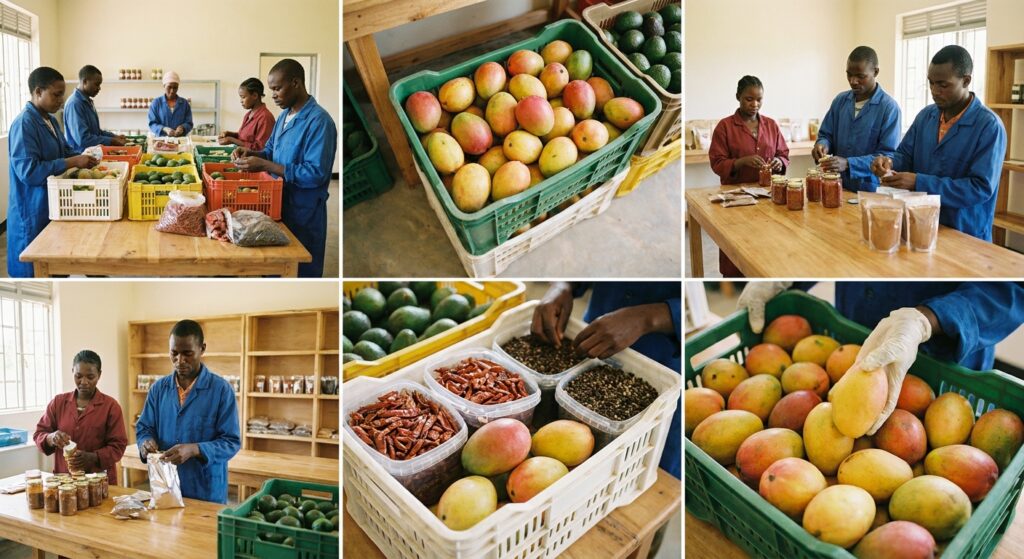
Investments were made: fruit fly traps were installed, and a small packing station was set up with hydrothermal treatment tanks to eliminate insect eggs.
In 2021, the cooperative shipped its first container of fresh mangoes by sea to Spain, in partnership with an established exporter.
The outcome: a very low rejection rate on arrival (<5%) thanks to strict compliance with the product specification, and a clear economic gain — producers received 400 FCFA/kg for exports compared with 150 FCFA/kg on the local market.
This success story was made possible by combining certification (GlobalGAP), financing (MCA equipment grant) and commercial introductions through an agrifood trade fair. It is now inspiring other cooperatives across the region.
The challenge will be to grow without sacrificing quality: the cooperative is targeting organic certification by 2025 to enter the even more lucrative dried organic mango segment, with support from an Italian NGO helping orchards convert to organic production for both cashew and mango.
Key success factors for exporting SMEs
Across these case studies, a common thread emerges: pursuing certification — whether for quality, organic or fair trade — acts as a springboard for SMEs to access higher-value markets, but it almost always requires external support, whether financial or technical.
Business leaders play a central role through vision and perseverance, but they can draw on a growing ecosystem of support organisations — export promotion agencies, investment funds, specialist NGOs — to make the step into international markets.
These examples show that with quality products that are well positioned, West African agrifood SMEs can not only win export market share, but also make a lasting contribution to local development.