Cold chain transport for Africa-Europe exports: providers, costs, and key risks
The European market offers a major opportunity for African agrifood SMEs. Every year, Europe imports more than 55 million tonnes of fruit and vegetables — around 40% of global trade in these products. That demand creates real openings for African exporters of mangues, avocats, haricots verts, and processed goods. Yet a successful refrigerated shipment to Europe requires more than good intentions. Your choice of provider, your cost control, and your risk management directly determine whether each operation is profitable. This article gives you the tools to compare your options, anticipate the main pitfalls, and ship your first consignment with confidence.
What you will find in this article:
- How to choose the right provider for your sector and volume
- What the real cost drivers are and how to manage them
- The operational risks to watch in order to avoid losses and rejections
- Which European markets offer the best entry points
- Practical ways to improve your export margin
Choosing the right cold chain transport provider for your export
The Africa-Europe refrigerated transport market involves several types of players. Each fills a specific role in the logistics chain. Understanding those roles helps you select the right partner for your situation.
Freight forwarders and transport agents coordinate your entire shipment. They book containers, organise road transport to the port, handle customs formalities, and manage the document trail. For an SME starting out in exports, a freight forwarder is often the simplest entry point. They pool the cargo of multiple clients, which gives you access to negotiated rates.
Shipping lines such as Maersk, MSC, and CMA CGM own the vessels and the refrigerated containers. Maersk operates around 85,000 reefer containers, MSC close to 72,000, and CMA CGM approximately 68,000. These companies run direct services on corridors from North, West, and East Africa to Europe. Working directly with a shipping line suits exporters with high and regular volumes.
Refrigerated road carriers handle the first and last mile. In Africa, they move your products from the production area or packing house to the port of loading. On arrival in Europe, other carriers take over for delivery to the client’s warehouse or distribution hub.
Cold chain operators manage refrigerated warehouses and cold rooms at key points along the route. They handle pre-cooling before loading — an essential step, since reefer containers maintain temperature but cannot cool down warm products.
Key criteria for choosing the right provider:
- Low or irregular volumes: choose a freight forwarder who offers groupage to share container costs.
- Regular and significant volumes: negotiate directly with a shipping line to obtain preferential rates.
- Highly sensitive products (haricots verts, flowers): require a HACCP-certified provider with real-time temperature monitoring.
- Landlocked origin: confirm that the freight forwarder controls the road leg to the port, as container repositioning costs can spiral quickly.
Understanding and managing cold chain transport costs
The cost of a refrigerated shipment to Europe depends on many factors. Knowing each cost item helps you identify where savings are possible and avoid unpleasant surprises.
The reefer container cost is often the first major item. According to market data, a 40-foot reefer container can cost between €8,000 and €25,000 to purchase, depending on condition and specifications. Rental remains the preferred option for SMEs: expect between €80 and €150 per day, depending on the provider and duration.
Ocean freight rates vary by route, season, and demand. Rates have risen sharply in recent years. On some horticultural corridors, air freight costs jumped from USD 2–2.20/kg to close to USD 3.80/kg to London or Amsterdam within a single season.
Inland transport at origin and destination is a cost that is often underestimated. Moving products from a production zone far from the port can account for 15 to 25% of the total logistics cost.
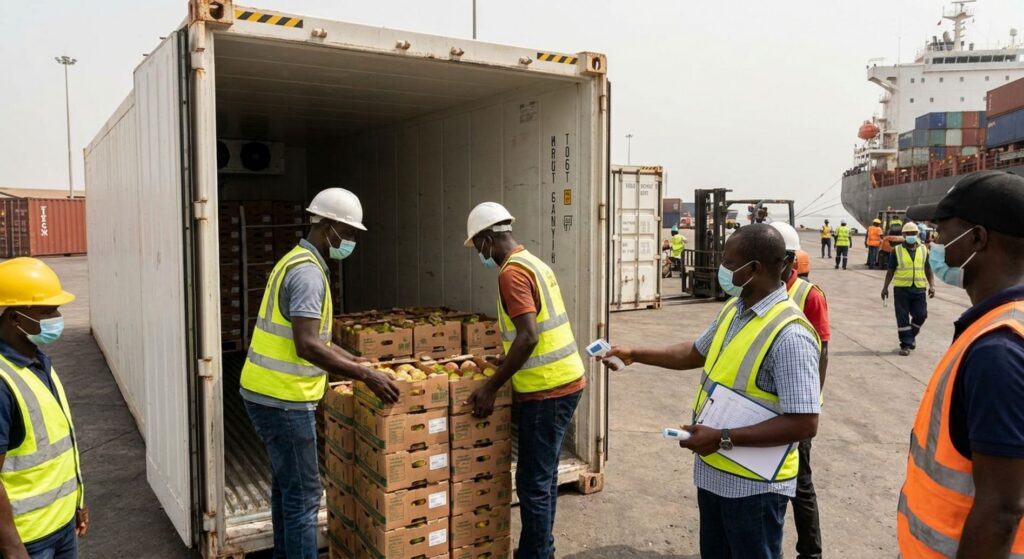
Port and handling charges include connecting the container to the vessel’s power supply, unloading, port taxes, and any storage fees while awaiting shipment. These charges accumulate quickly if your goods are held at the port.
Energy for temperature maintenance generates additional costs for reefer containers. Shipping lines generally charge a supplement for the electrical supply to the refrigeration unit during the sea voyage.
Transport insurance covers the risks of loss, damage, or cold chain failure. Its cost depends on the declared value of the goods and the level of cover chosen.
Indicative cost breakdown for an Africa-Europe refrigerated shipment
35–45 %
15–25 %
10–15 %
10–15 %
5–10 %
Key steps to reduce your costs:
- Pool your shipments with other exporters through a freight forwarder to reach a full container load.
- Plan your shipments outside peak season to benefit from lower rates.
- Negotiate annual contracts with your freight forwarder if your volumes are regular.
- Optimise container fill rates to spread fixed costs across the maximum volume.
Avoiding losses: operational risks to watch
A cold chain break or a documentation failure can turn a profitable shipment into a total loss. Here are the main risks to anticipate.
Pre-cooling before loading is a critical step that is often overlooked. Reefer containers maintain temperature but cannot cool down warm products. According to industry guidelines, products must reach their target temperature within 4 to 6 hours of packing. For Hass avocat, the recommended export temperature is between 5 °C and 7 °C at 90% humidity. Dropping below 3 °C causes flesh browning.
Transshipment points — any transfer of goods between two transport modes or vehicles — expose your products to temperature fluctuations. The critical moments are loading at the packhouse, transfer to the port, port operations, and unloading in Europe. According to logistics analysis, reducing these transfer points significantly cuts product losses.
Temperature traceability must be maintained throughout the journey. Require dated and time-stamped temperature records. Real-time monitoring systems can trigger an immediate alert if temperatures drift. On arrival, those records serve as compliance evidence in the event of a dispute.
Suitable packaging plays an essential role in preserving quality. Use approved insulating materials and ensure adequate ventilation inside the container for uniform air circulation.
Documentation compliance is a condition of entry into the European market. Required documents typically include the phytosanitary certificate, certificate of origin, packing list, commercial invoice, and HACCP compliance attestations. Any missing or incorrect document can lead to customs holds and additional storage charges.
Key points to remember:
- Always verify that your products are properly pre-cooled before loading.
- Plan your logistics to keep transshipment points to a minimum.
- Require a full temperature report for every shipment.
- Prepare all your export documents at least 48 hours before departure.
European markets within reach for African SMEs
Not all European markets are equally accessible for an African agrifood SME. Several factors determine your chances of success.
Geographic proximity and direct shipping links favour certain corridors. The ports of Rotterdam, Antwerp, and Le Havre are the main entry points for African products. CMA CGM is actively developing its services on the North Africa-Europe corridors for fruit transport.
Preferential trade agreements reduce or eliminate customs duties on many African products. Countries covered by the Cotonou Agreement or Economic Partnership Agreements (EPAs) access the European market under favourable conditions.
Retailer requirements vary by segment. Large supermarket chains impose strict specifications: GlobalGAP certification, full traceability, and consistent supply. Wholesale markets and specialist importers often offer more flexibility for new exporters.
Seasonality creates windows of opportunity. Europe imports large volumes of African fruit and vegetables during the European winter, when local production is at its lowest. Timing your shipments to those periods maximises your selling prices.
Priority markets to target:
- Netherlands: a major logistics hub through Rotterdam, with strong demand for exotic fruits and vegetables.
- France: a significant market for citrus, avocats, and processed products.
- Belgium: a gateway into Northern Europe via Antwerp.
- Germany: Europe’s largest consumer market, with high quality standards.
Improving your export margin: performance levers
Export success is not just about finding a buyer and shipping. Profitability depends on your ability to optimise every link in the chain.
Reducing product losses directly improves your margin. A 10% loss on a container means thousands of euros gone. Investing in better pre-cooling or higher-quality packaging can deliver an immediate return.
Comparing quotes systematically prevents overpaying. Request at least three quotes for each shipment. Include every cost item: inland transport, ocean freight, handling, insurance, and customs. Price differences between providers can reach 20 to 30% for an equivalent service.
Negotiating on volume gives you pricing power. Committing to multiple shipments per year puts you in a position to secure preferential rates. Some freight forwarders offer annual contracts with fixed prices that protect you from seasonal spikes.
Choosing the right transport mode for your product has a strong impact on costs. For products with a longer shelf life such as avocat or citrus, sea freight can cost up to 40% less than air. For highly perishable products like flowers or haricots verts, air freight often remains the only viable option despite the cost.
A quick decision checklist for your first shipment:
- Identify your product and its target transport temperature.
- Assess your monthly volume: groupage or full container load.
- Contact at least three freight forwarders for comparable quotes.
- Check their certifications (HACCP, cold chain) and their track record on your corridor.
- Prepare all your export documents before confirming the shipment.
- Require a temperature report at every delivery to build your quality history.
Frequently asked questions
What is the average cost of a reefer container for export to Europe?
Renting a 40-foot reefer container typically costs between €80 and €150 per day. The total cost depends on the transit time, ocean freight, inland transport, and port charges. Ask your freight forwarder for a comprehensive quote to get the full picture.
Should I choose air or sea freight for fresh produce?
The choice depends on your product’s shelf life. Highly perishable products such as flowers or haricots verts often require air freight. For avocats, citrus, or sturdier vegetables, sea freight offers savings of around 40% — provided the cold chain is rigorously managed.
How can I avoid rejections at European borders?
Prepare all your export documents in advance: phytosanitary certificate, certificate of origin, compliance attestations. Ensure your products are pre-cooled and require temperature monitoring throughout transport. These elements serve as compliance evidence during inspections.
What criteria should I use to compare freight forwarders?
Compare all-in rates covering every cost item. Check quality certifications, their ability to handle your specific corridor, temperature monitoring options, and client references in your sector. A freight forwarder with proven experience on your product and destination is a real asset.
Is groupage suitable for small volumes?
Groupage lets you share container costs with other exporters. It suits volumes below a full container load. Do check transit times, though — groupage can extend the journey while waiting for the container to fill up.