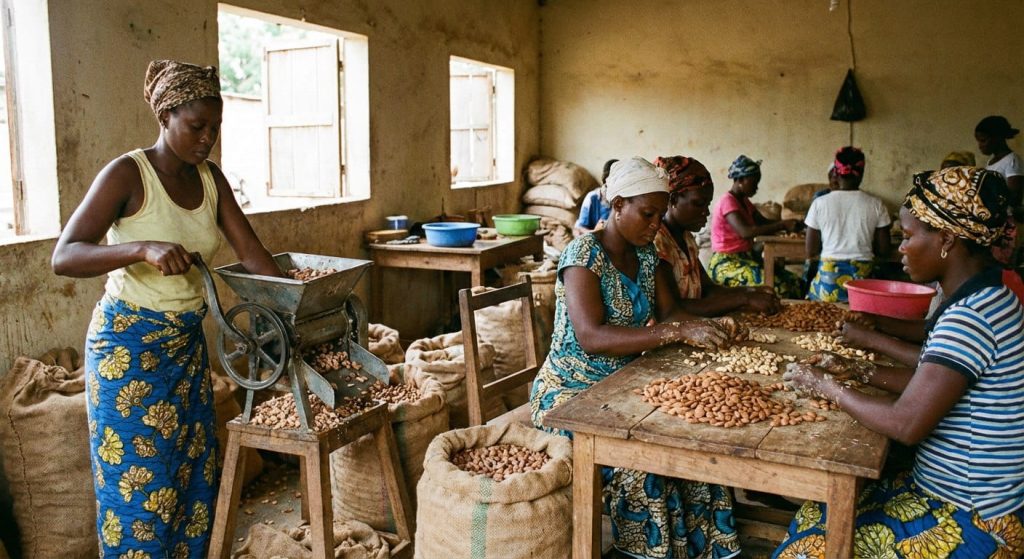
Côte d’Ivoire is the world’s leading producer of cashew nuts, with approximately 1.5 million metric tons of raw nuts in 2025. The sector is evolving rapidly: locally processed volumes and kernel sales are surging, driving value addition higher. For Ivorian micro and small enterprises, this momentum opens a unique window of opportunity to invest in local processing.
This article is written for owners and managers of small and micro agrifood businesses in Côte d’Ivoire. The goal is to provide an actionable guide for transitioning from raw nut exports to profitable processing operations that create jobs and meet EU and US market requirements. Each section offers up-to-date data, concrete levers, and guidance on financing and partnerships.
Article Overview
- Understanding volumes and revenues: raw vs. processed
- Setup costs: artisanal vs. industrial facilities for small enterprises
- Jobs, value addition, and export standards for kernels
- Practical solutions for launching or scaling local processing
- Commercial strategies: from field to the port of Abidjan
- FAQ – Local cashew processing
1 – Volumes and Revenues: Raw vs. Processed (2022–2025)
Côte d’Ivoire has become the world’s second-largest exporter of cashew kernels after Vietnam, while remaining the top producer of raw nuts. Raw nut production went from approximately 1.2 million metric tons in 2023 to 944,673 metric tons in 2024, then to 1.5 million metric tons in 2025. Over the same period, local processing accelerated at a remarkable pace.
Processed kernel output in Côte d’Ivoire more than tripled in four years, rising from 103,103 metric tons in 2020 to 344,000 metric tons in 2024. For 2025, processors are expected to handle 659,579 metric tons of cashew nuts, a roughly 92% increase over 2024. This scale-up is supported by an installed capacity of 830,000 metric tons across 37 processing facilities in 2025.
On the financial side, cashew kernel export revenues are projected to reach approximately 350 billion FCFA, or $623 million, in 2025. This represents a roughly 67% increase compared to 2024, when revenues were estimated at 209 billion FCFA. This growth is directly tied to higher processed volumes and the strategic shift toward kernel exports rather than raw nuts.
Key Takeaways – Volumes and Revenues:
- 1.5 million metric tons of raw nuts in 2025, with a target of 50% processed locally by 2030.
- Local processing more than tripled between 2020 and 2024 (103,103 → 344,000 metric tons).
- 2025 kernel export revenues projected at 350 billion FCFA, up 67%.
- 37 industrial processing facilities operational with 830,000 metric tons of installed capacity.
| Year | Raw nut production (metric tons) | Locally processed volumes (metric tons) | Kernel export revenues (FCFA) |
|---|---|---|---|
| 2022 | ≈1.1 million (CCA estimate, limited public data) | ≈200,000 (order of magnitude, no consolidated figure available) | Not precisely documented |
| 2023 | 1.2 million | Not reported in detail (trajectory toward 344,000 metric tons in 2024) | ≈209 billion FCFA (2024–2025 comparison baseline) |
| 2024 | 944,673 | 344,000 | 209 billion |
| 2025 (forecast) | 1.5 million | 659,579 | 350 billion FCFA |
2 – Artisanal vs. Industrial Facilities: Costs, Yield, and ROI for Small Enterprises
Publicly available data providing precise cost breakdowns for small artisanal processing units in Côte d’Ivoire is limited. Most published studies focus on large industrial facilities, which are typically financed by international investors. Small enterprises must therefore work with order-of-magnitude estimates, drawing on cost models observed in comparable agro-industries and existing public support mechanisms.
Large industrial facilities such as Dorado — widely cited as one of the world’s largest cashew processing plants, with a capacity of 70,000 metric tons per year — require capital investments of several billion FCFA and are not suited to small enterprises.
By contrast, semi-artisanal units with a capacity of 1,000 to 3,000 metric tons per year can be set up using simpler production lines combining mechanical shelling, manual sorting, and packaging. Initial costs can remain below 50 million FCFA when using reconditioned or second-hand equipment, though no official source publishes a detailed cost structure for this segment.
World Bank studies on cashew processing in Côte d’Ivoire show that national processing capacity grew from 68,515 metric tons to 350,000 metric tons between 2015 and 2024, driven by the development of agro-industrial zones and improved access to roads and logistics services.
These investments generated more than 18,321 jobs across the value chain, 66% of which are held by women. This confirms that processing — even at small scale — can be profitable when supply and market access are secured.
| Facility type | Typical annual capacity | Estimated initial investment | Suitable for a small enterprise |
|---|---|---|---|
| Artisanal / semi-manual | 500 – 1,000 metric tons | < 50 million FCFA (order of magnitude, no consolidated official figure) | Yes, as a cooperative or structured small enterprise |
| Semi-industrial | 1,000 – 5,000 metric tons | 50 – 500 million FCFA (depending on equipment and building) | Yes, with bank financing or public funding |
| Industrial | > 20,000 metric tons | Several billion FCFA | Not for small enterprises — suited to groups and foreign investors |
Key Factors for Return on Investment in a Small Processing Unit:
- Secure a reliable raw nut supply through contracts with producers or cooperatives.
- Obtain CCA authorizations promptly to sell both locally and for export.
- Pool costs (building, energy, logistics) through shared zones or co-processing facilities.
- Negotiate fiscal and customs incentives for equipment imports.
In practice, a 2–3 year return on investment is realistic for a small unit when three conditions are met: a high capacity utilization rate (at least 70%), stable export market access for kernels, and access to public incentives such as the 400 FCFA/kg kernel export subsidy and duty exemptions on equipment. Without these levers, financial and logistical costs can significantly extend the payback period.
3 – Jobs, Value Addition, and Standards for Kernel Exports
The development of local processing is already having a significant impact on employment. World Bank-supported programs have generated more than 18,321 jobs across the cashew value chain, 66% of which are held by women. More than 17,200 of these jobs are concentrated in processing facilities, with the remainder in inputs, services, and logistics.
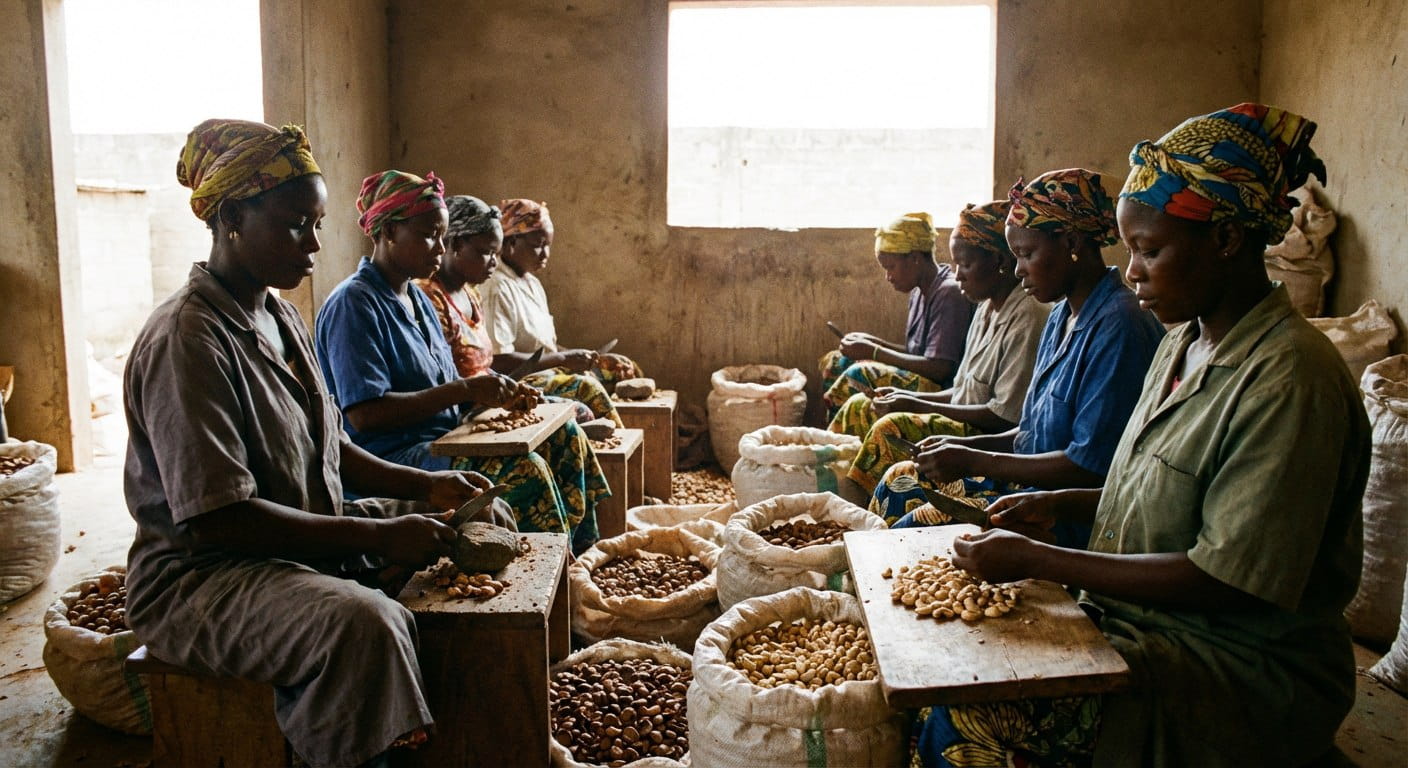
Ivorian authorities are targeting local processing of at least 50% of production by 2030 in order to maximize value addition and employment. In 2023, 21% of production was already processed locally, representing 344,000 metric tons. The 2025 projections — with 659,579 metric tons processed out of 1.5 million metric tons produced — show that the locally processed share is approaching 44%, reflecting a nearly 92% increase in processed volumes in a single year.
For small enterprises, this means operating within a fast-growing ecosystem with rising demand for subcontractors, services, and labor.
To export kernels to the EU or the United States, small enterprises must meet a core set of standards: authorization and quality oversight from the Conseil du Coton et de l’Anacarde (CCA), food safety standards (HACCP, sometimes ISO 22000), and batch traceability. Buyers increasingly require BRCGS or equivalent certifications for volumes destined for retail distribution.
While these certifications carry a cost, they can be shared through co-processing facilities or donor-supported projects.
| Dimension | Measured impact | Implication for a small enterprise |
|---|---|---|
| Direct employment | More than 17,200 jobs in processing facilities | Rapid creation of local and female employment in shelling and sorting |
| Total employment | 18,321 jobs across the sector, 66% women | Opportunity for social inclusion and access to impact financing |
| Value addition | Kernel revenues up 67% in one year (209 → 350 billion FCFA) | Potential to multiply revenues by 2–3x through processing |
| Export standards | CCA, HACCP, BRCGS depending on buyers | Invest in hygiene systems, traceability, and quality audits |
Key Takeaways – Standards and Value Addition:
- Kernels generate significantly more export value than raw nuts.
- Processing facilities are major employers of women (66–70% of the workforce).
- CCA and food safety standards are non-negotiable for accessing premium markets.
- Small enterprises can target niche segments (organic, premium quality) with smaller volumes but higher margins.
4 – Practical Solutions for Developing Local Processing
Côte d’Ivoire has put in place several fiscal incentives to encourage investment in agro-industry. The investment code includes specific measures for cashew and rubber processing investments, notably duty and tax exemptions on equipment and agro-industry tax credits.
According to PwC, these measures apply under the investment approval framework and can significantly reduce the cost of establishing a small processing unit.
In addition to fiscal incentives, the government supports processors through an export subsidy of 400 FCFA/kg of exported kernels since the 2017/2018 campaign. This subsidy, combined with duty and VAT exemptions on equipment, helped grow locally processed volumes from 43,700 metric tons in 2017 to 344,000 metric tons in 2024. Industry experts consider that this program has achieved its objectives by making local processing competitive at an African scale.
Infrastructure has kept pace with this growth. Three agro-industrial zones dedicated to cashew processing have been developed in Bondoukou, Korhogo, and Séguéla with World Bank support.
These zones provide serviced land, improved road access (1,800 km rehabilitated), and basic utilities for processing facilities. They are designed to accommodate both large industrial units and small enterprises operating as subcontractors or subleasing space.
| Type of support | Mechanism | Relevance for a micro-enterprise |
|---|---|---|
| Fiscal incentives | Duty and VAT exemptions on equipment, agro-industry tax credits | Reduction of initial investment cost and operating charges |
| Export subsidy | 400 FCFA/kg of exported kernels | Improved margins and stronger ROI |
| Cashew industrial zones | Bondoukou, Korhogo, Séguéla with dedicated infrastructure | Access to serviced land and shared facilities |
| Installed capacity | 37 facilities, 830,000 metric tons in 2025 | Subcontracting and partnership opportunities |
Key Takeaways – Solutions for Small Enterprises:
- Leverage existing fiscal incentives to lower the cost of market entry.
- Locate in or connect with an agro-industrial zone to reduce logistics costs.
- Use the 400 FCFA/kg subsidy as a margin driver on exports.
- Position as a partner or subcontractor to an existing facility rather than building from scratch.
5 – Commercial Strategies: From Field to Export via the Port of Abidjan
Ivorian cashew nuts and kernels are exported primarily through the port of Abidjan, which has a modern container terminal and an established network of international freight forwarders. The main destinations are Vietnam, India, the United States, the Netherlands, and Germany. Processed products (kernels) are also shipped via Abidjan’s international airport for targeted air freight, particularly to premium buyers.
Digital platforms and online marketplaces are progressively improving logistics. They offer cargo space booking, container tracking, and analysis of delays related to port congestion in Abidjan. Digitalization of customs procedures has reduced export processing times from 7–10 days to 2–3 days, securing delivery schedules and cutting storage costs. For a small enterprise, using these platforms through a freight forwarder or cooperative is an effective way to reduce logistics costs.
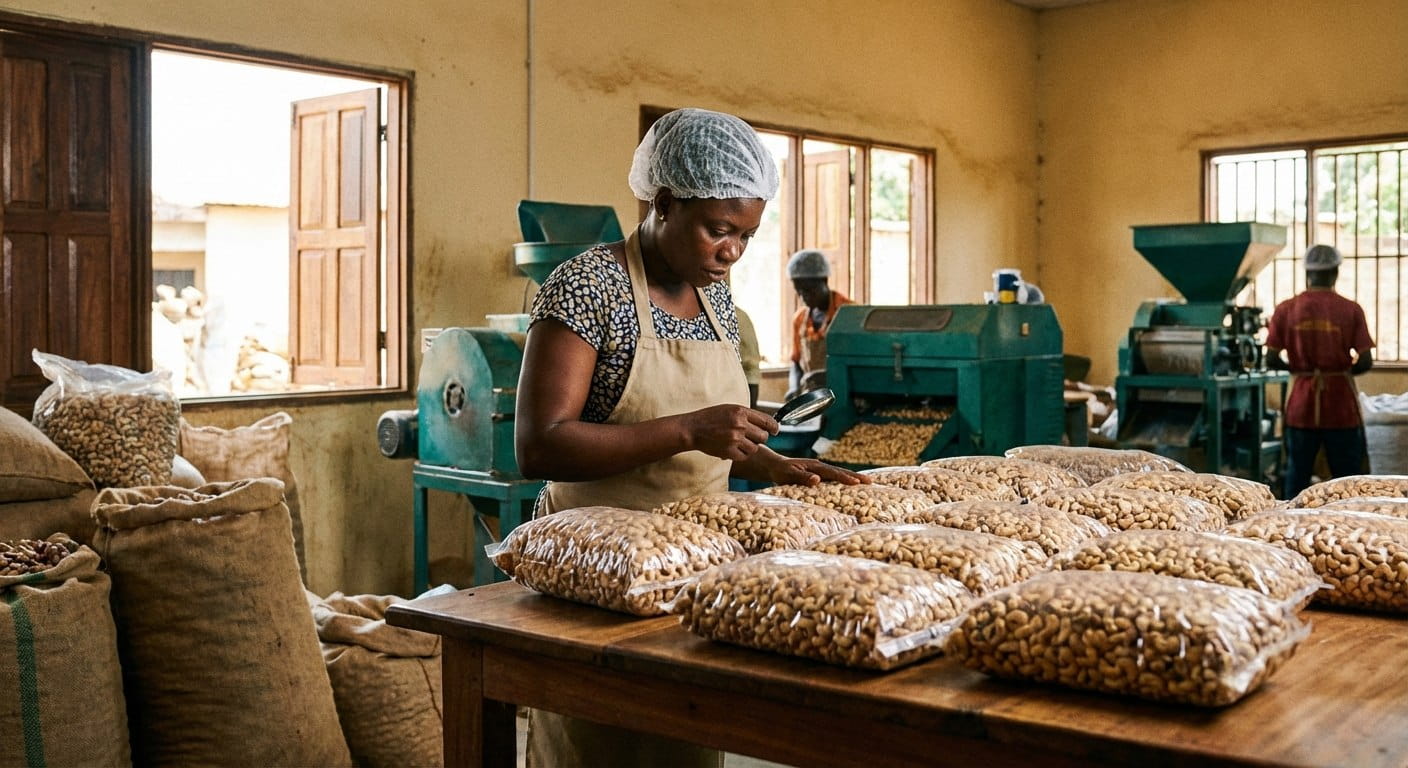
On the commercial side, Côte d’Ivoire is consolidating key strategic partnerships. The country exports kernels to Vietnam, which remains a global hub for processing and re-export, while strengthening direct sales to the EU and the United States.
The competitiveness of Ivorian kernels, supported by subsidies and incentives, has already propelled export revenues to 350 billion FCFA in 2025. For small enterprises, the challenge is to integrate into these supply chains through contracts with traders, industrial processors, or smaller end buyers.
| Stage | Key action | Lever for optimizing costs and margins |
|---|---|---|
| Field | Purchase contracts with producers and cooperatives, secured volumes | Reduce intermediaries and stabilize raw material costs |
| Processing | Shelling, sorting, packaging, compliance with CCA and food safety standards | Capture local value addition and access the 400 FCFA/kg subsidy |
| Domestic logistics | Transport to Abidjan, pooling of trucks and warehousing | Reduce cost per metric ton through consolidation |
| Export | Use of the port of Abidjan or the airport, digitalization of customs formalities | Reduce lead times and administrative costs |
| Target markets | Vietnam, India, EU, USA, Netherlands, Germany | Diversify market access to reduce price risk |
Key Takeaways – Commercial Strategy:
- Build an integrated chain from field to processing facility to Abidjan, minimizing intermediaries.
- Work with experienced freight forwarders for EU and US markets, prioritizing repeat contracts.
- Test pilot volumes with an EU or US buyer before scaling up.
- Leverage Côte d’Ivoire’s reputation as the world’s second-largest kernel exporter.
FAQ – Local Cashew Processing
What is the main advantage of processing locally rather than exporting raw?
Local processing allows businesses to capture a significantly larger share of value addition. Côte d’Ivoire projects 350 billion FCFA in kernel export revenues for 2025, up from 209 billion in 2024, driven by increased processed volumes. For a small enterprise, this translates into higher margins, local job creation, and greater resilience against raw nut price volatility.
Can a small enterprise launch a processing unit with a budget under 50 million FCFA?
Public sources do not provide a detailed cost structure for very small processing units. However, by opting for semi-manual equipment, sharing facilities, and taking advantage of fiscal exemptions and subsidies, it is possible to remain within this range. It is essential to conduct a feasibility study with a specialized advisor before committing capital.
What certifications are most important for exporting kernels to the EU?
The baseline requirement is approval and quality oversight from the Conseil du Coton et de l’Anacarde. This is supplemented by food safety standards such as HACCP or ISO 22000, and sometimes BRCGS depending on the buyer. Exact requirements vary by target buyer. As a starting point, it is advisable to approach intermediary buyers (traders, secondary processors) whose specifications are better suited to small enterprise capabilities.
How can logistics costs between the processing unit and the port of Abidjan be reduced?
Small enterprises can reduce logistics costs by consolidating transport with other exporters, using digital logistics platforms, and clustering within agro-industrial zones located near major road corridors. Digitalization of customs procedures at the port of Abidjan also reduces processing times and storage fees.
What types of financing are available to establish a small processing unit?
Small enterprises can combine several sources: conventional bank credit, agro-industry specialized credit lines, impact funds focused on women’s employment, and programs from the World Bank or other development finance institutions. Fiscal incentives and the export subsidy strengthen the bankability of the project by improving projected profitability.
Does the current dependence on Vietnam remain a risk for the Ivorian sector?
Vietnam still plays a central role as a global buyer and processor, which exposes Côte d’Ivoire to demand fluctuations. The national strategy is specifically aimed at reducing this dependence by scaling up local processing and developing direct kernel sales to the EU and the United States. For a small enterprise, diversifying market outlets is a strategic priority.
Can a micro-enterprise target EU/US premium markets directly?
It is possible but demanding. Businesses must achieve a high level of quality, traceability, and food safety compliance, and be prepared to undergo audits. A phased approach involves first working as a subcontractor for a larger facility or an already-certified exporter, while progressively strengthening in-house quality management systems.