European and North American export markets are raising the bar on sustainability. For small and micro agrifood businesses in Africa, this shift can feel like an added burden. Yet environmental and climate labels such as Rainforest Alliance and Carbon Neutral are now genuine commercial tools. These certifications help African SMEs reach international buyers, negotiate better prices and compete on high-value markets.
With the EU Deforestation Regulation (EUDR) taking effect in December 2025 for large companies and June 2026 for SMEs, traceability and sustainability are becoming conditions of entry to the European market. The European Union, which accounts for more than €60 billion in annual trade with Africa, now requires that cacao, coffee, palm oil and other agricultural commodities be deforestation-free and traceable to the plot of production.
This article is written for owners and managers of small and micro African agrifood businesses who want to understand how to turn these new standards into commercial opportunities. The aim is to show, through recent concrete cases, how environmental labels can become a real competitive advantage rather than a bureaucratic constraint.
Article outline
- How environmental labels open doors to export buyers
- Real commercial benefits for a small business
- Rainforest Alliance: concrete benefits for African agricultural supply chains
- Carbon Neutral: when and why this label becomes a competitive advantage
- Costs and access conditions for a small operation
- African SME examples that improved their market access
- Frequently asked questions
How environmental labels open doors to export buyers
Environmental and climate labels act as commercial passports on international markets. European and North American buyers are increasingly embedding sustainability criteria into their sourcing policies. According to a recent study, 80% of European consumers are willing to pay a 9.7% premium for sustainable, traceable products.
For African SMEs, obtaining a recognised certification means meeting the requirements of major retail chains and international processors. Labels such as Rainforest Alliance or GlobalGAP are often prerequisites for securing export contracts. In East Africa, coffee and tea exporters report that European buyers only formalise contracts once verifiable geolocation data have been provided.
Key points:
- Labels reduce reputational risk for international buyers
- They facilitate regulatory compliance (EUDR, sanitary standards)
- They enable access to premium markets and major retail chains
- They strengthen the credibility and transparency of the supply chain
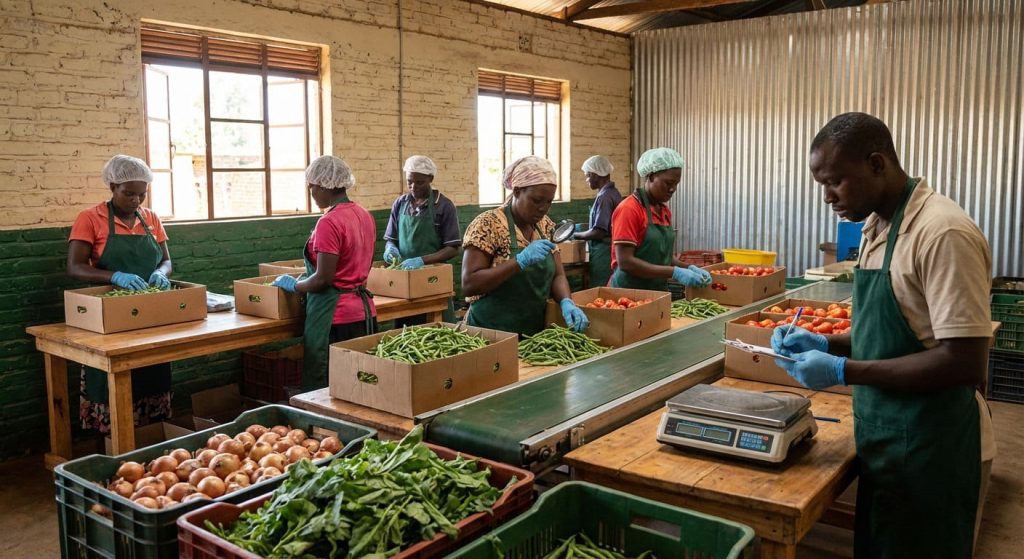
In Kenya, more than 5,000 farmers were trained on export requirements under the EU-BEEEP programme. Five packing stations obtained BRCGS certification and exported more than 2,000 tonnes of vegetables and dried mangoes. Around 1,000 farmers are progressing towards GLOBALG.A.P. and GRASP certification, strengthening access to premium markets.
| Label type | Main target markets | Direct commercial benefits |
|---|---|---|
| Rainforest Alliance | Europe, North America | Access to major retail chains, mandatory premium of USD 70 per tonne for cacao |
| GlobalGAP | Europe | Prerequisite for access to European supermarkets |
| Carbon Neutral | Europe, premium markets | Differentiation and access to carbon programmes |
| Fairtrade | Europe, North America | Guaranteed minimum price and development premium |
Real commercial benefits for a small business
The commercial benefits of environmental labels go well beyond simple regulatory compliance. They translate into measurable economic gains in terms of price, volume and contract stability. In 2024–2025, EU organic imports grew by 6.4%, reaching 2.64 million tonnes, demonstrating sustained demand for sustainable products.
For African SMEs, the benefits show up in three main ways. First, price premiums: Rainforest Alliance certification requires a minimum sustainability differential of USD 70 per tonne of cacao, paid directly to producers. In Ghana, certain certified cooperatives paid out 9.2 million Ghanaian cedis in sustainability premiums to 8,000 cacao farmers in 2022–2023.
Second, access to volumes and long-term contracts. Certified companies benefit from more stable trading relationships and multi-year contracts. In Uganda, Rainforest Alliance-certified coffee exports contributed to a record 6.3 million bags exported in 2023–2024. Sucafina’s IMPACT programme enrolled more than 12,500 farmers across various regions, improving coffee quality and boosting producer incomes.
Third, improved practices and productivity. A study conducted in Kenya and Zambia showed that GlobalGAP-certified farmers had a net income four times higher than non-certified farmers, thanks to efficiency gains and better product quality. Nearly two-thirds of certified farmers replanted or renewed their cacao farms in 2011, compared with 27% on non-certified farms.
| Commercial benefit | Measurable impact | Concrete example |
|---|---|---|
| Price premium | USD 70/tonne minimum (cacao) | FEDCO Ghana: 16 million cedis paid in premiums |
| Export volumes | Increase of 3–8% | Uganda: 6.3 million bags exported (2023–2024) |
| Net income | 4 times higher | GlobalGAP-certified farmers in Kenya |
| Market access | Formalised contracts | Kenya: record price of USD 2,706/bag in Kuwait |
In Kenya, coffee exports to premium markets such as Singapore and Hungary have reached record prices. One lot sold in Kuwait fetched USD 2,706.88 for a 50 kg bag — around USD 54 per kilogram — showing that quality and traceability can generate exceptional premiums in niche markets.
Rainforest Alliance: concrete benefits for African agricultural supply chains
Rainforest Alliance has established itself as one of the most recognised labels for African agricultural supply chains, particularly for coffee, cacao and tea. The 2020 certification programme was specifically designed for smallholder farmers, who account for 99% of farms certified under the Rainforest Alliance Sustainable Agriculture Standard.
The concrete benefits for African supply chains span several dimensions. For cacao, Rainforest Alliance certification eases compliance with the EUDR, which comes into force in 2025–2026. The system was adjusted in 2024 to allow the purchase and sale of cacao in line with EUDR requirements. Farmers can select specific criteria during the certification process, enabling them to supply EUDR-compliant cacao to the first buyer in the chain.
In Côte d’Ivoire, the cacao cooperative SOCAAN, which brings together 1,370 smallholder farmers, has had support from Rainforest Alliance since 2020. Sustainability manager Adou Constant explains: “Certification allowed us to increase our output through better farming practices. We were able to improve the lives of people in our community by building two schools and funding income-generating activities such as poultry farming for women in the cooperative.”
Specific Rainforest Alliance benefits for African SMEs:
- Sustainability Differential (SD): mandatory cash payment above market price
- Sustainability Investment (SI): financial support to maintain certification
- Free technical training for certified partners
- Free due diligence tools for EUDR compliance
- Group certification to reduce individual costs
For coffee, Uganda clearly illustrates the benefits of certification. In 2024, more than 34,254 certified coffee and tea farmers in the Mount Kenya region adopted regenerative farming practices. The programme led to the planting of 106,300 trees, the restoration of more than 106 hectares of degraded land and the creation of 202 jobs, 64% of which went to women and young people.
Certified coffee farmer Christine Karimi shares her experience: “As a Rainforest Alliance-certified farmer, producing good-quality coffee has helped me obtain premium prices at auction.” The data backs this up: Kenyan coffee exports to markets such as Singapore and Hungary consistently reach prices above the global average.
| Supply chain | Direct benefit | Key figures (2024–2025) |
|---|---|---|
| Cacao (Côte d’Ivoire, Ghana) | USD 70/tonne premium + EUDR compliance | More than 50,000 farmers supported in Côte d’Ivoire |
| Coffee (Uganda, Kenya) | Premium prices + access to speciality markets | 12,500 farmers enrolled in the IMPACT programme |
| Tea (Kenya) | Access to European market + regenerative practices | 34,254 farmers adopting regenerative agriculture |
Kenya temporarily suspended Rainforest Alliance certification for its tea industry in May 2025, citing high compliance costs weighing on smallholder farmers. This decision underscores the importance of assessing the return on investment before committing to certification, particularly for mid-sized operations producing between 5 and 15 million kilograms per year.
Carbon Neutral: when and why this label becomes a competitive advantage
Carbon Neutral certification is emerging as a major competitive advantage for African agrifood SMEs targeting European and North American markets. Unlike traditional environmental labels, Carbon Neutral focuses on reducing and offsetting greenhouse gas emissions, directly addressing the EU’s climate neutrality objectives for 2050.
For African SMEs, this label becomes a competitive advantage in three specific situations. First, when European buyers impose carbon reduction targets across their supply chains. Companies subject to the European Corporate Sustainability Reporting Directive (CSRD) must report on their Scope 3 emissions, which include their suppliers. Second, to access carbon finance programmes that generate additional revenue. Third, to stand out on premium markets where 76% of European consumers want to see the carbon footprint of food products clearly displayed.
Across Africa, several carbon farming programmes demonstrate the commercial potential of this approach. The AgriCarbon programme, launched in South Africa in 2021, became the first carbon farming programme in Africa to obtain registration and issuance of carbon credits under Verra’s VM0042 methodology for agricultural land management. The programme has since expanded to Argentina, Chile and Paraguay.
The Kenya Agricultural Carbon Project (KACP) shows how smallholder farmers can benefit from carbon markets. The project equips farming families with Sustainable Agricultural Land Management (SALM) practices to improve yields, increase incomes and reduce greenhouse gas emissions through carbon credits. In 2024, savings and loan systems were introduced in 82 farmer groups.
When the Carbon Neutral label becomes strategic:
- Exporting to the EU with buyers subject to CSRD obligations
- Accessing carbon finance programmes to generate additional revenue
- Differentiation on climate-sensitive premium markets
- Improving resilience and productivity through regenerative practices
- Getting ahead of future EU regulations on product carbon footprints
Voluntary carbon markets in Africa remain largely untapped despite considerable potential. According to a 2023 analysis, only 12 agricultural projects that had issued carbon credits could be identified across the entire African continent. Over 90% of projects focused on emission reductions, while fewer than 10% included a carbon removal component.
That said, credits linked to sustainable cropland and grassland management saw a 24% increase in absorption volume in 2023, pointing to growing interest. Credits with social and biodiversity co-benefits continue to attract a price premium, though it fell to 37% in 2023 from 63% in 2022 — highlighting the importance of prioritising non-carbon outcomes in project implementation.
| Carbon certification type | Estimated costs | Potential revenues | Target markets |
|---|---|---|---|
| ISO 14064 | Variable by size | Regulatory credibility | Europe, developed markets |
| Verra VCS | USD 10,000 – 50,000 | USD 15–45/carbon credit | International voluntary markets |
| Gold Standard | USD 15,000 – 60,000 | USD 20–50/carbon credit | Europe, premium markets |
Carbon Neutral certification requires significant investment in measurement, reporting and verification (MRV). Strict carbon credit requirements, limited financial resources and the need for robust governance frameworks all act as barriers to adoption for small operations. That said, SMEs that do engage with this route can access results-based finance and position themselves well ahead of future European regulations on product carbon footprints.
Costs and access conditions for a small operation
Understanding the real costs of certification is essential for African SMEs to assess the return on investment and avoid unprofitable commitments. Costs vary considerably depending on the type of label, the size of the farm and the company’s level of readiness. The group certification approach allows small producers to pool costs and make labels financially accessible.
For Rainforest Alliance certification, farmers pay for the audit services of their chosen certification body. Fees vary considerably depending on farm size and location. Small producers can organise themselves and apply for group certification to reduce expenses. Farmers must also cover all costs associated with meeting the Sustainable Agriculture Standard, which may include setting aside parts of their farm, implementing new management practices or building new infrastructure. Rainforest Alliance provides free technical support to help farmers through the certification process.
For companies, costs include four main components. Supply chain audit fees for companies whose Supply Chain Risk Assessment (SCRA) indicates an audit is required. The Sustainability Differential (SD), which is the cash amount per tonne paid to farmers (minimum of USD 70 per tonne of cacao). The Sustainability Investment (SI), which is a negotiable investment (minimum of USD 5.50 per tonne for bananas and fresh fruit). Per-product royalties: USD 0.0175 per pound of green coffee, USD 0.0157 per kilogram of cacao beans, USD 0.0147 per kilogram of made tea.
For GlobalGAP, total costs consist of three elements. Implementation costs to adapt operations to the standard. Certification body service fees covering time, travel and administrative costs for the audit. GLOBALG.A.P. certificate registration and licence fees, calculated based on farm size. In Uganda, the Uganda National Bureau of Standards (UNBS) initiative aims to reduce the cost of GlobalGAP certification from USD 10,000–25,000 to under USD 4,000 per farm, making certification accessible to a greater number of Ugandan farmers.
| Certification type | Initial costs | Annual recurring costs | Share paid by smallholder farmers |
|---|---|---|---|
| Rainforest Alliance (group) | Variable (training, infrastructure) | Audit + compliance | Variable with free technical support |
| GlobalGAP (Kenya) | USD 1,145 | USD 175 | 14–36% (exporters pay the rest) |
| GlobalGAP (Zambia) | USD 4,664 | USD 938 | 6% (exporters pay the rest) |
| GlobalGAP (Uganda – target) | Under USD 4,000 | To be determined | Being reduced by UNBS |
Strategies to reduce certification costs:
- Group certification to pool audit and advisory fees
- Seeking co-investment from exporters or development programmes
- Using the free technical support offered by Rainforest Alliance
- Prioritising labels required by target buyers rather than accumulating certifications
- Progressing gradually through tiered systems such as Eco-Mark Africa
A comparative study in Kenya and Zambia found that initial GlobalGAP costs ranged from USD 1,145 in Kenya to USD 4,664 in Zambia. Smallholder farmers paid an average of 14% of recurring costs in Kenya and 6% in Zambia, with exporters and donors covering the rest. Recurring costs stood at USD 175 in Kenya and USD 938 in Zambia. Despite these investments, certified producers reported substantial non-financial benefits, including better access to markets, credit and quality inputs.
No direct price premium is paid for GlobalGAP-certified products at the farm level, but preferential market access and operational efficiency gains generate higher revenues overall. Farmers who achieved GlobalGAP certification clearly reaped the rewards of adopting good agricultural practices, record-keeping and improved food safety and hygiene standards.
For carbon certifications, costs are generally higher due to the strict measurement, reporting and verification (MRV) requirements. Carbon farming projects in Africa require investments of between USD 10,000 and USD 60,000 depending on the chosen standard (Verra, Gold Standard) and the scale of the project. However, potential revenues from carbon credits can offset these costs over the medium term, with prices ranging from USD 15 to USD 50 per credit depending on quality and co-benefits.
African SME examples that improved their market access
Concrete examples of African SMEs that have successfully improved their market access through environmental labels show that these certifications can deliver tangible results. The cases below illustrate different approaches and contexts, offering valuable lessons for businesses looking to follow a similar path.
Case 1: Kyagalanyi Coffee (Uganda) — Rainforest Alliance for Arabica coffee
Kyagalanyi Coffee, one of Uganda’s largest coffee exporters, developed Arabica coffee production in the Rwenzori Mountains in collaboration with smallholder farmers. In 2018, the company received the Rainforest Alliance Sustainable Standard-Setter Award for its exceptional commitment to creating a child-labour-free zone. Kyagalanyi extended the Volcafe Way farmer support programme and certification standards to Robusta farms, reaching 5,000 farmers in the coming years under the UTZ/RFA initiatives in Masaka.
The company installed a processing plant at Namanve Industrial Park, enabling on-site roasting and packaging. This allows Kyagalanyi to produce value-added coffee products for export markets, increasing the value of Ugandan coffee exports on the global market. Rainforest Alliance certification has facilitated access to European and North American markets, where sustainability is a key purchasing criterion.
Case 2: SOCAAN Cooperative (Côte d’Ivoire) — Community transformation through certified cacao
The SOCAAN cacao cooperative in Côte d’Ivoire, which brings together 1,370 smallholder farmers, has had support from Rainforest Alliance since 2020. Certification boosted production through better farming practices and generated resources for community development investment. The cooperative built two schools and funded income-generating activities such as poultry farming for women members.
This case shows that the benefits of certification extend beyond direct farming income to create broader social and economic impact in rural communities. The cooperative also strengthened its ability to negotiate with international buyers and access European premium markets by guaranteeing traceability and compliance with EUDR requirements.
Case 3: Kenyan vegetable exporters — GlobalGAP for European market access
In Kenya’s Makueni County, the EU-BEEEP programme implemented by TradeMark Africa provided 15,000 fruit fly traps to farmers and trained more than 5,000 farmers on export requirements. Five packing stations obtained BRCGS certification and exported more than 2,000 tonnes of vegetables and dried mangoes. Around 1,000 farmers are progressing towards GLOBALG.A.P. and GRASP certification.
These interventions strengthen compliance systems while opening access to premium markets. Certification is no longer seen as administrative paperwork but as a passport that protects Kenyan farmers and fishers — and the entry ticket to leading agrifood trade across Africa.
Case 4: Ghana Cocoa Board (COCOBOD) — National traceability system for the EUDR
Ghana developed a national cacao traceability system (Ghana Cocoa Traceability System — GCTS) to ensure compliance with the EUDR. The system is based on verified, ground-truthed data that is reliable and credible, ensuring that all cacao produced in Ghana is traceable from the port of shipment to the production plot. The straightforward three-phase system tracks cacao from farm to community, from district to port, with quality checks at each stage.
This system positions Ghana as a low-risk country under the EUDR, simplifying due diligence requirements for European importers and preserving Ghana’s vital access to the EU cacao market. Ghana exports at least 50% of its cacao beans to Europe, generating significant revenue for socio-economic development.
| Company / initiative | Country | Label used | Measurable outcome |
|---|---|---|---|
| Kyagalanyi Coffee | Uganda | Rainforest Alliance | 12,500 farmers enrolled, access to premium markets |
| SOCAAN Cooperative | Côte d’Ivoire | Rainforest Alliance | 1,370 producers, 2 schools built |
| Makueni exporters | Kenya | GlobalGAP, BRCGS | 2,000 tonnes exported, 5,000 farmers trained |
| COCOBOD | Ghana | GCTS system (EUDR) | National traceability, low-risk country status |
These examples show that success depends on several factors: technical and financial support from partners, collective organisation of smallholder farmers, alignment of the certification with target markets, and embedding sustainability into the overall business model rather than treating it as a compliance box to tick.
Frequently asked questions
What is the difference between Rainforest Alliance and GlobalGAP for an African SME?
Rainforest Alliance focuses on social and environmental sustainability, with a mandatory sustainability differential paid to producers. GlobalGAP focuses primarily on food safety and good agricultural practices. For African SMEs exporting to Europe, GlobalGAP is often a baseline requirement for accessing supermarkets, while Rainforest Alliance offers additional price premiums and eases EUDR compliance for cacao and coffee.
How long does it take to obtain Rainforest Alliance certification?
The process varies depending on the farm’s level of readiness. For a group of smallholder farmers who are already organised, the full process can take 12 to 18 months, including training, compliance, the initial audit and certificate issuance. Rainforest Alliance provides free technical support to speed up the process.
Is Carbon Neutral certification worth it for a cooperative of 500 farmers?
Profitability depends on several factors: access to carbon markets, credit prices, certification and verification costs, and co-benefits. For a cooperative of 500 farmers, a group approach is essential. Successful projects generate USD 15 to USD 45 per carbon credit, but require initial investments of USD 10,000 to USD 50,000 depending on the chosen standard. Profitability improves with economies of scale and the sale of credits with social and biodiversity co-benefits.
Can you export to Europe without certification in 2025–2026?
For certain products such as cacao, coffee, palm oil and timber, EUDR compliance becomes mandatory in December 2025 for large companies and June 2026 for SMEs. This means that even without voluntary certification, traceability to the plot level and proof of non-deforestation are required. Certifications such as Rainforest Alliance facilitate this compliance but do not replace it. For other agricultural products, GlobalGAP remains a frequent requirement from European buyers.
How do I choose between several labels for my agrifood SME?
Start by identifying your target markets and their specific requirements. Ask potential buyers which certifications they require or value. Assess the return on investment by comparing total costs against price premiums and improved market access. Prioritise internationally recognised labels in your sector. Consider group certification to reduce costs. Do not accumulate certifications without a clear strategy: each label must correspond to a measurable commercial benefit.
Do environmental labels guarantee a minimum price for my products?
No, most labels do not guarantee a minimum price — Fairtrade being the notable exception. Rainforest Alliance requires a mandatory Sustainability Differential of USD 70 per tonne for cacao, paid above the market price, but this is not a guaranteed minimum price. Labels primarily improve access to premium markets, strengthen negotiating power and can generate variable price premiums depending on the buyer and product quality.
Is financial support available to cover certification costs?
Yes, several sources of support exist. Development programmes such as TradeMark Africa, GIZ and IFC offer training and co-financing. Some exporters cover part of the certification costs for their suppliers. Organisations such as Rainforest Alliance provide free technical support. Sustainable development funds and green finance initiatives can fund initial investments. Contacting national export promotion agencies and regional programmes is a good starting point for identifying available opportunities.