The 2026 cashew season has opened in an unusual climate. Farm-gate prices are falling in several countries. US tariffs are reshaping the buying habits of Asian processors. And export buyers are becoming more demanding on quality and certifications.
For a small agrifood business owner, selling cashew nuts in 2026 requires more preparation than before. You need to know the real prices, understand who buys what, identify what blocks an export sale, and anticipate the cost of meeting standards.
This article brings together the figures, organisations and practices you need to know to sell at higher prices and more consistently this year.
- Cashew prices in 2026: farm gate, processing plant, port and export
- Who buys cashew nuts in 2026: buyers and concrete market outlets
- Certifications and requirements for accessing export markets
- Market access in practice: logistics, incoterms and campaign calendar
- Profitability and business decisions for 2026
- Frequently asked questions
Before getting into the detail, one fact stands out. In 2026, a price announced by a government is no longer a guarantee. Several countries have seen their official floor price collapse mid-season, driven by world market forces. Understanding why helps avoid unpleasant surprises.
Cashew prices in 2026: farm gate, processing plant, port and export
The price of raw cashew nuts (RCN) changes at every link in the chain. A producer never receives the export price. An exporter never receives the price paid by the Asian processor. Here are the 2026 figures, country by country.
Farm-gate prices by country in 2026
| Country | Minimum producer price 2026 | Change vs 2025 | Regulatory body |
|---|---|---|---|
| Côte d’Ivoire | 400 FCFA/kg (official floor price) | -6% (425 FCFA/kg in 2025) | Conseil Coton Anacarde (CCA) |
| Ghana | 12.00 GH¢/kg | -20% (15.00 GH¢/kg in 2024/2025) | Tree Crops Development Authority (TCDA) |
| Guinée-Bissau | 410 FCFA/kg (official producer price), 250 to 350 FCFA/kg observed in the field | Not precisely reported | Transitional government |
| Bénin | Free market price (no floor price) | Not applicable | No floor price set |
| Burkina Faso | 385 FCFA/kg | Not precisely reported | Burkinabè authorities |
| Togo | 350 FCFA/kg | Not precisely reported | Togolese authorities |
| Tanzania | No fixed price, auction system. Peak at around 4,000 TSh/kg in 2024/2025, compared with 1,500 to 2,500 TSh/kg before the reform | Sharp increase linked to the reform of the sales system | Cashewnut Board of Tanzania (CBT) and Tanzania Mercantile Exchange (TMX) |
| Mozambique | Not precisely reported (prices reported as falling in 2026) | Decline reported | Instituto do Cajú de Moçambique (INCAJU) |
The Ivorian case deserves an explanation. The official floor price of 400 FCFA/kg was announced on 6 February 2026 in Yamoussoukro by the Minister of Agriculture, Bruno Nabagné Koné, at the national days for cajou, cotton and karité producers (Agence Ecofin, 2026).
But this floor price was not always observed in practice. During the season, the US tariff increases on imports from Vietnam and India — the two largest global processors of Ivorian cashews — caused buying to slow sharply. The price actually paid to producers fell to 200–300 FCFA/kg in some areas, well below the official floor (Agence Ecofin, 2026).
This is the first lesson of this season: a government floor price offers theoretical protection, but guarantees nothing if buyers stop buying. A small business owner must track international trade news, not just the official announcements from their own country.
Prices at each stage of the chain in Côte d’Ivoire, 2026 season
| Stage | 2026 floor price |
|---|---|
| Farm gate (producer) | 400 FCFA/kg |
| Domestic buying store | 425 FCFA/kg |
| Processing plant store (local processor) | 454 FCFA/kg |
| Port store (exporter) | 484 FCFA/kg |
Between the farm gate and the port, the official gap is 84 FCFA/kg, or 21%. This gap covers sorting, drying, transport, storage and intermediary margins. A producer who sells directly to a buying store, without going through multiple resellers, captures a larger share of that margin.
Export prices (FOB) and processed kernel prices
| Segment | Indicative price 2026 | Note |
|---|---|---|
| RCN FOB Abidjan, outturn quality 46–48 | 1,100 to 1,250 USD/tonne | Export market offers, August 2026 |
| RCN CNF, world market reference | 1,600 to 1,700 USD/tonne | October 2025 reference, upward trend since then |
| W320 kernel, Indian market | 1,000 to 1,600 INR/kg (approximately 11 to 18 EUR/kg) | June 2026, up 10 to 15% year-on-year |
| Processed kernels, Vietnam export to EU/US | Moderate increase mid-2026 | Vietnam remains the “price maker” on the world market |
The gap between the raw nut price and the processed kernel price is substantial. A tonne of raw nuts is worth around 1,100 to 1,250 USD FOB. That same tonne, once shelled and processed into kernels, can be worth several times that amount on the Indian or Vietnamese market. This is the whole case for local processing, explored further below.
Vietnam alone accounts for around 80% of global exports of processed cashew kernels. It sets the tone for prices in that segment (CMB News, 2026).
Key takeaways
- The floor price is not guaranteed — in Côte d’Ivoire, it fell to 200–300 FCFA/kg during the 2026 season, driven by US tariffs.
- The farm-gate to port gap exceeds 20% — selling at the right point in the chain, without unnecessary intermediaries, directly improves margins.
- Processing multiplies value — raw nuts are worth around 1,100 to 1,250 USD/tonne FOB, while processed kernels fetch significantly more when sold in India or Europe.
- Bénin has no floor price — prices there are purely negotiated, which requires sharper commercial awareness than in Côte d’Ivoire or Guinée-Bissau.
Who buys cashew nuts in 2026: buyers and concrete market outlets
The buying chain for African cashews has changed little in structure over the past decade. What is shifting in 2026 is the balance of power between buyers.
Who buys raw nuts (RCN)
Around 90% of raw cashew nuts produced in West Africa still go to Asia for processing. The two dominant buyers are Indian and Vietnamese processors.
Nigeria illustrates this clearly: of more than 170,000 tonnes exported in 2022, around 88,000 tonnes went to India and close to 80,000 tonnes to Vietnam for processing.
These Asian processors buy in large volumes, through brokers or local exporters, rarely directly from a small producer. For a small business, the most practical channel remains the cooperative, the producer group, or a licensed trader who consolidates volumes before export.
Who buys processed kernels
For processed kernels, three regions dominate global demand: India (domestic market and snacking), the United States (around 20% of global kernel imports), and the European Union, particularly Germany and France.
The European market is recovering in 2026 after a slowdown driven by inflation. Vietnam is consolidating its market share there, backed by the trade preferences it enjoys.
Which segments pay the most
| Segment | Value level | Recommended channel |
|---|---|---|
| Unsorted raw nuts | Lowest | Local market, avoid if possible |
| Sorted and dried raw nuts, export quality | Acceptable | Cooperative, licensed exporter, group sale |
| Broken kernels | Medium | Indian market, industrial snacking |
| Whole graded kernels (W320, W240, W180) | High | Direct export, EU/US markets, certification recommended |
| Certified organic or fair-trade kernels | Highest | Specialist EU buyers, 10 to 15% premium with GlobalG.A.P. certification |
Group selling works. In April 2026, the Fasso Djigui cooperative (SCOOPS COOPAFAMA) in Madinani, Côte d’Ivoire, organised a group sale of more than 20 tonnes of cashew nuts at 450 FCFA/kg — above the official floor price. The stated aim was to bypass “unscrupulous buyers who do not respect the state-set price” (Agence Ivoirienne de Presse, 2026).
This is a concrete example: an organised cooperative that sells in grouped volumes rather than individually can negotiate a price above the floor, even in a difficult season.
Priority for local processors at the start of the season
In Côte d’Ivoire, cashew nut purchases were reserved exclusively for local processors from 9 February to 16 March 2026, before raw nut exporters were allowed to buy. This measure was designed to secure supply for local processing plants before volumes left the country as raw exports (Le Patriote, 2026).
For a producer, this means that at the very start of the season, selling to a local processor can be simpler and faster than waiting for the market to open to exporters.
Key takeaways
- Asia remains the dominant buyer of raw nuts — India and Vietnam absorb the bulk of West Africa’s raw export volumes.
- Group selling protects prices — an organised cooperative can negotiate above the official floor, as Fasso Djigui demonstrated in Madinani.
- The first weeks of the season favour local processors — in Côte d’Ivoire, they have priority access to volumes in February and March.
- Certification opens the best-paying markets — whole graded and organic/fair-trade kernels remain the most profitable segments.
Certifications and requirements for accessing export markets
An export buyer no longer settles for a good price. They ask for written guarantees on quality, traceability and sometimes production methods. Without these guarantees, the sale simply does not happen, or happens at a lower price.
The most in-demand certifications
| Certification | What it guarantees | Estimated cost | Indicative timeline |
|---|---|---|---|
| HACCP (food safety management plan) | Control of food safety risks throughout the process | 300 to 1,500 EUR | A few weeks to a few months |
| ISO 22000 / ISO 9001 (small structure) | Food safety management system | 2,000 to 6,000 EUR | Not precisely reported |
| ISO 22000 (medium-sized plant) | Comprehensive system, internationally recognised | 5,000 to 10,000 EUR (approximately 3 to 6.5 million FCFA) | 6 to 12 months |
| European Union organic (via Ecocert or equivalent) | No synthetic chemical inputs | From 3,000 EUR, up to several tens of thousands of euros depending on the number of producers | 2 to 3 years conversion, then annual audit |
| GlobalG.A.P. | Good agricultural practices, field-level traceability | Approximately 7,500 USD for initial certification | Not precisely reported |
| Fairtrade (via FLOCERT) | Guaranteed minimum price, development premium, governance | Annual fees per producer, variable depending on cooperative size | Not precisely reported |
These last two certifications are often pursued together. GlobalG.A.P. covers food safety and field traceability. Fairtrade covers minimum price and social governance. Many exporting cooperatives obtain both, since premium buyers in Europe frequently require them together.
With a valid GlobalG.A.P. certification, a cooperative can access premiums of 10 to 15% on the base price. Without certification, access to these premium markets remains very limited or closed entirely.
For a detailed explanation of why HACCP and ISO 22000 have become essential for selling into Europe, and how to obtain them step by step, the article HACCP and ISO 22000: why these certifications open the door to Europe walks through the concrete steps.
What blocks an export sale
- Moisture content in the raw nuts that is too high, encouraging mould during transport.
- A defect rate (broken, immature or blemished nuts) above the buyer’s accepted thresholds.
- No traceability on the exact origin of batches, which a growing number of European buyers now require.
- No basic health certification document at all, for institutional buyers or large retail chains.
- Poorly maintained or contaminated jute bags, which create compliance problems on arrival.
Conversely, what increases the price paid: controlled moisture content, rigorous sorting, consistent grading, and written traceability from the field to the exported bag.
Key takeaways
- HACCP is the lowest-cost entry point — from 300 EUR, it is often the first certification to target.
- ISO 22000 costs 5,000 to 10,000 EUR for a medium-sized plant — an investment to budget over 6 to 12 months.
- Organic and Fairtrade require a structural commitment — a 2 to 3-year conversion for organic, cooperative governance for Fairtrade.
- GlobalG.A.P. certification can add 10 to 15% to the selling price — a real return on investment if the volumes support it.
Market access in practice: logistics, incoterms and campaign calendar
The campaign calendar
The cashew harvest period in West Africa generally runs from February to May, with the peak season falling between February and April. Each country then sets its own official opening and closing dates for commercialisation.
| Country | 2026 campaign period |
|---|---|
| Côte d’Ivoire | Opening early February 2026, priority for local processors from 9 February to 16 March |
| Bénin | 6 February to 30 September 2026 |
| Guinée-Bissau | March to September 2026 |
Selling at the very start of the campaign is not always the best strategy. Prices are sometimes higher once the market has found its real level, in March or April, after harvest forecasts have been confirmed.
Sorting, drying and packaging: the basics that make a price difference
A poorly dried cashew nut loses value, even if it is sold at the official floor price. Export buyers automatically apply price reductions to batches that are too moist or poorly sorted.
The basic rules to follow before selling:
- Sun-dry the nuts to a controlled moisture level, generally targeted at around 8% maximum according to buying standards.
- Sort to remove immature, broken or blemished nuts, which push up the defect rate above accepted levels.
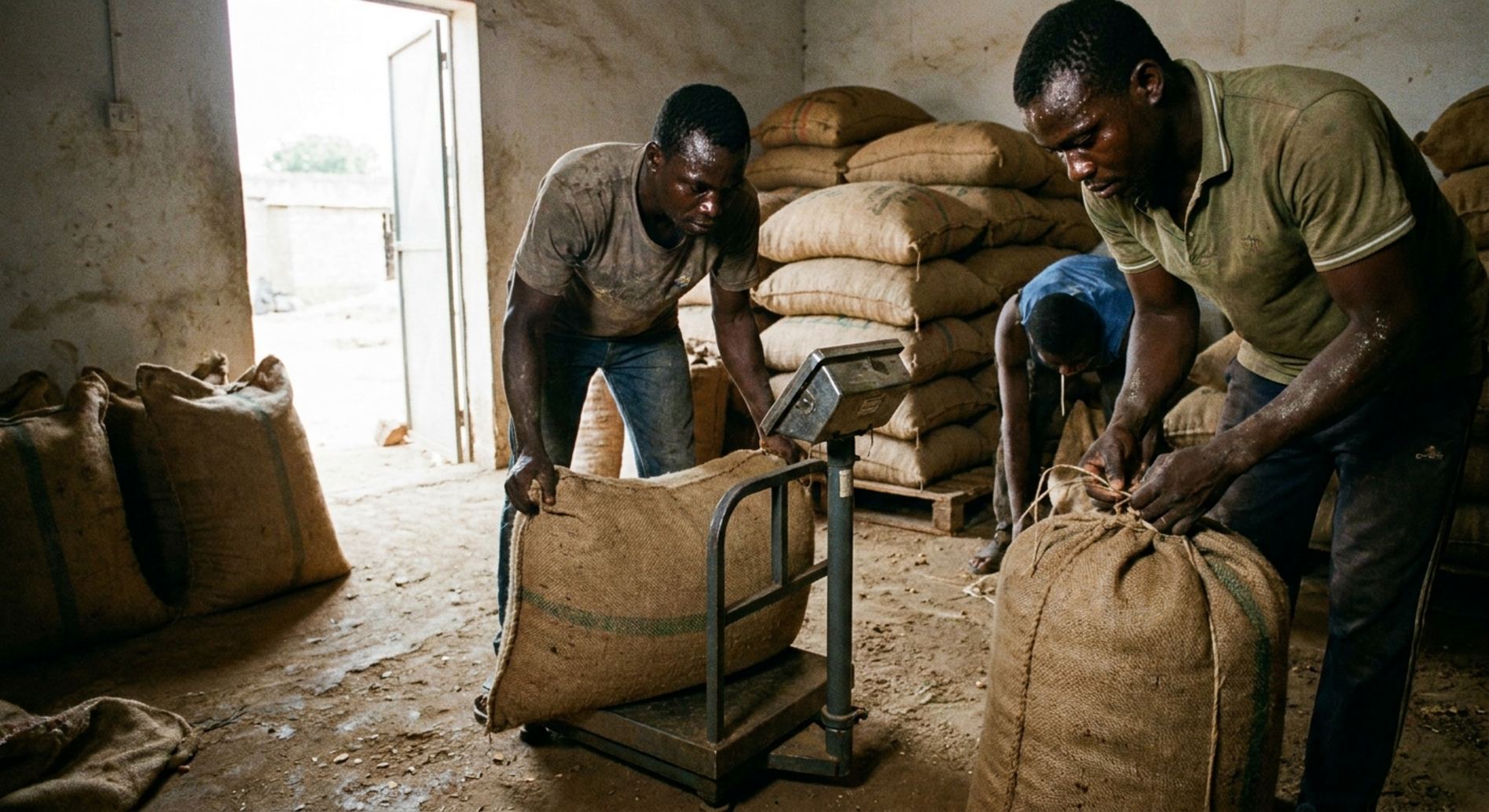
- Use clean, appropriate jute bags — the standard export format is 80 kg per bag.
- Store away from moisture between collection and sale, to prevent mould.
Incoterms and port logistics
For exports, the FOB (Free On Board) incoterm remains the standard from Côte d’Ivoire, departing from the ports of Abidjan and San Pedro. The exporter delivers the goods on board the vessel, and the buyer takes responsibility for sea freight.
A 20-foot container carries approximately 16 tonnes of cashew nuts in jute bags. A 40-foot container carries approximately 28 tonnes.
The most common payment terms involve a 40% advance on order, with the balance settled on FOB delivery at port. An exporter needs an export licence issued by the country’s regulatory authority — such as the Conseil Coton Anacarde in Côte d’Ivoire — to load a container at port.
The port of San Pedro has grown in recent years into a key logistics hub for Ivorian agricultural exports, including cashews, with a dedicated container terminal absorbing a rising share of non-cacao traffic (Abidjan Express, 2026).
Key takeaways
- The harvest peaks from February to April in West Africa, but the best prices do not always come at the very start of the campaign.
- Rigorous drying and sorting prevent price reductions — target a controlled moisture level of around 8% maximum.
- FOB remains the standard incoterm from Abidjan and San Pedro, with payment typically in two stages (advance then balance on delivery).
- An export licence is essential to load a container — apply to the national regulatory authority.
Profitability and business decisions for 2026
Selling at a higher price in 2026 often means investing something upfront, whether in compliance or local processing. Here are the cost benchmarks to know before committing.
Investment costs for local processing
| Unit size | Estimated investment | Indicative capacity |
|---|---|---|
| Small artisanal unit | 3.5 to 6.7 million FCFA | Small scale, a few tonnes per day |
| Intermediate plant | Approximately 10.2 billion FCFA (15.5 million EUR) | 15,000 tonnes of raw nuts per year |
| Industrial plant | 15 billion FCFA (approximately 23 million EUR) | Large capacity, example observed in Côte d’Ivoire |
| Plant in Guinea (example: Diaouné Agro-Industrie) | 11 million USD | Not precisely reported |
The gap between the small artisanal unit and the industrial plant is enormous. For a small business, micro-processing remains the most realistic entry point: manual or semi-mechanised shelling, selling kernels in small quantities on local or regional markets before considering direct export.
Financing remains the main bottleneck
In Côte d’Ivoire, despite annual production hovering around 1.3 to 1.5 million tonnes depending on the season, installed local processing capacity still falls well short of its potential. In March 2026, thirteen processing plants representing more than 150,000 tonnes of annual capacity were affected by a blockage in the financing mechanism planned between the Banque Nationale d’Investissement (BNI) and the Conseil Coton Anacarde (CCA) (Abidjan.net, 2026).
A tripartite financing agreement between the BNI, the CCA and domestic processors was eventually unblocked in June 2026, covering the supply and processing of around 100,000 tonnes of raw nuts (Agence Ivoirienne de Presse, 2026).
Ghana illustrates the same challenge at a larger scale. The country processed only 15,000 tonnes locally out of an estimated production of 262,000 tonnes in 2025 — under 6% — with more than 94% of volumes exported raw. The stated target is to bring that share to 50% by 2030 (Rio Times, 2026; AgroCentric, 2025).
This contrast between raw export volumes and volumes actually processed locally shows how much room for progress exists, but also how difficult it is to finance the necessary investment without external support.
For a small business owner looking to finance compliance upgrades or a first processing investment without going through a conventional bank loan, the article Financing production without a conventional bank loan sets out concrete options. And to budget precisely for the cost of certification and the funding sources available, the article How much does agrifood certification cost and how to finance it details the amounts and funding sources available.
Organisations supporting the sector
Several bodies support African producers and processors, with training programmes, trade matchmaking and sometimes co-financing:
- African Cashew Alliance (ACA) — pan-African professional network, organises an annual conference. The 2026 edition takes place in Accra, Ghana, from 15 to 18 September, on the theme of financing and value addition (African Cashew Alliance, 2026).
- ComCashew (formerly African Cashew Initiative, ACi) — programme funded by the German Federal Ministry for Economic Cooperation and Development (BMZ) and the European Union, implemented by GIZ in partnership with ACA, FairMatchSupport and TechnoServe. Since 2009, it claims more than 38,000 direct jobs created in its countries of operation (ComCashew, 2026).
- Conseil Coton Anacarde (CCA) — Ivorian regulator, sets floor prices and issues export licences.
- Cashewnut Board of Tanzania (CBT) — Tanzanian regulator, managing since 2024/2025 an auction system in partnership with the Tanzania Mercantile Exchange.
Jobs and the impact of local processing
Local processing goes beyond commercial margins. It creates jobs, and those jobs are held predominantly by women. Several recently opened plants in Côte d’Ivoire employ between 70% and 80% women on their production lines, based on cases observed in the sector between 2024 and 2026.
This is an argument that cooperative and SME managers can use with funders and financial partners: beyond turnover, local processing has a direct and measurable social impact.
Risks and levers for 2026
| Risk | Way to protect against it |
|---|---|
| Farm-gate price collapse mid-season (Ivorian case, 2026) | Monitor international tariff news, avoid selling the entire stock at once |
| Dependence on a single buyer or a single market | Diversify between local sales, sales to a local processor and exports |
| Batch rejection for non-compliance on quality | Invest in sorting and drying before sale, target a basic certification (HACCP) |
| Insufficient cash flow to invest in processing | Explore non-bank financing and support programmes (ACA, ComCashew) |
| Dispersed sales in low volumes | Join a cooperative to negotiate group sales, as in Madinani |
For a business owner considering going further in adding value to their production — beyond selling raw nuts — a useful companion read is the article Adding value to cashew nuts in Côte d’Ivoire, which explores the different strategies for moving up the value chain, from shelling to selling processed products.
Key takeaways
- Micro-processing is a realistic entry point for a small business, with a starting investment of 3.5 to 6.7 million FCFA.
- Financing remains the main barrier to local processing, in Côte d’Ivoire as in Ghana.
- ACA and ComCashew programmes offer training and networking — worth engaging with actively.
- Diversifying sales channels protects against price shocks like the one seen in Côte d’Ivoire in 2026.
Frequently asked questions
What is the farm-gate price for cashew nuts in Côte d’Ivoire in 2026?
The official floor price set by the Ivorian government for the 2026 season is 400 FCFA per kilogram, down 6% from the 425 FCFA of 2025. But this floor price was not always observed during the season: driven by US tariffs, some producers saw their actual price fall to 200–300 FCFA per kilogram in certain areas.
Why is the cashew nut price falling in 2026 despite a good harvest?
The fall is explained mainly by factors external to the African continent: the rise in US tariffs on imports from Vietnam and India — the two largest global processors — slowed their purchases of African raw nuts. The decline of the US dollar also weighed on the conversion of international prices into local currency.
Is certification required to sell for export in 2026?
It is not always legally mandatory, but it is increasingly expected commercially. Without a basic certification such as HACCP, access to institutional buyers and major retail chains remains very limited. With a certification like GlobalG.A.P., a premium of 10 to 15% on the selling price becomes accessible with certain buyers.
What is the difference between selling raw nuts and selling processed kernels?
Raw nuts (RCN) sell at around 1,100 to 1,250 USD per tonne ex-Abidjan port in 2026. Once shelled and processed into graded kernels, the value of that same tonne increases substantially on the Indian, Vietnamese or European markets. This is why local processing, even at an artisanal level, significantly improves margins — provided the investment in processing equipment can be made.
What budget should be set aside for compliance in 2026?
For a basic HACCP certification, expect to spend between 300 and 1,500 euros. For ISO 22000 certification in a medium-sized plant, the budget is more likely to be 5,000 to 10,000 euros, over a period of 6 to 12 months. European organic certification starts at around 3,000 euros but can rise considerably depending on the number of producers to be integrated into the traceability system.
When is the best time to sell during the campaign to get the best price?
There is no universal rule, but the 2026 campaigns show that harvest forecasts announced in February are often optimistic, reality becomes clearer in March, and the market generally finds its real level in April. Selling the entire stock at the opening of the campaign can therefore deprive a producer of a better price a few weeks later — provided the nuts can be stored properly without quality loss.
Which countries offer the best farm-gate price in West Africa in 2026?
Based on official 2026 figures, Ghana posts one of the highest equivalent minimum producer prices in the sub-region, followed by Côte d’Ivoire at 400 FCFA/kg, Burkina Faso at 385 FCFA/kg, Guinée-Bissau at 410 FCFA/kg officially, and Togo at 350 FCFA/kg. Bénin has no fixed floor price, which can represent either an opportunity or a risk depending on market conditions at the time.
Which export market should you target for your cashew nuts?
Our free Top Export Markets tool gives you, in under 60 seconds, the 3 best export markets for your product — demand, tariff regime and logistics.