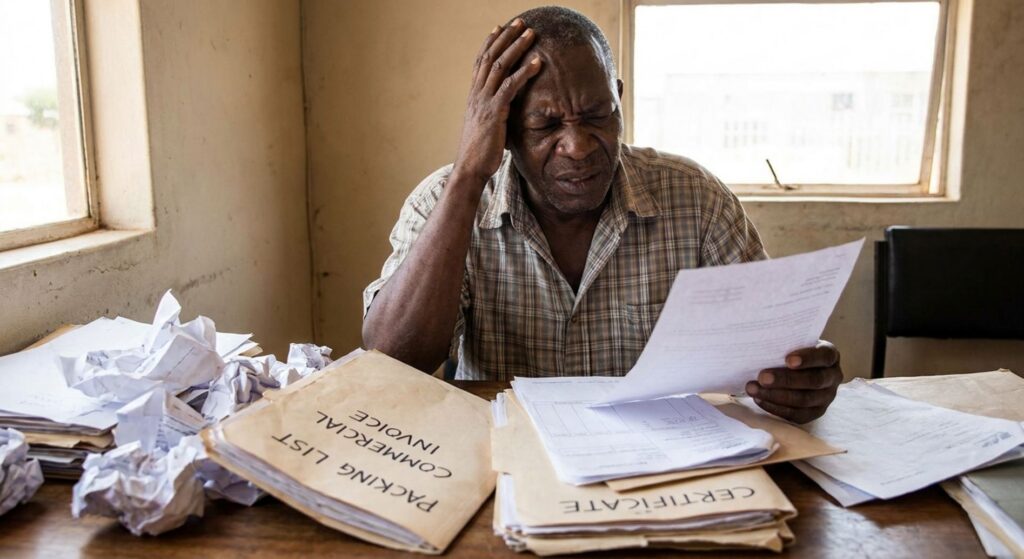
A container held at port for three weeks. An invoice rejected because the declared weight doesn’t match the packing list. A misclassified tariff code that triggers a reassessment months after shipment.
For an African agrifood SME, these incidents are not minor administrative hiccups. They tie up cash flow, damage the relationship with the buyer and, in the worst cases, can cost the company an export market entirely.
The good news: most costly customs mistakes repeat themselves from one company to the next and can be avoided with a basic level of discipline. This article covers the five most common categories of error, with real observed costs, the bodies you need to know, and concrete steps to secure each shipment.
- Documentary errors that hold up shipments
- A wrong customs code: the classification that costs you dearly
- Incorrectly declared customs value: the real hidden cost
- Customs regimes and country-by-country requirements in Africa
- Practical steps to secure each shipment
Before examining each category of error in detail, one figure puts the scale of the problem into perspective. According to the World Bank’s Business Ready 2025 report, only 21% of the economies studied have all the infrastructure needed to manage cross-border trade effectively (World Bank, Business Ready 2025). In other words, in the vast majority of African countries, it falls on the exporter to make up for systemic gaps through the quality of their own documentation.
Documentary errors that hold up shipments
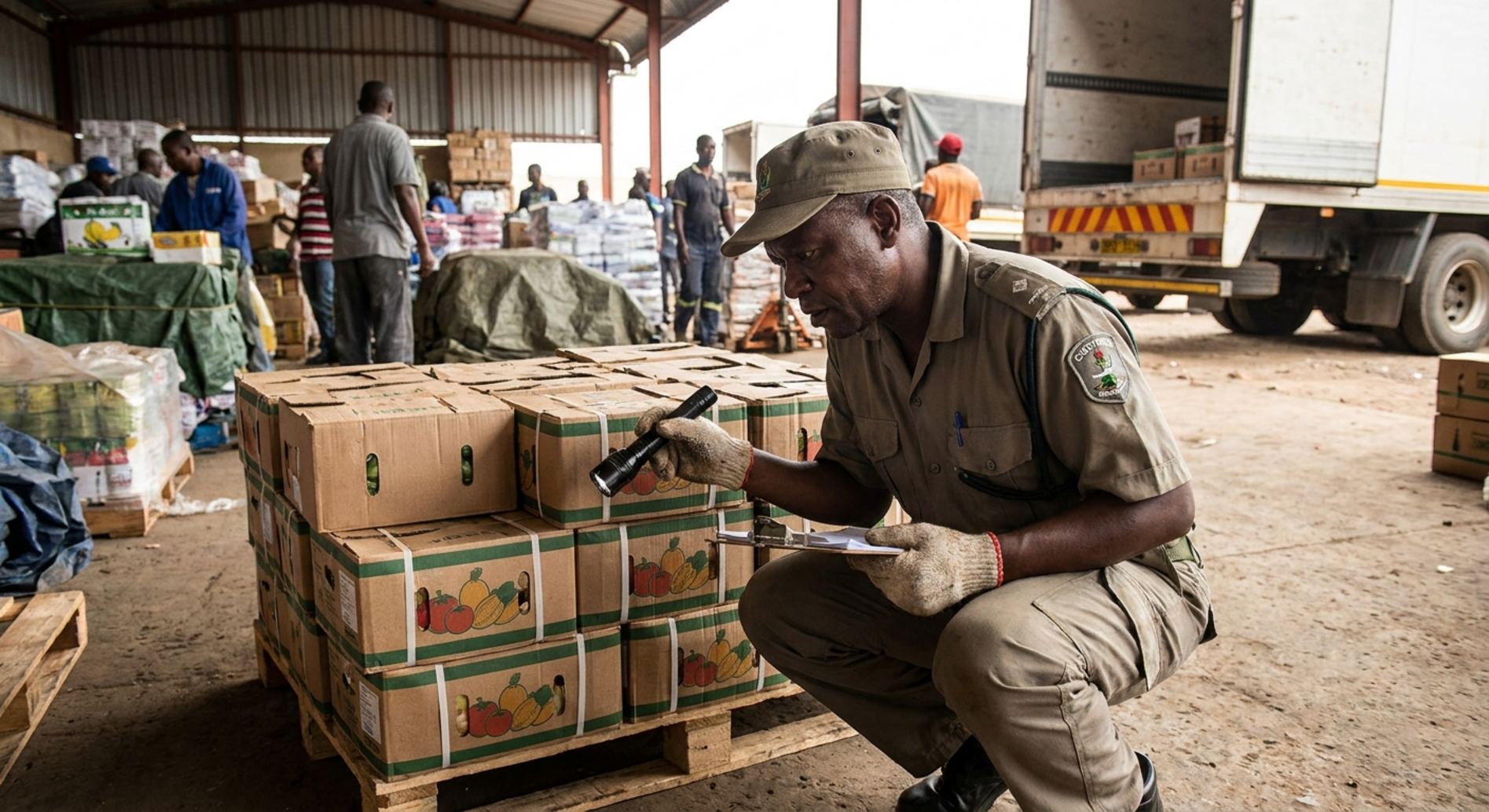
The vast majority of customs hold-ups do not stem from a suspicious physical inspection, but from a poorly assembled set of documents. A single number, weight or signature that doesn’t match across documents is enough to get an entire cargo held.
Three documents carry most of the risk: the commercial invoice, the packing list and the certificate of origin. The commercial invoice contains the financial data — value, currency, Incoterm — that forms the basis for calculating duties and taxes. The packing list, by contrast, contains no financial data: it describes each package precisely, with its quantity, weight and contents, and allows customs to verify that what is physically being shipped matches what has been declared.
As soon as these two documents diverge, even on a minor detail, the customs officer can suspect fraud and hold the goods pending verification. For a perishable agrifood product — fresh mangue, fruit purée, refrigerated goods — every day of detention brings the exporter closer to a total loss of the cargo.
| Document | Role | Common error | Typical consequence |
|---|---|---|---|
| Commercial invoice | Basis for calculating duties and taxes | Value inconsistent with the contract or documentary credit | Hold-up, bank payment refused |
| Packing list | Physical verification of contents | Weight or number of packages differs from the invoice | Enhanced inspection, delay of several days |
| Certificate of origin | Proof of origin for a preferential regime | Entity or country of origin incorrectly identified | Loss of preferential rate, full duties applied |
| Phytosanitary certificate | Health compliance for plant-based products | Pest treatment not documented | Refused entry at destination country |
The phytosanitary certificate case makes the issue clear. Since 2025, the European Union has temporarily suspended imports of fresh mangue from Mali following repeated interceptions linked to fruit flies (Tephritidae), due to a lack of documented evidence of effective treatment (FreshPlaza, 2025). On the other hand, a regional initiative launched in 2014 in Burkina Faso, backed by the Agence Française de Développement and the European Union, doubled the country’s fruit exports to 200,000 tonnes by 2018, with a significant reduction in interceptions at European borders (CORAF). The difference between the two situations comes down almost entirely to the quality of the documentation and upstream treatment.
For agrifood exporters, one final point deserves attention: the European regulation on imported deforestation (EUDR), which adds a specific documentary layer for cacao and coffee. We cover this in detail in the section on customs regimes below.
Key takeaways
- Consistency above all – the invoice, packing list and certificate of origin must show exactly the same quantities, weights and values.
- The phytosanitary certificate is not a formality – without documented proof of pest treatment, the risk of rejection on arrival is real, as the 2025 suspension of Malian mangue exports demonstrated.
- Documentary compliance has a measurable ROI – the doubling of Burkina Faso’s mangue exports between 2014 and 2018 is directly linked to upstream investment in documentary compliance.
A wrong customs code: the classification that costs you dearly
The HS code (Harmonized System), also called the “HS code” or “customs code”, is an international six-digit code that determines the tariff category of a product. It is managed by the World Customs Organization (WCO) and used by virtually every customs administration in the world.
This code is not an administrative detail: it directly determines the rate of customs duties applied, any enhanced controls, and eligibility for a preferential regime. A misclassification — even an unintentional one — exposes the exporter to a retroactive reassessment covering several months of shipments already delivered.
For the flagship product categories covered by Export Direct Info, the reference headings are established and leave no room for guesswork. Fresh or dried cajou nuts fall under heading 08.01, with a distinction between 0801.31 (in shell) and 0801.32 (shelled). Cacao and its preparations fall under chapter 18, with heading 1801.00 covering cacao beans specifically (World Customs Organization, HS Nomenclature).
| Product | HS heading | Watch point |
|---|---|---|
| Cajou nuts in shell | 0801.31 | Do not confuse with shelled nuts (0801.32) — different duty rate |
| Cacao beans | 1801.00 | Distinguish from processed cacao (mass, butter, powder) — same chapter 18 but different subheadings |
| Karité (almonds, raw butter) | Chapter 12 / 15 depending on processing | The degree of processing changes the heading — have it validated by an accredited classifier |
| Dried or processed mangue | Chapter 8 or 20 depending on the process | Simple drying vs preparation with added sugar: two distinct headings |
In practice, a company that exports cacao beans under a code intended for processed cacao — or the reverse — faces three compounding risks: systematic physical inspection while the actual nature of the product is verified, a reassessment on the duty differential if the rate applied was lower than the actual rate, and in repeated cases, classification as a high-risk operator by the customs administration.
When there is any doubt about the correct heading, the best approach is to request a binding tariff ruling from the customs authority of the exporting country, or to have the classification validated by the freight forwarder or customs broker before the first shipment. We cover this in our article on the role of freight forwarders and customs in West Africa, where the choice of a reliable logistics partner makes a direct difference on this type of risk.
Incorrectly declared customs value: the real hidden cost
The customs value must reflect the full price paid or payable by the foreign buyer, as defined by the WTO Agreement on Customs Valuation. Two symmetrical errors create problems: under-valuation, used to artificially reduce duties, and over-valuation, often caused by confusion over the Incoterm or which costs to include.
Under-valuation is a specific customs offence under most African legislation. In Côte d’Ivoire, the Customs Code states that a false declaration regarding the nature, value or origin of goods, supported by false, inaccurate or incomplete documents, constitutes an offence punishable by a fine of no less than 50,000 FCFA per package, or per tonne for unpackaged goods (Customs Code of Côte d’Ivoire, regulatory section). On a shipment of several dozen packages, the bill can quickly run into several million FCFA — and that’s before factoring in the risk of seizure.
Beyond the fine, the real cost of a valuation error lies mostly in the logistics charges triggered by the resulting hold-up. Demurrage fees, billed per container per day beyond the free period granted by the shipping line, pile on top of port storage charges. As a commonly cited illustrative example among West African transit professionals, a container charged 25,000 FCFA per day in demurrage can rack up 250,000 FCFA in extra costs in just ten days of delay (DHL Global Forwarding, Senegal).
| Type of cost | Trigger | Order of magnitude |
|---|---|---|
| Fine for false declaration (Côte d’Ivoire) | Incorrect value, nature or origin with inaccurate documents | Minimum 50,000 FCFA per package or per tonne |
| Container demurrage | Exceeding the port free period | Approximately 25,000 FCFA per day per container (common example) |
| Port storage charges | Goods not collected within deadlines | Progressive billing, added on top of demurrage |
| Tariff reassessment | Wrong HS code or inconsistent value | Not precisely communicated, varies with the duty differential |
The most effective safeguard is to build the full landed cost into the sale price from the outset: duties, taxes, port charges and a safety margin to cover any inspection. That upstream calculation protects the export margin far better than shaving a declared value to gain a few points of competitiveness on paper.
Key takeaways
- Under-valuation is never a shortcut – it is a punishable offence, with fines that start high from the very first package in violation.
- The real cost goes beyond the fine – demurrage and storage charges accumulate every day the cargo sits blocked waiting to be cleared.
- The sale price must reflect the full landed cost – building in duties, taxes and anticipated logistics costs protects the margin better than a reduced declared value.
Customs regimes and country-by-country requirements in Africa
Beyond documentation and tariff classification, every African country has its own prior authorizations, its own clearance windows and, increasingly, requirements set by destination markets. Overlooking any one of these layers is enough to block a shipment that looked perfectly compliant on paper.
Several countries have digitized their trade formalities through a single window for foreign trade, with concrete results on processing times. In Côte d’Ivoire, the Guichet Unique du Commerce Extérieur (GUCE), operational since 1 July 2013, centralizes online the value declaration, bank domiciliation and detailed goods declaration (GUCE Côte d’Ivoire). In Senegal, the ORBUS platform, developed by GAINDE 2000, digitizes and electronically signs all foreign trade documents, reducing both processing times and costs (WTO Trade Facilitation Database).
Many African countries also rely on SYDONIA (ASYCUDA in English), the automated customs management system developed by UNCTAD in Geneva. The ASYCUDAWorld version, launched in 2004, is now used by more than one hundred countries or territories worldwide, including a large share of African customs administrations (UNCTAD). These tools reduce the margin for human error, but they never replace the documentary discipline described above.
Some products require an additional authorization even before reaching customs. In Senegal, any product intended for human consumption must first obtain a Manufacturing and Marketing Authorization (FRA), issued by the Division of Food Safety Control: the application requires four product samples for analysis by an accredited laboratory, compliant labelling mock-ups and a description of the manufacturing process (Direction du Commerce Intérieur, Senegal). This FRA authorization is then a prerequisite for obtaining the export certificate of origin, making it a step that must be planned well in advance of the first order — a subject we explore further in our article on the cost of agrifood certifications and how to finance them.
The African Continental Free Trade Area (AfCFTA) adds its own specific layer: to benefit from the intra-African preferential tariff, the exporter must provide proof of origin — either a certificate issued by the customs authorities of the exporting country, or a self-declaration of origin, reserved for approved exporters or shipments with an invoice value below USD 5,000 (WCO guide on AfCFTA rules of origin). Cameroon issued its very first AfCFTA certificate of origin in October 2022 (Bougna.net, 2022), marking the beginning of a still gradual roll-out across several countries.
Cameroon also illustrates, from the other side, the cost of long-standing sanitary non-compliance. Since 2018, the country has been unable to export mangue, papaya, guava, peppers, aubergine and tomatoes to the European Union, following repeated failures of its national sanitary and phytosanitary control system: residues of harmful substances were detected on multiple occasions, despite compliance certificates issued by the Cameroonian authorities. A tightening of European phytosanitary rules, which came into force in December 2019, confirmed that exclusion (Investir au Cameroun). This case is a reminder that an isolated documentary error costs one company dearly, but a failing national sanitary control system can close a market to an entire sector.
Cacao and coffee exporters must now also prepare for the European Union Deforestation Regulation (EUDR). After two delays, its entry into force is set for 30 December 2026 for large companies and June 2026 for small exporting operations. Each batch will need to be linked to a geolocated plot and accompanied by a due diligence statement proving the absence of deforestation after 31 December 2020 (EUDR official timeline). In Côte d’Ivoire, the world’s leading cacao producer, this requirement is already reshaping how the sector operates, particularly for small cooperatives that must geolocate each plot belonging to their members (Mongabay, April 2026).
| Country / framework | Requirement or tool | What to anticipate |
|---|---|---|
| Côte d’Ivoire | GUCE (since 2013) | Online declaration, but full documentary file still required beforehand |
| Senegal | ORBUS + FRA authorization | FRA must be obtained before the certificate of origin — factor the lead time into the export schedule |
| Mali | Enhanced EU phytosanitary controls (2025) | Documented fruit fly treatment required, or risk suspension |
| Cameroon | AfCFTA + EU restrictions on certain fruits and vegetables | Check on a product-by-product basis before shipping |
| AfCFTA zone (continental) | Certificate or self-declaration of origin | Apply for approved exporter status in advance if volumes are regular |
| Cacao / coffee sectors to the EU | EUDR: plot geolocation | SME deadline: June 2026 — start preparing the due diligence file now |
Practical steps to secure each shipment
Faced with this accumulation of rules, the goal is not to master everything in-house, but to put a simple process in place that catches errors before loading. Five steps consistently distinguish exporters who keep their customs incidents to a minimum.
First step: a pre-shipment checklist — short but systematic — that cross-checks the invoice, packing list, certificate of origin and sanitary certificate before every shipment. A simple cross-review by a second person in the company is enough to catch most numerical inconsistencies.
Second step: an internal sign-off before loading, focused on the points that trigger the most hold-ups. This means systematically checking the HS code used, the consistency of the declared value against the commercial contract, and the validity of sanitary or origin authorizations at the date of shipment.
Third step: close coordination with the freight forwarder or customs broker, chosen for their knowledge of the corridor being used — not just for their rate. A good freight forwarder flags a questionable tariff code or a missing document before the goods reach the port. This choice, often underestimated by smaller operations, is covered in our article on freight forwarders and customs in West Africa.
Fourth step: realistic lead time planning. In West African ports, standard customs clearance typically takes between 2 and 5 days — a timeline an experienced freight forwarder can cut by one to two days by keeping the file moving smoothly (Les Afriques, 2026). Building this buffer into the delivery dates communicated to the buyer avoids contractual penalties for late delivery.
Fifth step: simulating the full landed cost before setting a sale price. By factoring in duties, taxes, port charges and a safety margin for a potential inspection, the exporter protects their export ROI even when a documentary issue arises.
A sixth step, often overlooked by smaller operations: ongoing training for the teams managing exports. In Côte d’Ivoire, the Office Ivoirien des Chargeurs (OIC) runs regular training sessions on customs procedures, tariffs and transit — including a session for 28 business operators on 25 and 26 March 2026 in Abidjan-Plateau. Nelly Christiane Rolland, the OIC’s director of shipper assistance, put it plainly: companies that don’t understand clearance procedures suffer significant losses and generate repeated disputes with the customs administration (FratMat, March 2026). This type of training, often free or low-cost for SMEs, remains one of the fastest ways to bring an export team up to speed on the points that cause the most damage.
The example of the Busia one-stop border post between Uganda and Kenya shows just how large the gains can be when procedures are streamlined upstream. Funded by the World Bank under the East Africa Trade and Transport Facilitation Project launched in 2010, the scheme cut the average border crossing time by 80%, with a 98% reduction in customs processing time on the Kenyan side and 69% on the Ugandan side (The Conversation). At the level of an individual company, the same logic applies: every hour saved upstream on file preparation translates into days saved at customs clearance.
Key takeaways
- A cross-checked pre-shipment checklist – it catches most documentary errors before they become hold-ups.
- The freight forwarder is a partner, not just a service provider – their knowledge of the corridor reduces both delays and the risk of misclassification.
- Planning ahead protects the margin – building duties, taxes and logistics costs into the sale price prevents unwelcome surprises along the way.
What to keep in mind before your next shipment
The most costly customs errors for African agrifood SMEs are not unpredictable accidents. They concentrate around a limited number of control points: documentary consistency, the tariff code, the declared value and the specific authorizations required by each country and each destination market.
By building a simple process — even a lightweight one — around these four points, a small company can sharply reduce its customs hold-ups and turn its logistical reliability into a commercial asset with buyers. This is also an increasingly decisive condition for sustained access to export markets in Europe and Asia, where documentary reliability now carries as much weight as product quality in an importer’s decision.
Frequently asked questions
What documents are required to export an agrifood product from Africa?
At a minimum: a commercial invoice, a packing list, a certificate of origin and, for plant-based products, a phytosanitary certificate. Depending on the country and product, a prior sanitary authorization (such as the FRA in Senegal) may also be required before the customs declaration can even be filed.
What is an HS code and why does a classification error cost so much?
The HS code, or customs code, is an international six-digit code that determines the rate of customs duties and the controls applicable to a product. A misclassification can lead to a retroactive reassessment covering several months of shipments, systematic physical inspections and a loss of credibility with the customs administration.
How do you avoid under-valuation at customs?
The declared value must always reflect the full price paid or payable by the buyer, consistent with the commercial contract and, where applicable, the documentary credit. Any attempt to reduce this value to lower duties exposes the exporter to fines that start high — on top of the costs of any resulting hold-up.
Is the AfCFTA certificate of origin compulsory for all African exporters?
It is only required to benefit from the preferential tariff under intra-African trade covered by the African Continental Free Trade Area. It can take the form of a certificate issued by the customs authority of the exporting country, or a self-declaration, reserved for approved exporters or low-value shipments.
Does the European EUDR regulation apply to small companies exporting cacao or coffee?
Yes, but with an extended deadline. Large companies must be compliant by 30 December 2025, while smaller operations have until June 2026 to put in place the plot geolocation and due diligence declaration required.
What should you do if a cargo is held up at customs?
Work quickly with the freight forwarder to identify the document or piece of information causing the hold-up, then provide the corrective documents requested without delay. The faster the response, the lower the demurrage and storage charges — which accumulate every day the goods remain blocked.