Since 1 May 2026, China has applied zero customs duties to nearly all products from 53 African countries.
Cashew and coffee benefit directly, with the added removal of sanitary barriers that had previously blocked many countries from selling there.
But a zero tariff does not mean an unconditional open market.
China’s requirements on registration, traceability and quality remain strict, and profitability depends above all on logistics and the sales channel chosen.
Here is what to check before starting out, step by step.
- What China’s zero tariff in 2026 actually changes
- Cashew: unified market access to China finally open to all of Africa
- Green coffee: China lifts its sanitary quarantine country by country
- The administrative checklist for compliant exports
- What it really costs: logistics, registration and margin
- Finding a buyer in China: trade fairs, platforms and B2B channels
- Sell raw or process locally before exporting?
- FAQ: exporting cashew or coffee to China
This policy did not come out of nowhere. It is the result of a phased Chinese announcement, rolled out between late 2024 and 2026, that eventually covered almost the entire continent.
Understanding the exact timeline helps avoid two common mistakes: assuming all African countries have been covered from the same date, or confusing the removal of customs duties with automatic import authorisation.
What China’s zero tariff in 2026 actually changes
China’s policy was built in two stages. On 1 December 2024, China extended zero-tariff coverage to 100% of tariff lines for the 33 African countries classified as least developed countries (LDCs) that maintain diplomatic relations with Beijing, according to a WTO notification reported by Xinhua (english.www.gov.cn).
On 1 May 2026, this tariff elimination was extended to the 20 African countries that are not LDCs but maintain diplomatic relations with China, in the form of a preferential tariff applicable until 30 April 2028. In total, 53 of the 54 African countries are now covered. Only Eswatini remains excluded, due to its official relations with Taiwan (english.www.gov.cn).
| Date | Countries concerned | Tariff coverage | Duration |
|---|---|---|---|
| 1 December 2024 | 33 African least developed countries (LDCs) with diplomatic relations with China | 100% of tariff lines | Permanent (WTO notification) |
| 1 May 2026 | 20 non-LDC African countries with diplomatic relations with China | 0% as a preferential tariff | Until 30 April 2028 |
| Exception | Eswatini (official relations with Taiwan) | Excluded from the scheme | – |
Source: Tariff Commission of the State Council of China, via english.www.gov.cn, 2026.
One technical point matters for quota-bound sectors: when a product is subject to a tariff-rate quota, only the in-quota rate drops to zero. The out-of-quota rate remains unchanged. This mechanism can affect certain processed agricultural products, so it is worth checking product by product before building an export forecast.
Another nuance raised by several Ivorian experts quoted in the local business press: zero customs duties do not remove China’s quality, food safety and traceability standards enforced by the General Administration of Customs of China (GACC). An agri-economist quoted by Fratmat notes that tariff access does not exempt Ivorian exporters from raising their standards to meet these requirements. Another expert, Dr Kichiedou, quoted by Linfodrome, considers cashew among the sectors with strong potential in the Chinese market, but warns that preferential access does not automatically guarantee commercial success.
Key points to remember
- Two waves, two statuses: the 33 African LDCs have benefited from zero tariffs since December 2024; the other 20 countries only since May 2026, and for a limited period ending in 2028.
- One country excluded: Eswatini, for diplomatic reasons related to Taiwan.
- Zero tariff is not zero control: GACC sanitary and traceability standards remain fully in force.
- Tariff-rate quotas persist for certain processed products, with the out-of-quota rate unchanged.
Cashew: unified market access to China finally open to all of Africa
For raw cashew, the obstacle was never really the customs tariff — it was phytosanitary access. Before June 2026, only a handful of African countries had secured, one by one, a bilateral quarantine agreement with China: Guinea-Bissau, Mozambique and Gambia were among the rare exceptions.
That changed on 9 June 2026. According to the Chinese customs authority as reported by Xinhua, cashew nuts produced in any African country with diplomatic relations with China can now enter the Chinese market, provided they meet a single set of inspection, quarantine and sanitary requirements. The country-by-country bilateral negotiation process is gone (investinchina.chinaservicesinfo.com, Xinhua, June 2026).
| Before 9 June 2026 | Since 9 June 2026 |
|---|---|
| Phytosanitary access limited to a few countries via bilateral agreement (Guinea-Bissau, Mozambique, Gambia) | Access open to any African country with diplomatic relations with China |
| Separate country-by-country negotiations, with no shared timeline | A single set of sanitary and quarantine requirements for all eligible producers |
Source: General Administration of Customs of China (GACC), via Xinhua, 15–16 June 2026.
For Côte d’Ivoire, the world’s largest producer of raw cashew nuts, this is a door opening late compared to other export destinations. In 2025, the country exported more than 860,000 tonnes of raw nuts, primarily to Vietnam and India, with China not yet appearing as a significant buyer in available statistics. The Conseil Coton-Anacarde-Karité (CCAK) is targeting more than 100,000 additional tonnes for the 2026 season through a partnership with US company The Andersons — a sign that diversifying markets is already a sector priority, regardless of China.
The Ivorian farmgate price for the 2026 season stands at 400 FCFA per kilo, down 25 FCFA, a drop attributed mainly to lower US purchasing. China’s opening therefore comes at a moment when producers are actively looking for new outlets to support prices.
To translate this regulatory access into actual sales, the Agence Côte d’Ivoire Export and the Chinese embassy in Abidjan agreed, at a meeting on 5 March 2026, on joint priorities to grow Ivorian exports to China, with a dedicated Ivorian pavilion planned at the CIIE trade fair in Shanghai in November 2026 (see the section on trade fairs and platforms).
Green coffee: China lifts its sanitary quarantine country by country
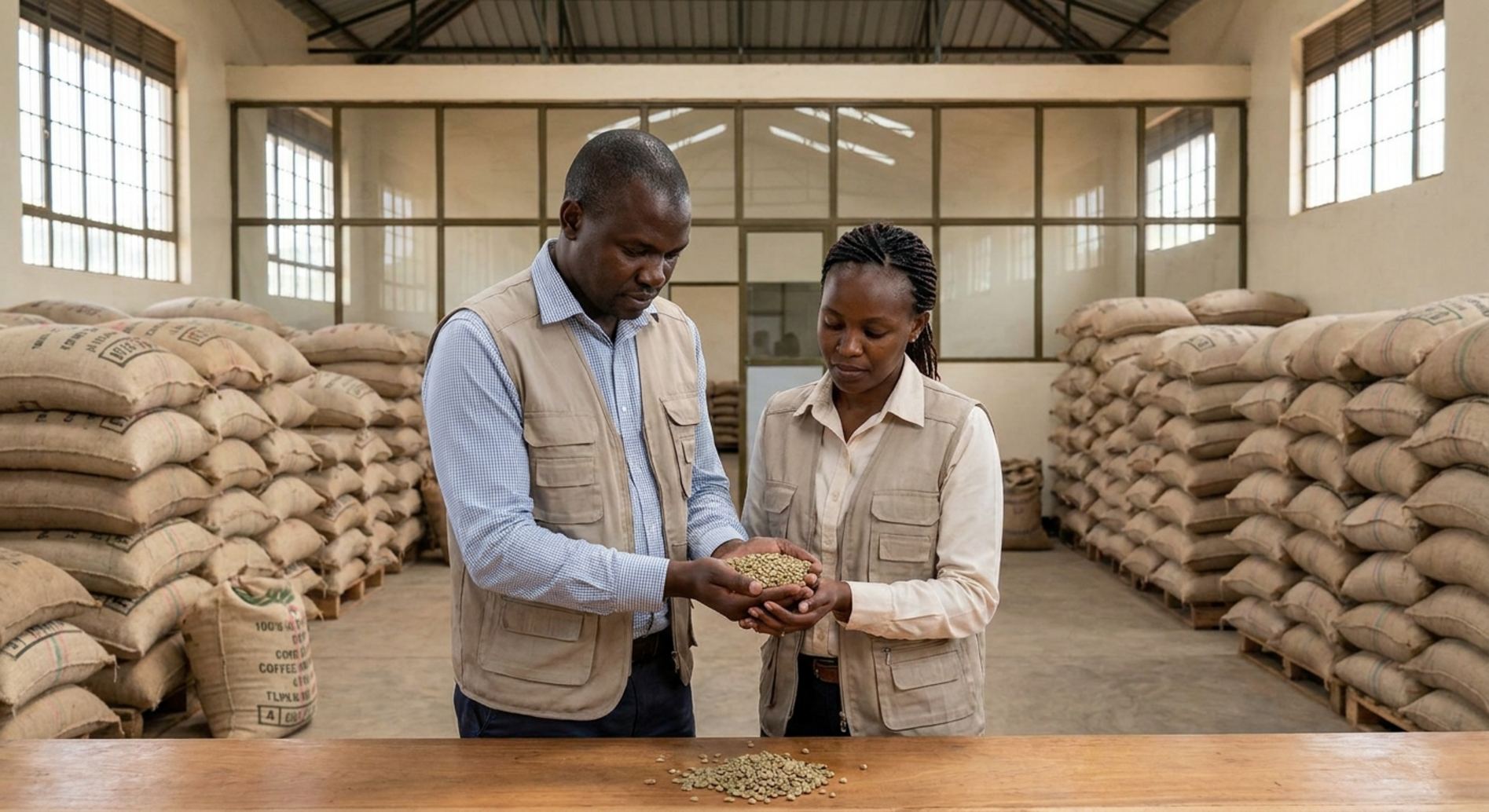
Coffee follows a similar logic to cashew, but on a different timeline. Since 20 July 2026, China has allowed green coffee imports from the 53 African countries covered by diplomatic relations, without requiring a separate bilateral quarantine agreement per country. Coffee thus becomes the second African agricultural product, after dried chillies, to benefit from quarantine access without specific restrictions (source reported by AllAfrica).
Ethiopia, which had already secured bilateral access before this reform, illustrates how quickly this market can grow. According to the Ethiopian Coffee and Tea Authority (ECTA), Ethiopian coffee exports to China rose from 34,284 tonnes ($219 million) in the previous year to 47,836 tonnes ($347 million) in the 2025/26 fiscal year. China has thus become Ethiopia’s third-largest coffee export market, up from fifth the previous year.
| Indicator | Previous year | 2025/26 fiscal year |
|---|---|---|
| Volume exported to China | 34,284 tonnes | 47,836 tonnes |
| Value | 219 million USD | 347 million USD |
| China’s rank among Ethiopian export markets | 5th | 3rd |
Source: Ethiopian Coffee and Tea Authority (ECTA), cited by specialist coffee press, 2026.
The US agency USDA FAS puts even more striking figures on the 2024/25 season: a 264.1% increase in exports to China, reaching 670,000 60-kg bags, at a time when China was only Ethiopia’s 17th export market a decade earlier. The gap between these two sources (ECTA and USDA) stems mainly from different units of measurement and different seasons, but the trend is the same in both cases: rapid growth, driven partly by the removal of customs duties.
Israel Degefa, CEO of Kerchanshe, Ethiopia’s largest coffee producer-exporter, attributes this momentum directly to tariff policy: “The zero-tariff policy makes our coffee highly competitive in the Chinese market,” he told the specialist press. Burundi, for its part, shipped its very first direct batch of arabica coffee to China in 2026 — 38.4 tonnes — a signal that even smaller-scale sectors can now test this market.
On the administrative side, a quiet change deserves attention: unroasted coffee beans, like unroasted cacao beans, now fall under the establishment registration system managed by China’s Ministry of Animal and Plant Quarantine (MAPQ), which is part of GACC, rather than the CIFER system used for most other food products. A coffee exporter must therefore check with their national sanitary authority which registration pathway applies to their specific product.
The administrative checklist for compliant exports
Before looking for a Chinese buyer, an exporter must secure four administrative building blocks: registration of their establishment with GACC, a phytosanitary or sanitary certificate per shipment, compliance with Chinese labelling requirements, and the standard customs documents (invoice, packing list, certificate of origin).
The central regulatory framework is GACC Decree No. 248, in force since 1 January 2022, which requires every foreign food manufacturer, processor or warehouse supplying China to register — with the exception of additives. This text is to be replaced by Decree No. 280 from 1 June 2026 onwards: existing registrations under the Decree 248 regime will need to be renewed under the new terms (source: food.chemlinked.com).
| Step | Responsible body | Indicative timeline | Cost |
|---|---|---|---|
| Registration of the exporting establishment (Decree 280, formerly 248) | GACC, via national sanitary authority and the CIFER platform (or MAPQ for green coffee/raw cacao) | 5-year validity; renewal application to be submitted 3 months before expiry | Not precisely communicated |
| Phytosanitary certificate per shipment | National plant protection service of the exporting country | Varies by country; to be requested before each shipment | Not precisely communicated |
| Compliant labelling (simplified Chinese, nutritional information, origin) | Responsibility of the exporter or Chinese importer, depending on the contract | To be prepared before final packaging production | Varies by provider |
| Customs documents (invoice, packing list, certificate of origin, bill of lading) | Chamber of commerce or customs authority of the exporting country | A few days before loading | Local administrative fees, variable |
Source: FranceAgriMer (Expadon2/CIFER note, February 2025), Fieldfisher, food.chemlinked.com, 2025–2026.
An older point, still cited by some economic services, draws a distinction between two cases: a producer who exports directly to China must register with GACC, whereas a producer whose goods are exported by a third party (trader, trading company) may not always be subject to this direct obligation. This distinction should be reconfirmed with the national sanitary authority before relying on it, as it comes from a note dated 2012.
For SMEs looking to lock in compliance costs before committing, the article on financing agri-food certification details the options available to avoid having to cover registration and compliance costs alone.
What it really costs: logistics, registration and margin
A zero tariff counts for nothing if logistics wipe out the margin. Two factors weigh particularly heavily on Africa-China shipments in 2026: the situation in the Red Sea, which is pushing some maritime traffic to reroute around the Cape of Good Hope, and the specific surcharges applied on certain routes.
According to the Drewry composite index, the cost of a 40-foot container reached $2,712 on 21 May 2026, a figure driven mainly by Asia-Europe routes but indicative of the general tension in global maritime freight. The Cape of Good Hope detour typically adds 10 to 14 days of transit and between $600 and $900 per container on many African routes.
| Cost item | Indicative cost | Transit time |
|---|---|---|
| Maersk surcharge, China/Hong Kong to East Africa (Mombasa, Dar es Salaam), from 15 June 2026, non-spot bookings | +$1,000 / 20-foot container, +$2,000 / 40-foot container | – |
| Cape of Good Hope detour (Red Sea context) | +$600 to $900 / container | +10 to 14 days |
| Commercial example China–Gabon, FCL (not independently verified) | $6,751 to $8,268 (20 ft); $8,798 to $10,839 (40 ft) | 34 to 40 days |
| Commercial example China–Gabon, LCL groupage | ~$953 / m³ | 35 to 44 days door-to-door |
Sources: Drewry via suaidglobal.com, freshplaza.com (Maersk surcharges), sino-shipping.com, 2026. Commercial rates cited are not independently verified and vary by period.
One new direct service worth tracking for West African exporters: CMA CGM has announced three loops called WAX, connecting southern China and the port of Qingdao to Abidjan, Lekki, Kribi, Tema and Pointe-Noire, with a first departure from Qingdao scheduled for 30 March 2026. A direct service of this kind can reduce the number of transshipments and therefore overall transit time, but the precise rate needs to be negotiated with the carrier or a local freight forwarder.
Another margin factor: seasonality. Freight rates can jump by 40 to 80% during peak season (August to October), while shipments planned during the low season (January to March) generally cost less. An exporter who can spread production across the year therefore has a real logistical negotiating card to play.
Before drawing up a margin forecast, the following costs must all be added together: GACC compliance, phytosanitary certificate, sea freight with any applicable surcharges, cargo insurance, any intermediary or Chinese importer commission, and the currency risk between the local currency and the yuan or dollar. Without this full calculation, the zero-tariff advantage can disappear entirely into the logistics line.
Finding a buyer in China: trade fairs, platforms and B2B channels
Regulatory access does not create a buyer. Several channels have already proven effective for African products comparable to coffee and cashew, and are better combined than used in isolation.
The China International Import Expo (CIIE) remains the most visible event. Its 9th edition will be held in Shanghai from 5 to 10 November 2026, at the National Exhibition and Convention Center. At the 7th edition in 2024, exhibitors from Rwanda, Benin and Ethiopia presented sésame, dried pineapple and karité butter, with the explicit aim of strengthening trade channels for African products. The Agence Côte d’Ivoire Export is planning a dedicated pavilion for the 2026 edition, building on its strengthened collaboration with the Chinese embassy mentioned above.
Chinese B2B platforms are a second channel, more accessible day to day than an annual trade fair. In January 2022, three Ethiopian coffee brands (Wild, Arada and Hedero) were launched on Tmall Global, Alibaba’s platform, as part of the eWTP programme run with the United Nations Economic Commission for Africa and the Ethiopian government. More than 11,200 bags of Ethiopian coffee reportedly sold in a single second at launch, according to the event’s press release.
A third channel, less well known but active, runs through Chinese regional hubs dedicated to Africa trade. The city of Changsha, in Hunan, imported more than 6.5 million yuan worth of coffee in the first four months of a recent year, driven by promotional events and live-selling sessions focused on African products such as coffee, sésame and pepper.
For an African agri-food SME, the most realistic combination is often to use the CIIE or a national pavilion to establish a first qualified contact, then close and repeat sales through a B2B platform or an importer identified on the ground — rather than targeting large volumes from the first shipment.
Sell raw or process locally before exporting?
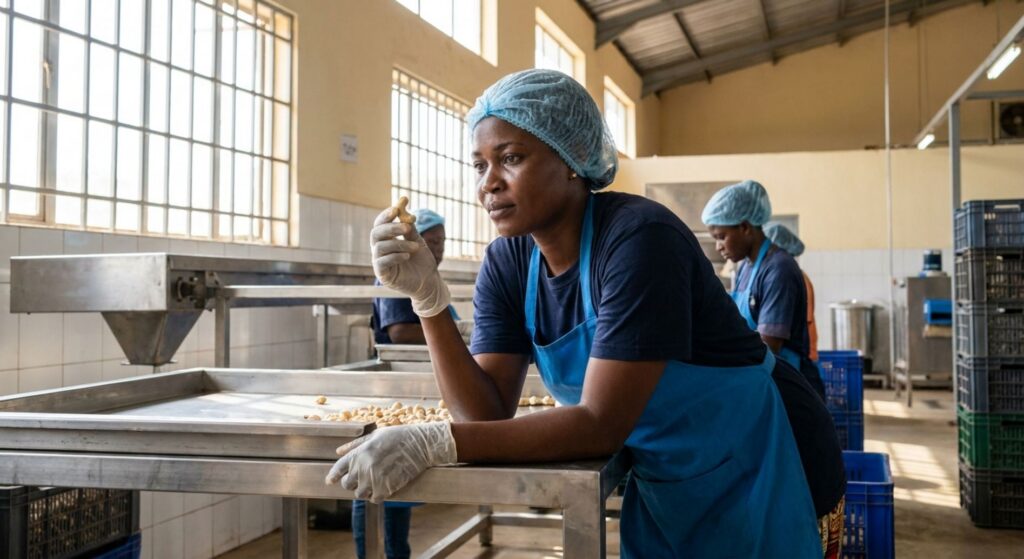
The value-added question is particularly sharp for Ivorian cashew. The government is targeting local processing of 50% of raw cashew nuts by 2030, up from a still-minority share today, and is actively pushing for processing plants to be established on Ivorian soil.
Employment figures linked to this processing activity vary by source and counting period, but converge on a similar order of magnitude. More than thirty processing plants inaugurated in 2024 are said to have created over 15,000 direct jobs, 70% of them held by women, according to government figures reported by CPCCAF. The World Bank, using a different scope and period (2015–2024), counts 18,321 jobs created, 66% of them held by women.
| Indicator | Value | Source |
|---|---|---|
| Direct jobs linked to plants inaugurated in 2024 | More than 15,000 (70% women) | Ivorian government, via CPCCAF |
| Jobs created between 2015 and 2024 | 18,321 (66% women) | World Bank |
| Volume processed locally, recent season vs. 2024 | 659,579 tonnes vs. 344,026 tonnes | Conseil Coton-Anacarde-Karité, business press |
| National local processing target | 50% of raw nuts by 2030 | Ivorian government |
Source: World Bank (banquemondiale.org), CPCCAF, Ivorian business press, 2025–2026.
At plant level, the example of Boundiali (Tombougou site) gives a more concrete picture: its director counts 400 direct jobs on site and estimates that around 1,500 indirect jobs are supported in surrounding villages thanks to the plant’s activity.
For an SME, the choice between selling raw and processing depends mainly on three factors: the price differential offered by the Chinese buyer for a processed product (shelled kernel rather than raw nut, roasted coffee rather than green), the investment cost of a processing or shelling line, and the ability to meet the additional hygiene standards that processing requires. Selling raw is simpler administratively but captures less value; processing requires upfront financing, which the article on financing production without traditional bank credit explores without waiting for a conventional bank loan.
For a company starting out, testing raw exports to China first with a small volume — before investing in a processing line dedicated to that specific market — limits financial risk. The Chinese quality and traceability standards highlighted earlier by Ivorian experts are easier to validate on a small batch than at industrial scale.
One final point to watch: the Ivorian cashew sector has already built a structuring partnership with a US player (The Andersons) and sells primarily to Vietnam and India. China is an additional opportunity, not a replacement for these existing outlets. Diversifying buyers, including within the Chinese market, remains the best protection against dependence on a single client or a single geography. The article on cashew nut value creation in Côte d’Ivoire details practical options for capturing more value locally before export.
FAQ: exporting cashew or coffee to China
Does China’s zero tariff apply to all African countries?
No. It covers 53 of the 54 African countries that have diplomatic relations with China. Only Eswatini is excluded, due to its official relations with Taiwan. The 33 least developed countries have benefited since December 2024; the other 20 countries since 1 May 2026 and until 30 April 2028.
Is a zero tariff enough to export cashew or coffee to China?
No. Exporters must also comply with the sanitary, quarantine and traceability requirements of the General Administration of Customs of China (GACC), and register their exporting establishment. Tariff access and sanitary access are two separate frameworks.
When did African raw cashew gain unified sanitary access to the Chinese market?
Since 9 June 2026. Before that date, only a handful of countries such as Guinea-Bissau, Mozambique and Gambia had secured phytosanitary access through bilateral agreements. A single set of requirements now applies to any African country with diplomatic relations with China.
Which African countries already export coffee to China in significant volumes?
Ethiopia is the best-documented case, with nearly 48,000 tonnes exported to China in the 2025/26 fiscal year, making China Ethiopia’s third-largest coffee export market. Burundi shipped its first direct batch in 2026, totalling 38.4 tonnes.
What document must be obtained before the first shipment to China?
At minimum: registration of the exporting establishment with GACC (Decree 280, which replaced Decree 248 from 1 June 2026) and a phytosanitary or sanitary certificate issued by the competent authority of the exporting country for each shipment.
Is it better to export raw or processed cashew to China?
It depends on the price differential offered by the Chinese buyer and the company’s investment capacity. Selling raw is simpler administratively; processing captures more value but requires upfront financing and compliance with additional hygiene standards.
The Chinese market is neither an automatic goldmine nor an illusion. It is a real and recently opened outlet, still largely unexplored by most African agri-food SMEs, but one that demands the same documentary and logistical rigour as any other export market. Companies that check every step — from GACC registration to sales channel selection — start with a genuine head start in a market where African competition remains, for now, limited.