Certifications and financing for agrifood SMEs in West Africa
Agrifood certifications play a crucial role for SMEs in West Africa (Senegal, Côte d’Ivoire, Ghana, Nigeria).
They open access to demanding markets such as the European Union, reassure consumers about product quality, and facilitate access to financing.
In this article, we explore the opportunities linked to international standards, the certifications and financing available by sector (cocoa, mango, cashew, processed products, local cereals), as well as the logistics and customs aspects that must be mastered for export.
At the end of the article, an FAQ section answers the most common practical questions.
Contents:
1. Opportunities & international standards
For West African agrifood SMEs, complying with international standards offers real growth opportunities.
The European Union (EU) is the primary export market for agrifood products from the region, and demand there is on the rise.
For example, Côte d’Ivoire exported €4.74 billion to the EU in the first nine months of 2024, up +57% year on year.
Nigeria also saw its agrifood sales to the EU surge by +150% to €1.27 billion over the same period.
These spectacular gains are largely explained by the surge in prices for certified products (cocoa, etc.) on the global market.
By complying with quality standards, SMEs can therefore take advantage of these favourable trends. However, accessing these demanding markets requires strict compliance with quality, food safety and traceability standards.
The EU imposes rigorous food regulations (health legislation, pesticide residue limits, etc.), and is even tightening its environmental requirements. For example, the new European “anti-deforestation” regulation will require, by end of 2025, deforestation-free traceability for products such as cocoa and coffee.
This will oblige West African exporters to prove that their crops have not contributed to deforestation – a challenge, but also an opportunity to add value to sustainable supply chains. In this context, several international certification frameworks stand out.
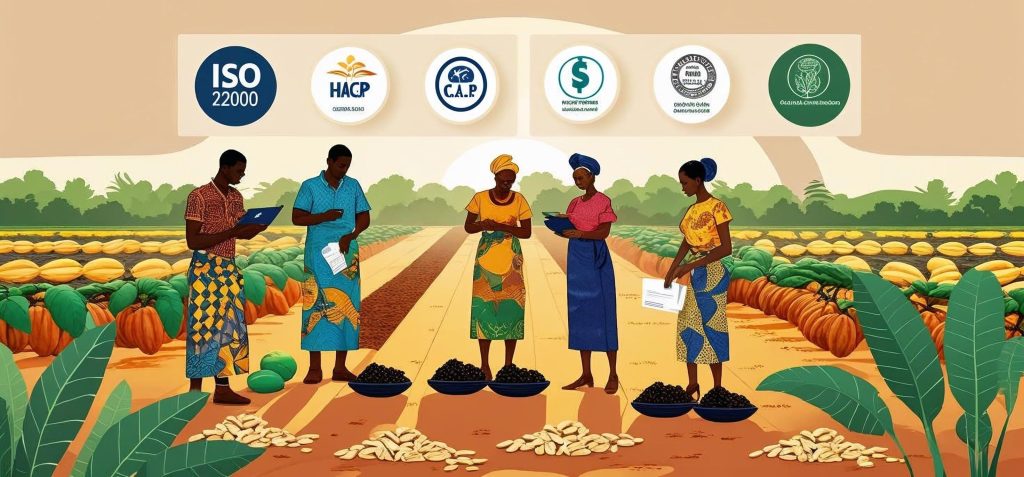
The table below summarises the main relevant standards:
| Certification/standard | Scope | Benefit for an agrifood SME |
|---|---|---|
| ISO 22000 (food safety) | Management system guaranteeing food safety (integrated HACCP approach). | Strengthens customer confidence in product quality. Often required to sell to industrial buyers or large retailers. |
| ISO 9001 (quality) | Quality management system. | Helps structure the business to improve quality and customer satisfaction. A foundation for other certifications. |
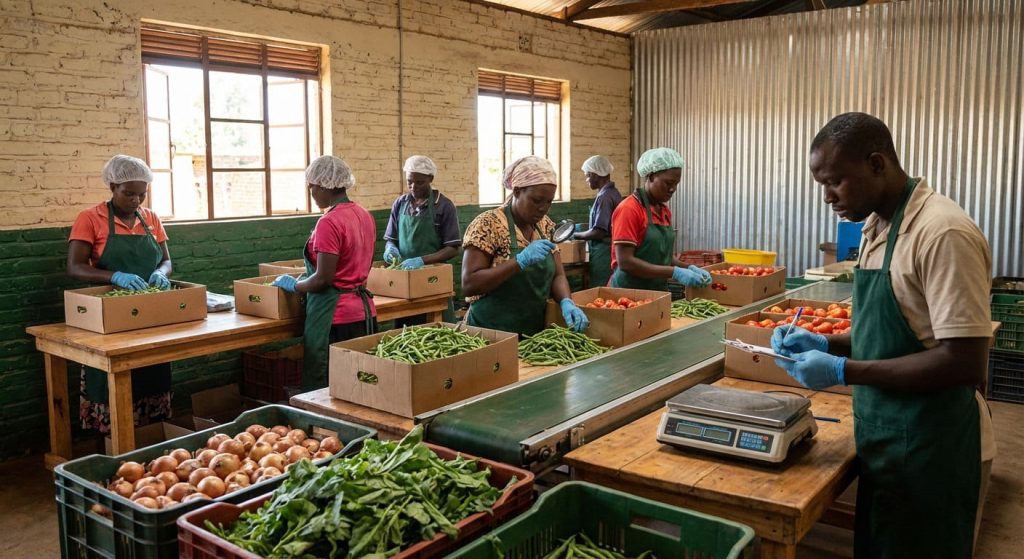
| GlobalG.A.P. (good agricultural practices) | Standard for farms (fruit, vegetables, etc.) ensuring practices that respect hygiene, the environment and worker welfare. | Strongly recommended for exporters of fresh produce to the EU. For example, many mango and pineapple exporters in West Africa are GlobalG.A.P. certified in order to access European supermarkets. |
| HACCP (food safety) | Hazard analysis and critical control points system. | Mandatory in the EU for agrifood businesses. Prevents contamination risks throughout the production process. |
| Fair trade, organic and other labels | Sustainability certifications (Fairtrade, organic farming, Rainforest Alliance…) | Give access to niche markets with high added value, with price premiums (e.g. +$240 per tonne Fairtrade premium for certified cocoa). |
Adopting these standards requires an initial investment (training, equipment, upgrades).
Nevertheless, the benefits are multiple: fewer export batch rejections (and therefore cost savings), better selling prices, access to new buyers, and enhanced credibility with financial institutions. A certified SME represents lower risk for a lender.
Increasingly, public programmes are encouraging these quality improvement processes. For example, the United Nations Industrial Development Organization (UNIDO) and ECOWAS have implemented a West Africa Quality Programme that has already helped modernise 25 companies in the region with a view to obtaining ISO 9001 and ISO 22000 certification.
Complying with international standards is no longer merely a constraint: it is a genuine competitive opportunity.
Leaders of agrifood SMEs have every interest in integrating these standards as soon as possible to sustain and develop their international activities.
2. Certifications & financing by sector
Certification needs and financing mechanisms vary according to the agricultural sector.
We review five major sectors in West Africa – cocoa, mango, cashew, processed products and local cereals – highlighting for each the key standards to meet and the financing available.
Cross-cutting financing available.
Several financial mechanisms benefit all agrifood sectors:
At the regional level, the ECOWAS Bank for Investment and Development (EBID) approved in January 2024 a credit line of
$70 million (CFAF 40 billion) dedicated to agro-industrial SMEs in five West African countries. This financing, disbursed through local banks, aims to increase agricultural production, improve value chains and strengthen food security in the sub-region.
In Senegal, the government launched an ambitious programme at the end of 2024 for “large-scale and secure” SME financing, with the objective of increasing annual credit to SMEs from CFAF 500 billion in 2023 to CFAF 3,000 billion over the 2024–2028 period. Already, 57 Senegalese agricultural SMEs have obtained loans totalling CFAF 440 million through this partnership in 2024.
Cocoa: sustainability standards and support funds
Cocoa is an economic pillar in Côte d’Ivoire and Ghana, which together account for more than 60% of global production.
In 2023, Côte d’Ivoire produced nearly 1.9 million tonnes of beans, approximately 40% of the world harvest. Ghana is targeting 700,000 tonnes in 2024/25 following a cyclical decline.
The EU imports this West African cocoa in large quantities, generating CFAF 2,018 billion in export revenue for Côte d’Ivoire in 2023.
To access international buyers and achieve better prices, the cocoa sector has had to embrace sustainability certifications.
The main standards are the Fairtrade label, Rainforest Alliance (which has integrated UTZ) and the organic label.
Approximately 22% of global cocoa is now sustainably certified. Fairtrade guarantees, for example, a minimum price of $2,400 per tonne and a premium of $240 per tonne. Rainforest/UTZ focuses on good agricultural and environmental practices.
Thousands of Ivorian and Ghanaian farmers are members of certified cooperatives.
On the financing side, the cocoa sector benefits from specific mechanisms.
Côte d’Ivoire and Ghana introduced a living income differential (LID) of $400 per tonne in 2019.
National support funds exist: the Conseil Café-Cacao (Côte d’Ivoire) and Cocobod (Ghana).
International projects such as ACI II (World Bank) and EU-WCF (World Cocoa Foundation) finance quality and traceability.
Specialised microfinance institutions also offer campaign loans.
Mango: export quality and partnerships
Mango from West Africa is highly sought after on the international market.
In 2023, Ghana exported approximately $55 million worth of fresh and dried mangoes.
To succeed in exports, GlobalG.A.P. certification is mandatory for farms supplying the EU.
For example, in Ghana, an association had 63 orchards GlobalG.A.P. certified in 2021.
In Senegal, producer groups have been trained and certified through international projects.
Cashew: the rise of local processing
Cashew is a flagship product in West Africa. Côte d’Ivoire is the world’s leading producer
with 1,150,000 tonnes forecast for 2025.
Government objective: achieve 50% local processing by 2030. Investments of $24 million have enabled new processing plants to be launched in 2024. For export, ISO 22000 or BRC Food certification is recommended.
Processed products: quality requirements and regional opportunities
Processed agrifood products (juices, jams, preserves…) require HACCP, ISO 22000 or BRC/IFS certification.
SMEs such as Blue Skies Ghana and SENICO Senegal export thanks to these certifications and the support of local or international funds.
The regional ECOWAS market is opening up with the AfCFTA (African Continental Free Trade Area).
4. Logistics & customs: exporting from West Africa
Exporting agrifood products does not stop at production certifications: goods must also be transported from the field to the foreign customer in good condition. For SMEs in West Africa, navigating logistics and customs challenges is a decisive step in the value chain. Fortunately, significant progress has recently been made to facilitate trade from West African ports.
Port infrastructure being modernised.
The region’s ports – Dakar (Senegal), Abidjan (Côte d’Ivoire), Tema/Takoradi (Ghana), Lagos-Apapa and Tin Can Island + Lekki (Nigeria) – handle the bulk of export flows. Aware of their vital role, governments have invested to increase capacity and reduce bottlenecks.
For example, the Port of Abidjan inaugurated a second container terminal (CIT) at the end of 2022, a project worth CFAF 596 billion, 85% financed by China. This new terminal can now accommodate larger vessels directly from Asia or Europe, and brings the port’s capacity to 3 million TEU per year, up from 1.2 million previously. It transforms Abidjan into a genuine regional transshipment hub.
For its part, Nigeria commissioned the Lekki Deep Sea Port in Lagos in 2023, the most modern in the country. Capable of receiving container ships of 14,000 TEU, Lekki Port is targeting an annual throughput of 2.7 million TEU at full capacity. This will relieve congestion at Lagos’s existing ports and accelerate shipments.
Senegal, meanwhile, has launched construction of the mega-port of Ndayane, and in the meantime has optimised the container terminal in Dakar (quay extensions, new gantry cranes).
Cold chain and appropriate handling.
For perishable products (fruit, vegetables, fresh products), having a reliable cold chain through to loading is crucial. Notable improvements have been made.
In Dakar, a specialised terminal for temperature-controlled products is being planned, and private cold-storage warehouses have already been established near the port and airport.
In Abidjan, the port operator has increased the number of reefer container plugs and opened an agro-industrial logistics centre near the port in 2021. Road hauliers are also equipping themselves with refrigerated trucks to link production zones to ports without any break in the cold chain. A concrete example: the mango campaign in Mali/Senegal uses a “mango route” whereby refrigerated trucks transport mangoes to the port of Accra or Abidjan within a few days, ensuring better quality on arrival in Europe than before.
For non-perishable products, bulk handling (cocoa, cashew) remains possible, but increasing containerisation is being observed for traceability and flexibility reasons (sealed containers can be directly inspected at destination ports, facilitating customs clearance).
Customs procedures: towards a single window.
Export administrative procedures have been progressively digitalised. The objective, supported by the WCO and ECOWAS, is to implement single windows for foreign trade in each country.
As of 1 January 2024, an international standard (the IMO’s FAL Convention) makes it mandatory for ports to implement single window systems. In practice, online platforms such as ORBUS in Senegal, GUCE in Côte d’Ivoire, or the Trade Hub portal (under development in Nigeria) allow exporters to submit all documents just once (phytosanitary certificate, certificate of origin, commercial invoice, bill of lading, etc.), which are then distributed to the various agencies (customs, ministry of agriculture, health, etc.) for validation.
This drastically reduces back-and-forth exchanges and processing times. For example, in Benin, the adoption of the electronic single window made it possible to consolidate around thirty services into a single entry point and saved several days in the process.
For SMEs, fewer administrative hassles mean cost savings and less risk of goods being delayed and deteriorating.
Export regulations and import standards.
Before exporting, it is essential to verify compliance with the requirements of the target country. The EU requires, for example, that products of animal origin (meat, dairy products) may only come from countries and establishments previously approved – yet only 3 African countries held this authorisation in 2024.
For plant-based products, a national phytosanitary certificate is required, attesting that the shipment is free from diseases or harmful organisms (essential, for example, for mango with regard to fruit fly).
Exporters must also comply with the quotas and regulations of their own countries: some countries restrict the export of strategic raw materials to encourage local processing (e.g. Côte d’Ivoire reserves a period at the start of the campaign during which only local processing plants may purchase cashew nuts).
Being well acquainted with these rules avoids committing violations. On the transport side, SMEs are advised to work with freight forwarders specialising in agrifood, who are experienced in managing reefer containers, careful stuffing (palletisation, securing) and export documentation. This comes at a cost, but the efficiency and reduction in the risk of customs disputes make it worthwhile.
Transport costs and lead times.
Shipping a 20-foot container from Abidjan to Antwerp takes approximately 15 days of sea transit, and from Lagos to Rotterdam around 20 days (with stopovers). To this must be added inland pre-carriage and customs clearance time. Costs can range from $1,500 to $3,000 per container depending on the destination and the season, excluding inland costs.
SMEs must factor these lead times and costs into their commercial negotiations (choice of Incoterm, e.g. FOB vs CIF). Recent global logistics disruptions (post-Covid congestion, soaring container prices in 2021) have highlighted the importance of diversifying routes and remaining flexible. Some West African exporters have begun using alternative ports as the situation demands: for example, cashew shipments from northern Ghana depart via Lomé (Togo) to save time.
In summary, export logistics in West Africa are improving rapidly, driven by investments in ports, the digitalisation of customs, and growing awareness of the need for cold chain management. SME managers must keep abreast of these developments and make the most of them: a container shipped without incident means faster cash inflows and the satisfaction of a well-served international customer. The ultimate goal is for exports from Dakar, Abidjan or Lagos to become almost as smooth as from Antwerp or Shanghai – and efforts to that end are certainly under way.
5. FAQ – Frequently asked questions
What is the cost of an agrifood certification?
Answer: The cost depends on the type of certification, the size of the business and the existing level of preparedness.
To give rough figures, a basic certification such as implementing a HACCP plan can cost a few thousand euros (CFAF 2 to 5 million).
A full ISO 22000 certification for a medium-sized processing plant may require €5,000 to €10,000 (CFAF 3 to 6.5 million) over 6 to 12 months.
GlobalG.A.P. certification for a farm can cost a few hundred euros, plus any necessary investments (CFAF 1 to 3 million).
Labels such as Fairtrade or Rainforest Alliance involve annual fees and audit costs, again in the order of a few thousand euros for a cooperative.
It is often possible to reduce the bill by seeking group certification.
Advice: Before embarking on the process, have a compliance audit carried out by an expert to accurately estimate the gaps to be addressed and therefore the budget required.
Which bodies issue certifications?
Answer: Certifications are issued by accredited certification bodies: Bureau Veritas, SGS, TÜV, AFNOR, DQS, Ecocert…
For GlobalG.A.P.: Control Union, NSF, Bureau Veritas, etc.
For Fairtrade, Rainforest Alliance and organic labels: FLOCERT, Ecocert.
For official approvals (EU export of animal products), it is the state veterinary and phytosanitary services that inspect and approve.
National standardisation bodies (ASN in Senegal, NAFDAC in Nigeria, CODINORM in Côte d’Ivoire) can support compliance or issue national labels.
Are there financial aids available for certification?
Answer: Yes, many aids exist, as governments and development partners actively encourage SME certification.
Examples: grants from the West Africa Quality Programme (WAQP, ECOWAS and EU), the Bureau de Mise à Niveau in Senegal, the Quality Support Fund in Côte d’Ivoire, the World Bank, the AfDB, USAID.
Reduced-rate “upgrading” loans also exist through certain banks.
It is recommended to contact the export promotion agency or chamber of commerce in your country to identify the schemes currently available.
How long does it take to obtain a certification?
Answer: Depending on the certification, the timelines are as follows: 3 to 6 months for HACCP in a small unit, 6 to 12 months for ISO 22000 or ISO 9001, one agricultural season (6 to 9 months) for GlobalG.A.P., 4 to 8 months for Fairtrade or Rainforest Alliance, and 2 to 3 years for organic conversion.
The process includes the audit, correction of non-conformities, and annual or triennial renewal depending on the label.
Which certifications are required to export to the EU?
Answer: For fresh fruit and vegetables: GlobalG.A.P. is virtually indispensable. For processed food products, a validated HACCP plan is required, and often ISO 22000 or IFS/BRC certification. For cocoa, coffee and cashew, holding a sustainability label (Fairtrade, Rainforest Alliance…) is an advantage. The EU will require deforestation-free traceability by 2025 for cocoa, coffee, palm oil, etc. For products of animal origin, the country and the establishment must be approved by the EU.
How do you find partners and customers after certification?
Answer: Attend specialist trade fairs (SARA Abidjan, FIARA Dakar, SIAL…), register on platforms (ITC Trade Portal, West Africa Connect), join sector associations, highlight your certification in your communications, and seek support from local export advisers.