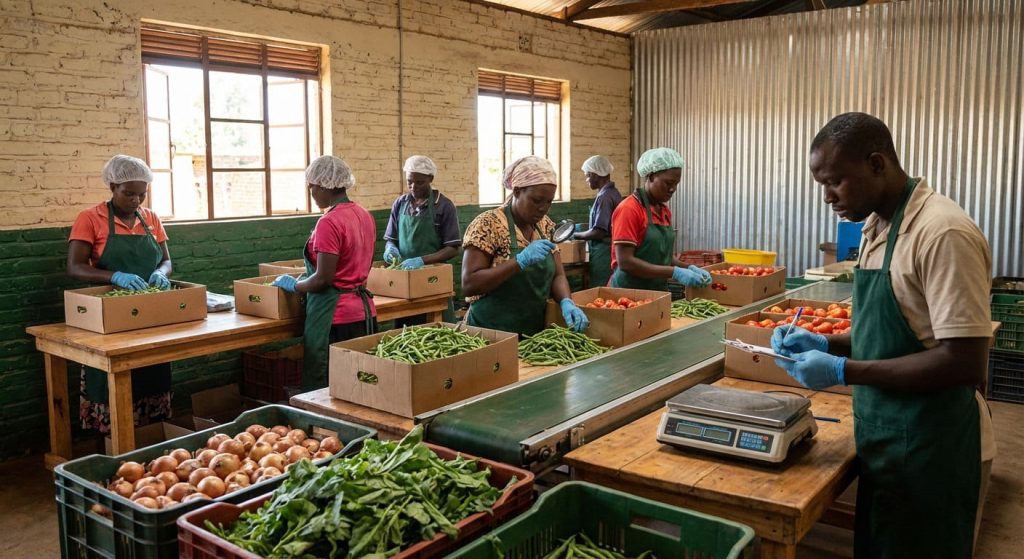
Exporting fresh fruit and vegetables to the European Union (EU) requires far more than simply good-quality produce. African SME managers active in this trade must comply with strict standards.
Among these standards, GlobalG.A.P. certification has become a non-negotiable requirement. Without it, many European importers flatly reject shipments, even when the products themselves are excellent.
Why such a demand? What does the certification actually offer? How do you obtain it, and what does it cost? This article gives you a thorough overview of why GlobalG.A.P. is the key to accessing European markets when you export mangoes, pineapples, green beans, avocados, papayas, or fresh peppers.
We begin by explaining what GlobalG.A.P. certification is and why it has become indispensable for exports to Europe. We then compare it with other standards such as GRASP, BRC, and ISO 22000, before looking at concrete examples from West Africa (Côte d’Ivoire, Sénégal, Burkina Faso, Bénin).
We also cover the certification process, how long it takes, and what it costs. A frequently asked questions (FAQ) section at the end addresses the most common queries from exporters.
What is GlobalG.A.P. certification?
GlobalG.A.P. (Good Agricultural Practices) is a private, voluntary framework of good agricultural practices covering food safety, traceability, environmental sustainability, and worker welfare on farms. In practice, it is a set of international standards that producers must meet, backed by rigorous controls. GlobalG.A.P. certification applies in particular to fresh fruit and vegetables (versions also exist for aquaculture, flowers, and other sectors).
By meeting these standards, a producer demonstrates that they have put in place a documented system of good agricultural practices covering every stage of production (responsible pesticide use, farm hygiene, worker health and safety, environmental protection, and so on).
Over the years, GlobalG.A.P. has established itself worldwide as a mark of quality and trust in the fresh produce sector. In 2023, more than 194,000 certified producers across 137 countries underscored the global reach of this standard.
Across Africa, many horticultural operations have adopted GlobalG.A.P. to access international markets. The certification is valid for one year and must be renewed annually through a follow-up audit. Each certificate is issued for a specific product (such as mango, pineapple, or green bean) and confirms that the entire production chain for that product meets the required good practices.
Why is GlobalG.A.P. certification essential for exporting to Europe?
In the European market, GlobalG.A.P. certification has become a near-mandatory prerequisite for fresh fruit and vegetables. While no law requires it, it is a commercial condition: major importers and supermarket chains make it a condition of purchase.
According to sector experts, private certifications such as GlobalG.A.P. “are not optional in the European market. If you want to be taken seriously as a supplier, you need to guarantee a safe, sustainable product and a socially responsible company.”
Put plainly, an uncertified producer or exporter will struggle enormously to find buyers for their goods in the EU, even if the harvest is of good gustatory or sanitary quality.
The reason for this demand is that GlobalG.A.P. gives buyers a third-party guarantee that good agricultural practices have been followed. A European importer buying GlobalG.A.P.-certified mangoes or green beans knows that the products were grown to strict food safety standards, with reduced pesticide residues and reliable traceability. They can then resell those goods to supermarkets with confidence.
For European retailers, GlobalG.A.P. is even regarded as the “minimum standard” required to supply major chains. This expectation sits within a broader context where food safety, sustainable development, and social responsibility have become paramount — both for consumers and, by extension, for professional buyers.
In practice, without GlobalG.A.P. certification, many importers will turn away a shipment on arrival in Europe, or will simply not sign a purchase contract in the first place. A certified producer, by contrast, has a far better chance of building lasting commercial relationships.
Studies have shown that GlobalG.A.P. certification leads to higher export revenues for producers who adopt it, by opening access to premium markets and enabling them to negotiate better prices. In short, GlobalG.A.P. acts as a passport into the European market for fresh fruit and vegetables.
GlobalG.A.P. vs other certifications: GRASP, BRC, ISO 22000…
There are many standards and certifications in the agrifood sector. Where does GlobalG.A.P. stand in relation to some of them? The comparative table below summarises the differences between GlobalG.A.P. and three other frameworks that are frequently mentioned: GRASP, BRCGS (formerly BRC), and ISO 22000.
| Certification | Focus / objective | Scope | Duration & validity |
|---|---|---|---|
| GlobalG.A.P. | Good agricultural practices (quality, food safety, environment, workers) | On-farm production (fruit, vegetables, etc.), before the packing stage | Farm certificate, valid for 1 year (annual audit) |
| GRASP | Social module (GlobalG.A.P. add-on): working conditions, employee rights | Voluntary assessment on farms in addition to GlobalG.A.P. | Assessment conducted alongside the GlobalG.A.P. audit (annual validation) |
| BRCGS (BRC) | Food safety and quality (GFSI-recognised standard) | Agrifood processing and packing (packing stations, factories) | Processing site certificate, audited every 6 to 12 months depending on results |
| ISO 22000 | Food safety management system (formalised HACCP approach) | Any organisation in the food chain (from production to distribution) | Management system certification, 3-year cycle with annual surveillance audits |
In short, GlobalG.A.P. is aimed primarily at agricultural producers and forms the foundation for demonstrating compliance with good on-farm practices. GRASP complements it on social aspects at farm level (it is of particular interest to buyers attentive to supplier social responsibility). BRCGS and other food safety standards (IFS, FSSC 22000 derived from ISO 22000, etc.) target processing, packing, and distribution stages, and are often required by customers for packing stations or factories exporting to the EU.
A fresh fruit and vegetable exporter in Africa will therefore frequently need to combine GlobalG.A.P. (for production) with, for example, a BRCGS or HACCP certification for their packing facility, and possibly social modules (GRASP, SMETA, etc.) depending on buyer requirements.
African exporters: the example of Côte d’Ivoire, Sénégal, Burkina Faso, and Bénin
Many francophone West African countries have successfully built fresh fruit and vegetable export industries to Europe over recent decades. These successes have been built largely on the adoption of quality standards, GlobalG.A.P. in particular, in order to meet European market expectations.
Côte d’Ivoire: The leading mango exporter in West Africa, Côte d’Ivoire shipped more than 40,000 tonnes of mangoes in 2024, a historic record. The country also exports pineapples and bananas to Europe. Almost all major mango plantations and packing stations are now GlobalG.A.P.-certified (or in the process of becoming so), because European buyers require it.
As far back as the 2010s, around 70% of exported mangoes came from certified producers, and that share has only grown since. Without certification, Ivorian exporters are shut out of European supply chains — which explains the major push to certify Ivorian mango orchards.
Sénégal: Sénégal has specialised in exporting fresh vegetables to Europe, notably green beans, sweet corn, and peas, as well as off-season mangoes. In 2024/2025, Sénégal exported around 15,000 tonnes of green beans and more than 700 tonnes of fresh peppers, almost entirely to the EU. Reaching these volumes required Senegalese producers to organise and adopt international standards.
In 2023, an estimated 40 Senegalese horticultural companies were certified (GlobalG.A.P., organic, Tesco Nurture, BRC, etc.). Meeting standards such as GlobalG.A.P. has enabled Sénégal to become the 4th-largest supplier of green beans to the EU. Senegalese cooperatives and exporters that invest in certification see their export season lengthen and their products command better prices in the European market.
Burkina Faso: Through its mango sector (both fresh and dried), Burkina Faso has risen to become one of Africa’s leading exporters. Between 2019 and 2023, Burkinabè mango exports generated an average of 17.18 billion FCFA per year (around 30 million USD), with a record of 22.1 billion FCFA in 2022. This success is partly built on the adoption of quality standards. Burkinabè mangoes destined for Europe are almost all produced under controlled regimes (GlobalG.A.P., organic, or fair trade).
GlobalG.A.P. certification is actively promoted by local development projects to help smallholder farmers access international markets and avoid rejections linked to quality or compliance issues.
By building capacity (training in good practices, fruit fly control, traceability), Burkina Faso has significantly reduced post-harvest losses and earned the trust of importers.
Bénin: The Beninese pineapple sector also illustrates the positive impact of certification on access to the European market. In 2023, FENACOPAB — a federation of pineapple producer cooperatives — obtained GlobalG.A.P. certification alongside the commissioning of a modern grouping and packing centre. The results were immediate: FENACOPAB became the country’s leading pineapple exporter, accounting for 50% of volumes exported in 2023, with 417 tonnes shipped that year.
Crucially, certification gave its producers access to new outlets for more than 2,000 tonnes of pineapples, at prices well above what they had previously achieved.
The quality of Beninese pineapples is now recognised on the international market, and producers have increased their income while reducing rejection and loss rates. This Beninese example shows that investing in compliance (GlobalG.A.P. and beyond) can transform a sector and make it competitive over the long term.
Cost and process of GlobalG.A.P. certification
Getting started with GlobalG.A.P. certification requires solid preparation. It is advisable to allow 6 to 12 months to upgrade practices, train staff, document all procedures, and carry out internal audits before the official audit.
The process generally unfolds in several stages: registration with an approved certification body, implementation of good practices (often with the help of guides or consultants), an initial on-site audit by an accredited auditor, correction of any non-conformities, and then issuance of the certificate. Once certified, a renewal audit is required every year to maintain the certification.
The cost of certification varies depending on the size of the operation, the number of products certified, and the country. Estimates suggest that the total cost for an individual agricultural SME can range from €1,000 to €2,500 per year. This includes GlobalG.A.P. registration and licence fees (ranging from €51 to a few hundred euros per certificate), the certification body’s fees (for the audit), and compliance costs (improvements to the farm, training, etc.).
Costs can be higher if the certifying body must travel from abroad (travel expenses) or if the operation is complex. In Sénégal, for example, one practical guide estimated initial setup costs at around 4 million FCFA (approximately €6,000), plus 1 million FCFA per audited site annually (≈€1,500).
These figures may seem significant, but many producers view certification as a necessary investment to access higher-value markets.
Support and assistance are available for SMEs seeking certification. Public programmes or development partners (international organisations, NGOs) sometimes offer subsidised training, mock audits (pre-audits), or even co-financing for certification, recognising that it strengthens the competitiveness of local agricultural sectors.
In Bénin, for instance, the Fonds National de Développement Agricole (FNDA) co-financed the GlobalG.A.P. certification project for pineapple cooperatives, with a dedicated budget of 74,000 CHF (Swiss francs) to set up a packing centre and support producers. This type of initiative reduces the financial burden on small farms and eases their path to compliance.
Once certified, a farm must maintain good practices consistently. Unannounced inspections can take place, and any serious breach — such as exceeding pesticide residue limits or failing to keep records up to date — can result in suspension of the certificate. The key to lasting success lies in continuous improvement: certification is not an end point, but an ongoing process for maintaining buyer confidence.
The benefits in return include access to a larger pool of customers, reduced risk of shipments being rejected at European borders for non-compliance, and often greater operational efficiency on the farm (thanks to the organisation and planning that GlobalG.A.P. requires).
Frequently asked questions (FAQ) on GlobalG.A.P. certification
What exactly is GlobalG.A.P. certification?
GlobalG.A.P. is a private “good agricultural practices” framework covering agricultural production from the farm through to the harvested product (before processing). It sets standards for food safety, traceability, environmental protection, and working conditions on the farm. Obtaining the certification means that a producer meets these standards and has been verified by an independent certification body.
Is GlobalG.A.P. certification mandatory for exporting to the European Union?
Legally, no — no European law explicitly requires GlobalG.A.P. certification to import fresh fruit and vegetables. In commercial terms, however, it has become virtually unavoidable. The vast majority of importers and distributors in Europe require it from their suppliers. Without GlobalG.A.P. or an equivalent, accessing European supermarkets is extremely difficult. In that sense, it is a de facto requirement if you are targeting the European market.
What is the difference between GlobalG.A.P. and organic or fair trade certifications?
GlobalG.A.P. focuses primarily on food safety and good agricultural practices, without prohibiting the use of chemical products (though it regulates them strictly). Organic farming certification, by contrast, bans synthetic pesticides and fertilisers; it follows a different set of requirements and official regulations. Fair trade certification (Fairtrade, for example) centres on commercial and social conditions (minimum prices, producer premiums, working conditions), but does not directly address food safety. It is common for a single farm to hold GlobalG.A.P., organic, and fair trade certifications simultaneously, in order to access multiple market segments. These certifications are complementary.
How long does it take to obtain the certification?
The preparation time depends on the current state of your operation. If many new practices need to be put in place (building washing areas, training staff, documenting procedures, etc.), this can take several months. In general, producers spend between 6 months and a year preparing before the certification audit. The audit itself takes a few days. If non-conformities are minor and quickly corrected, the certificate can be issued within a few weeks. A pre-audit mock inspection is strongly recommended.
What is the annual cost of maintaining the certification?
Beyond the initial costs (which are often higher in the first year), recurring expenses need to be budgeted for. These include the annual audit fee (between €800 and €2,000), the GlobalG.A.P. licence fee (from a few tens to a few hundred euros), and costs for training, document management, or corrective actions. The annual cost may represent a few percent of turnover, but it is often offset by better prices and greater commercial stability in export markets.
Article written in November 2025 – Links and figures are current as of the publication date. Check target market requirements periodically, as standards can change.