Karité: how to add value and export your production to the cosmetics industry
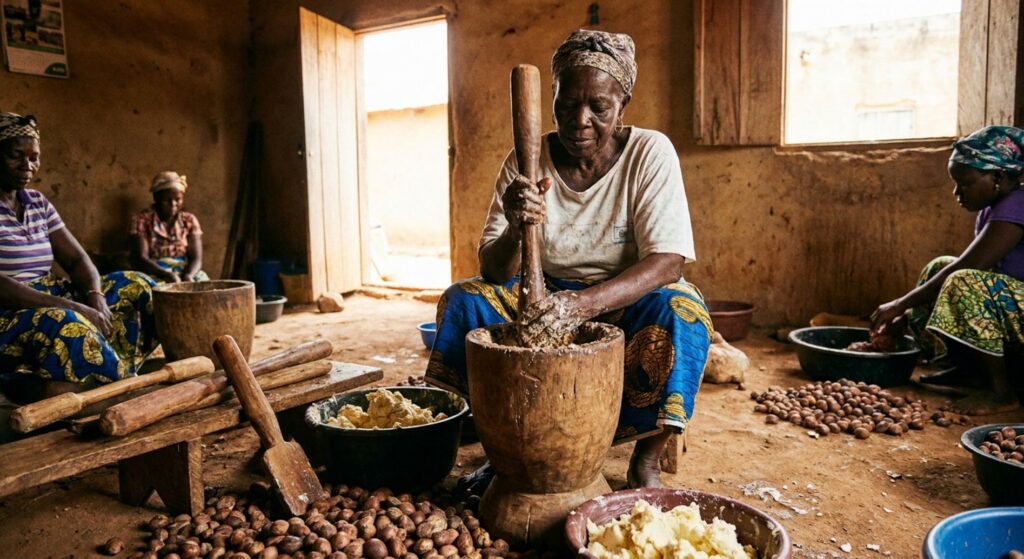
Shea butter has become one of the most sought-after natural ingredients in the global cosmetics industry. For African micro and small agrifood businesses, this growing demand is a concrete, high-margin opportunity to add value and break into export markets. Yet selling to cosmetics manufacturers requires far more than collecting nuts: controlled quality, appropriate certifications, sound logistics and a clear commercial positioning are what separate a one-off sale from a lasting partnership.
This article walks you through the steps to turn your karité production into a high-value exportable product. You will learn how to identify the most profitable outlets, meet industrial buyers’ requirements, move up the value chain through straightforward steps, and prepare your first exports without risking border hold-ups.
Contents:
- Market positioning and priority outlets for African karité
- What cosmetics manufacturers want to buy: the criteria that close deals
- Adding value and moving up the value chain: increasing your margin on karité
- Export preparation: certifications, standards and logistics
- Profitability and commercial organisation: landing your first contracts
Market positioning and priority outlets for African karité
The global shea butter market reached approximately USD 99 million in 2023 and could exceed USD 259 million by 2031. This average annual growth rate of 12.8% puts karité among the most dynamic vegetable fats in the natural segment. For an African small business, knowing where the highest-paying buyers are prevents you from selling to the wrong segment.
Three tiers of outlets are available to African producers and processors. Each comes with different requirements and margins.
Local and sub-regional cosmetics manufacturers
Cosmetics manufacturers in West Africa represent a first, accessible outlet. They look for crude or semi-refined butter in moderate volumes. The most in-demand formats are 25 to 50 kg drums. These buyers generally accept less stringent specifications than European industrials. Geographic proximity cuts logistics costs and shortens payment terms.
International cosmetics manufacturers
The European shea butter market exceeds USD 800 million in 2025, with projections beyond USD 1.5 billion by 2032. European and North American manufacturers mainly buy refined butter that meets COSMOS or Ecocert standards. They favour annual B2B contracts with regular multi-tonne volumes.
The formats these buyers require vary according to their positioning. Listed below in ascending order of processing level:
- Dried karité nuts: raw material for industrial refiners
- Unrefined crude butter: sought for “authentic” and artisanal product lines
- Refined deodorised butter: the standard for industrial cosmetic formulations
- Karité olein and stearin: separated fractions for specific technical applications
High-value-added niches
Some buyers pay a significant premium for differentiating characteristics. Fairtrade-certified fair trade enables selling prices 20 to 40% higher than conventional butter. Organic certification opens the door to fast-growing “clean beauty” brands. Traceability back to the producing village appeals to brands that communicate on the social impact of their sourcing.
What cosmetics manufacturers want to buy: the criteria that close deals
Industrial buyers evaluate shea butter against precise technical parameters. Mastering these criteria means you avoid rejected shipments and can negotiate a higher price. Below are the key parameters that determine access to cosmetics markets.
Physico-chemical quality
The acidity level is the primary selection criterion. Codex Alimentarius standards set a maximum of 6% for crude butter and 0.3% for refined butter intended for food and cosmetic applications. A high level signals oxidation or poor storage of nuts before processing.
≤ 0.3%
≤ 1%
≤ 3%
≤ 6%
Residual moisture must stay below 0.05% for refined butter. Excess moisture encourages microbial growth and accelerates rancidity. Insoluble impurities must not exceed 0.1% in cosmetic-grade butter.
Stability and shelf life
Cosmetics manufacturers require guaranteed oxidative stability over 12 to 24 months. The peroxide value measures the level of primary oxidation. A quality butter has a peroxide value below 10 meq/kg. Packaging under an inert atmosphere (nitrogen) significantly extends shelf life.
Traceability and volume consistency
Traceability is an increasingly decisive criterion. Buyers want to know the precise geographic origin, the collection and processing methods, and the production dates. This transparency meets the expectations of end consumers and European regulatory requirements.
Supply consistency matters as much as quality. A manufacturer would rather work with a supplier who can deliver 5 tonnes per month for 12 months than one who offers 60 tonnes in a single delivery. This consistency requires rigorous organisation of collection and storage.
- Required documentation: certificate of analysis, safety data sheet, certificate of origin
- Tests required: acidity, peroxide value, moisture, melting point, Lovibond colour
- Control frequency: on every batch for new suppliers, then on a sampling basis
Adding value and moving up the value chain: increasing your margin on karité
Selling raw nuts generates the lowest margin in the value chain. Each additional processing step raises the selling price and reduces dependence on fluctuations in world prices. Below are the levers available to African small businesses to move up the value chain.
From crude to refined: the price gap
Refining shea butter multiplies the selling price by two to three times depending on final quality. Grade A crude butter trades at around USD 2 to 3/kg on international markets. Refined deodorised cosmetic-grade butter reaches USD 5 to 8/kg.
→
Refined cosmetic butter
(×2 to ×3 on price/kg)
Refining requires investment in equipment and technical skills. A small-scale refining unit processing 100 kg per day costs between USD 5,000 and USD 15,000. Semi-industrial equipment capable of processing several tonnes per day requires investment of USD 50,000 to USD 200,000.
Packaging suited to target markets
Packaging is an often underestimated value-adding lever. Cosmetics manufacturers prefer standardised formats that simplify their internal logistics. Food-grade epoxy-lined metal drums of 190 kg are the industrial standard. Cartons of 20 to 25 kg with inner polyethylene bags suit smaller volumes.
For niche markets, small-format packaging (pots from 100 g to 1 kg) allows direct sales to specialist boutiques or e-commerce retailers. This positioning does, however, require investment in labelling, regulatory compliance and last-mile logistics.
Differentiation through certifications
Certifications open access to premium market segments. COSMOS certification by Ecocert guarantees that the butter meets European natural and organic cosmetics standards. This certification gives access to “clean beauty” brands posting double-digit growth.
Certified fair trade (Fairtrade) highlights the social impact of production. Studies show that consumers are willing to pay a premium of 10 to 30% for fair trade products in the cosmetics category.
Value through origin and storytelling
Certain geographic origins carry a stronger reputation. Karité from Burkina Faso, Ghana and Mali enjoys international recognition. Communicating on the precise origin, traditional collection methods and the role of women producers creates differentiation that is hard to replicate.
Export preparation: certifications, standards and logistics
Exporting shea butter to international cosmetics markets requires thorough preparation. Border hold-ups are usually the result of insufficient planning around documentation, standards or transport conditions. Here is how to secure your first exports.
Required certifications by market
The European Union applies regulation EC 1223/2009 on cosmetic products. Every ingredient must have a product safety information file. The US FDA requires that cosmetic ingredients be declared compliant with good manufacturing practices.
- European Union: regulation EC 1223/2009, safety assessment, CPNP notification
- United States: FDA compliance, no prior approval required but manufacturer’s liability applies
- Japan: PMDA notification for cosmetic ingredients, specific safety testing
- Africa: standards vary by country, generally less strict
Voluntary certifications such as COSMOS, Ecocert or Natrue are not legally required. They are, however, a commercial prerequisite for accessing brands positioned in the natural and organic space.
Export file and documentation
Every shipment requires a complete set of documents. A single missing document can hold goods at the border for several weeks.
- Certificate of origin: issued by the chamber of commerce in the exporting country
- Phytosanitary certificate: certifying the absence of plant pests and diseases
- Certificate of analysis: physico-chemical test results for the batch
- Commercial invoice: detailing quantities, values and terms of sale
- Packing list: describing the packaging of each shipping unit
- Bill of lading or airway bill: transport document
Logistics and packaging
Shea butter is sensitive to temperature fluctuations. Maritime transport in a standard container exposes the cargo to temperatures that can exceed 40°C in the hold. A refrigerated container (reefer) maintains a constant temperature but increases transport costs by 30 to 50%.
Packaging must protect the product against oxidation, moisture and contamination. Food-grade epoxy-lined metal drums are the standard for industrial volumes. Adding desiccant sachets and vacuum or nitrogen sealing extends shelf life.
Labelling compliant with target markets
Labelling requirements vary by local regulation. The European Union requires labelling in the language of the destination country, including the INCI name of the ingredient (Butyrospermum Parkii Butter), the country of origin, the batch number and the minimum durability date. The United States imposes similar requirements with specific formats.
Profitability and commercial organisation: landing your first contracts
The profitability of a karité export business depends as much on commercial organisation as on product quality. African small businesses must optimise their costs, structure their supply and build credibility with international buyers.
Reducing production costs
Nut collection costs often account for 40 to 50% of the cost price of crude butter. Organising through cooperatives or economic interest groups allows collection, storage and transport to be pooled. This pooling lowers the unit cost and improves negotiating power against intermediaries.
Planning nut purchases at the start of the season, when prices are at their lowest, significantly improves margins. Storing nuts in good conditions (ventilation, protection against moisture) preserves their quality for several months.
Financing and working capital needs
Exporting to cosmetics markets involves payment terms of 30 to 90 days after delivery. This gap between purchasing raw materials and receiving payment creates a significant working capital requirement. Suitable financing solutions include:
- Campaign credit: short-term bank loan to finance nut purchases
- Export factoring: assignment of receivables to a financial institution in exchange for early payment
- Buyer pre-financing: advance paid by the buyer against a delivery commitment
- Export guarantee funds: public schemes reducing the risk of non-payment
B2B pricing and negotiation
The B2B selling price must cover all costs: raw materials, processing, packaging, certifications, logistics, commercial margin and contingency provision. A transparent pricing structure reassures buyers and makes negotiations easier.
International trade terms (Incoterms) define who bears costs and risks at each stage of transport. FOB (Free On Board) transfers risk to the buyer from the moment of loading at port. CIF (Cost Insurance Freight) includes transport and insurance to the destination port.
Accessing first contracts
Trade shows are the most effective channel for meeting industrial buyers. In-Cosmetics (Europe), Cosmoprof (Italy, Asia) and SIAL (Paris) bring together decision-makers from the sector. Attending these events requires investment but generates qualified contacts that cannot be obtained any other way.
B2B sourcing platforms such as Tridge and Alibaba connect African suppliers with international buyers. A complete profile showing certifications, photos of facilities and available samples significantly increases quote requests.
FAQ
What minimum volume do cosmetics manufacturers require for a first contract?
Cosmetics manufacturers generally accept first orders of 500 kg to 2 tonnes to test a new supplier. This volume allows them to assess quality, consistency and reliability before scaling up orders. Some buyers first request samples of 1 to 5 kg for laboratory analysis.
How much does COSMOS certification cost for a small karité processing business?
COSMOS certification by an accredited body costs between EUR 2,000 and EUR 5,000 for initial certification, depending on audit complexity. Annual maintenance fees amount to approximately EUR 1,500 to EUR 3,000. These costs cover the on-site audit, documentary review and the right to use the logo.
How can shea butter quality be maintained during maritime transport?
Transport in a refrigerated container maintains a constant temperature between 15 and 25°C, which is ideal for preserving quality. Where this is not possible, packaging under an inert atmosphere (nitrogen), the use of airtight drums and avoiding periods of extreme heat all reduce the risk of deterioration.
What is the shelf life of refined shea butter?
Refined cosmetic-grade shea butter keeps for 24 to 36 months under optimal conditions. Storage away from light, heat and moisture in an airtight container preserves its properties. A low initial peroxide value guarantees better stability over time.
Do European buyers require organic certification for karité?
Organic certification is not legally required to sell shea butter in Europe. However, cosmetics brands positioned in the natural and organic space almost always require it. It is a decisive commercial advantage for accessing