
West African agrifood 2025: export opportunities for SMEs
Introduction
West Africa’s agrifood sector is growing steadily, driven by a young population and rapid urbanisation.
Close to 25% of regional GDP and 45% of jobs come from agriculture [World Bank, 2024].
SMEs play a key role, but must adapt to shifting urban demand and modern regulatory requirements. In 2024, West African cereal production is estimated at 73.7 million tonnes despite climate variability.
This guide is written for SME owners and covers several aspects of exporting.
You will find 2024–2025 data, comparative tables and charts. Every source is cited to ensure the reliability of the figures.
This guide is organised by major theme to support the growth of your agrifood SME as it exports from West Africa to European and Asian markets.
- 1 – Opportunities & standards
- 2 – Certifications & financing
- 3 – Product focus
- 4 – Textiles & crafts
- 5 – Logistics & customs
- Export FAQ
1 – Agrifood opportunities & standards by country
Each West African country offers distinct opportunities for agrifood SMEs in 2025.
Nigeria: More than 220 million consumers, the sub-region’s largest market. The agricultural sector accounts for close to 25% of GDP and 70% of jobs. Maize, rice and cassava production are strategic, driven by urban demand.
Côte d’Ivoire: The world’s leading cacao exporter, with the agrifood sector contributing around 20% of GDP. Urbanisation is boosting domestic consumption while exports of fruit (pineapple, mango, banana) are rising.
Ghana: Agriculture accounts for 20% of GDP. The country exports mangoes, pineapples and cacao to the EU and is developing high-value horticulture.
Senegal: The agrifood sector represents 15% of GDP and employs 22% of the working population. The country is focused on rice self-sufficiency and off-season fruit exports (notably mangoes).
Standards and regulations:
On the regulatory front, states are aligning their standards with international benchmarks. ECOWAS is harmonising agricultural standards across the region, drawing on the Codex Alimentarius.
To export to the EU, companies must comply with European phytosanitary regulations.
Every country is strengthening its sanitary and phytosanitary controls to meet EU export requirements (pesticides, traceability, hygiene). For instance, European standards require tropical fruit exporters to comply with strict chemical residue limits.
West African countries are also investing in national standards agencies (such as Nigeria’s NAFDAC or Codex Alimentaire Côte d’Ivoire) to guarantee quality and safety. Meeting these standards opens access to new markets, but requires SMEs to upgrade their operations (compliant packaging, certifications, etc.).
Regional regulatory alignment is gradually facilitating both intra-African trade and international trade, in line with the African Continental Free Trade Area.
| Country | Population (M) | Agriculture’s share of GDP | Key regulatory framework |
|---|---|---|---|
| Nigeria | 220 | ~25% | ECOWAS, Codex Alimentarius, EU standards |
| Côte d’Ivoire | 28 | ~20% | ECOWAS, Codex Alimentarius, EU standards |
| Ghana | 33 | ~20% | ECOWAS, Codex Alimentarius, EU standards |
| Senegal | 17 | ~15% | ECOWAS, Codex Alimentarius, EU standards |
Opportunities also differ from country to country:
In Nigeria, the focus is on import substitution (rice, dairy) and state-backed local agro-industry.
In Côte d’Ivoire, agropoles and industrial zones are being developed to process cacao, cajou and fruit locally.
In Ghana, high-value crops (horticulture, organic cacao) are on the rise, and agritech is playing a growing role.
In Senegal, programmes focused on food sovereignty (rice, onion) and off-season fruit exports to Europe are taking centre stage.
Across the board, growing urban demand is pulling the sector forward: by 2050, 60% of Africans will live in cities, driving consumption of fresh and processed products. SMEs that can serve these markets while meeting standards will hold a significant competitive edge in 2025.
2 – Agrifood certifications and available financing
To stand out and reach premium markets, West African agrifood SMEs are increasingly banking on quality certifications. The most sought-after labels include the Organic Agriculture (Bio) label for EU exports, HACCP/ISO 22000 certification for food safety, and GlobalG.A.P. for good agricultural practices (particularly in fruit and vegetables). These certifications give international and local buyers (supermarkets, hotels) confidence in the quality of the products.
For example, obtaining organic certification allows producers to sell at a price roughly 20% higher on export markets (ITC). Equally, a GlobalG.A.P.-certified mango producer can access European supermarket shelves that were previously out of reach. The upgrading process does come at a cost (staff training, hygiene improvements, external audits), but it is an investment that pays off quickly through access to new outlets and higher product value.
At the same time, financing is becoming more accessible for SMEs in the sector. Public and private programmes have been launched between 2024 and 2025 to support local agro-industry. For example, the Development Bank of Ghana (DBG) launched a $32.4 million programme in 2025 dedicated to agricultural loans for SMEs, with technical assistance included (DBG Ghana). In Senegal, the sovereign fund FONSIS is investing in women’s entrepreneurship: in January 2025, its WE! Fund injected 750 million FCFA into two innovative agrifood SMEs led by women. At the regional level, institutions such as the African Development Bank (AfDB) are deploying specific mechanisms: a pan-African programme launched in 2024 will support 180 agrifood SMEs in more than 20 countries to make them eligible for financing.
Local banks and investment funds are also turning their attention to agribusiness. In Nigeria, agricultural funds are targeting priority value chains (rice, maize, cassava) with dedicated envelopes (e.g. a $180 million fund announced in 2024 for strategic sectors). Credit guarantee schemes are multiplying (e.g. NIRSAL in Nigeria, which guarantees agricultural loans) to reduce the perceived risk for commercial banks. SMEs can now finance a new tractor, a fruit drying line or factory certification — things that were unthinkable just a few years ago.
| Country/programme | Amount & mechanism | Impact for SMEs |
|---|---|---|
| Ghana – DBG Agri SME | 500M GHS ($32.4M) in dedicated loans + technical assistance | Preferential-rate credit for agricultural inputs, processing and distribution |
| Senegal – FONSIS WE! Fund | 750M FCFA invested as equity (women entrepreneurs fund) | Financing for expansion of local factories (catering, organic juices), creation of women’s jobs |
| AfDB – Agri SME programme | Technical support for 180 SMEs in 20 countries (2024–2026) | Training and advisory services to make projects bankable, improved access to bank financing and investors |
| Nigeria – Special agri fund | 50bn NGN (~$130M) government fund (planned 2025) | Subsidised loans for agro-SMEs (rice, cacao, dairy), improved rural infrastructure (irrigation, storage) |
By combining certification and financing, African SMEs can move upmarket. For example, an Ivorian organic cacao cooperative that secures a loan for a processing unit will be able to export certified fair-trade chocolate, capturing far more value than it would by simply selling raw beans. SME managers must therefore know these labels and programmes, and use them as growth drivers in 2025.
3 – Product focus: cereals, fruit, cacao
This section examines three agrifood pillars of West Africa — cereals, tropical fruit and cacao — in terms of volumes, margins and the specific challenges facing each value chain.
Cereals: These are the dietary staple of the sub-region (maize, rice, sorgho, mil). In 2024, West African cereal production reached approximately 73.7 million tonnes (FAO). Despite a 2% increase on the five-year average, this volume is slightly below 2023 levels due to localised droughts and flooding. Nigeria alone accounts for 37% of this output, being the region’s largest producer of maize and sorgho. Cereals are a strategic food security issue: even a modest harvest shortfall sharply increases rice and wheat imports. Up to 49.5 million people could face acute food insecurity in West Africa if the trend is not reversed. That said, opportunities exist: urban demand for processed cereal products (fortified flours, packaged semolina, improved breads) is booming.
Tropical fruit: Mangoes, pineapples, bananas and other exotic fruit are a flagship sector for exports and for the premium local market. Ghana and Côte d’Ivoire are among Africa’s leading pineapple producers, with Ghana producing close to 800,000 tonnes annually. Mango has become an important export fruit, particularly out-of-season to Europe (March to June). Côte d’Ivoire, Mali, Senegal and Burkina Faso supply the bulk of fresh mangoes to the European market during this window. Opportunities also lie in processing: dried mangoes (in high demand on the European organic market), pineapple juice, jams and frozen fruit. In Ghana, non-traditional agricultural exports (including fruit) generated $3.8 billion in 2023 (Stats Ghana). Côte d’Ivoire exports large volumes of dessert bananas to the EU (more than 300,000 tonnes per year) thanks to investment in GlobalG.A.P.-certified plantations. The main challenge remains perishability: 30–40% of mangoes can be lost without proper logistics (cold chain, packaging). In 2025, the commercial margin on processed fruit can be substantial: for instance, 1 kg of dried mangoes yields 5 to 6 times the value of a kilo of fresh mangoes shipped in bulk.
Cacao: Côte d’Ivoire and Ghana together account for close to 60% of world cacao production (ICCO). Côte d’Ivoire produced around 2 million tonnes of beans in 2023/24, and Ghana around 500,000 to 650,000 tonnes after a difficult year. The cacao sector is a key export pillar (generating more than $8 billion in revenue for African farmers), but most beans are exported raw, with very little local processing. Yet the global chocolate market is estimated at $110 billion — ten times the value of African bean exports. This shortfall is driving on-site processing initiatives: both giants (Côte d’Ivoire and Ghana) are targeting at least 50% local grinding by 2030. In 2025, opportunities in the cacao sector also include derivative products (cacao butter cosmetics, plantation ecotourism) and sustainability labels (organic cacao, fair trade).
| Product | Annual volume (2024) | Leading country | Opportunities |
|---|---|---|---|
| Cereals (maize, rice, sorgho) | 73.7 million t | Nigeria | Processing, food security, import substitution |
| Tropical fruit (mango, pineapple) | >1 million t/year (West Africa total) | Ghana, Côte d’Ivoire | Export, drying, juice, organic fruit |
| Cacao | 2.5 million t | Côte d’Ivoire, Ghana | Local processing, sustainability labels, chocolate export |
Cereals, fruit and cacao together illustrate West Africa’s agricultural potential, while highlighting the importance of controlling value chains from end to end. SMEs that innovate in processing and local marketing of these products strengthen the region’s food resilience and tap into strong markets — from sachets of fortified infant flour to premium “West Africa origin” dark chocolate bars.
4 – Textiles, crafts and local added value
Agrifood development in West Africa is pulling other sectors along with it, including textiles and crafts, generating a genuine local circular economy. An unexpected connection? Not really. By making better use of agricultural raw materials and combining them with artisanal expertise, SMEs create products with strong local added value.
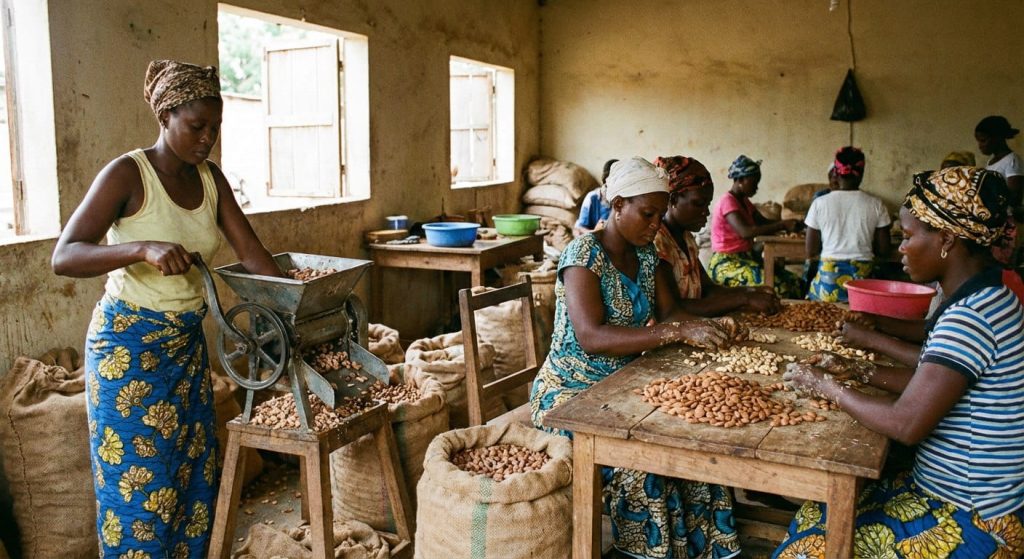
Artisanal and eco-friendly packaging is a concrete example. Women’s cooperatives in Burkina Faso make bags from jute fibre or local cotton to package cacao or coffee, replacing imported sacks. In Senegal, young entrepreneurs design packaging from recycled paper and pineapple fibres for local fruit juices, combining artisanal appeal with food-grade requirements. This kind of “made in Africa” packaging tells a story and attracts customers seeking authenticity, while keeping added value in the country.
The textile sector also benefits from synergies with agriculture: cotton, a major Sahelian export crop (Mali, Burkina Faso), can feed local textile and garment industries. A number of Ivorian and Ghanaian SMEs are making bags, aprons and clothing from local cotton and natural plant dyes (indigo, hibiscus). These items highlight the agriculture-craft link: for example, a woven fabric bag containing coffee or cacao is both packaging and a craftwork that can be showcased at trade fairs.
Trade fairs and international shows play a catalysing role in promoting this local added value. The Salon International de l’Agriculture et des Ressources Animales d’Abidjan (SARA) is a prime example: the 2023 edition attracted more than 320,000 visitors over 10 days, bringing together 800 exhibitors from 30 countries — farmers, craftspeople and agro-industrialists. SMEs present not only their raw products (e.g. cajou, mangoes) but also their processed goods and derivative items (textiles, cosmetics, crafts). These events generate significant economic spin-offs: at SARA more than 1,300 B2B meetings took place in 2023, leading to export contracts and technology partnerships. Likewise, the FIARA in Dakar (international agriculture fair) welcomes thousands of visitors each year and a host of artisans — leather workers using local hide, calabash sculptors, designers of adapted farming tools — who interact directly with farmers and entrepreneurs. These exchanges spur local innovation: an artisan might, for instance, design a better solar dryer for fruit after talking with mango producers at a show.
Finally, the impact on income and employment is worth highlighting. Local processing and crafts retain a greater share of wealth within rural communities. In Côte d’Ivoire, for example, an artisan chocolatier cacao sector is emerging: local chocolate makers are turning beans into bars sold through short supply chains (tourist shops, airports), which can multiply the revenue per kilo by three or four compared to selling raw beans. Agri-artisanal tourism is also developing: plantation visits with natural textile dyeing workshops, tastings and demonstrations of jam-making or shea butter production. This creates local employment, particularly for young people and women, and preserves traditional know-how (indigo dyeing, traditional weaving, basket-making) by giving it new outlets tied to agribusiness.
| Local initiative | Initial investment | Estimated benefits / ROI |
|---|---|---|
| Organic certification of a production (mangoes, cacao) | Training and audit costs (a few thousand €) | +20% on export price (average organic premium), access to new specialist markets |
| Participation in an international trade fair (e.g. SARA) | Stand rental, sample transport (~€2,000–3,000) | Direct commercial contacts (up to 1,300 B2B meetings at SARA 2023), post-fair partnerships and export orders |
| Investment in a local processing unit (mini-dairy, chocolate factory) | Equipment purchase, training (~€50,000 and above) | Product value x3 to x10 once processed: e.g. 1 tonne of cacao processed into chocolate ≈ 10× the value of raw beans; local job creation, market differentiation |
By combining agriculture, crafts and creative industry, West African SMEs are developing original models. This strengthens the made in Africa brand — an asset for standing out in a standardised global market. In 2025 more than ever, betting on local added value (whether through packaging design, the artisanal quality of a product or the cultural story it carries) is a recipe for success and sustainable growth for African SMEs.
5 – Logistics, customs and digitalisation
Logistics remains the critical challenge for agrifood SMEs in West Africa. Significant progress has been made in recent years, but hurdles remain in 2025: high transport costs, slow customs procedures and sometimes inadequate infrastructure.
On average, logistics costs in sub-Saharan Africa are 4 to 6 times higher than in other emerging economies. Shipping a container from the port to the interior of the country, for instance, costs far more and takes far longer than in Asia or Europe. The result: West African exporters see their products become more expensive and lose competitiveness.
The most common logistics bottlenecks include port congestion (notably in Lagos/Apapa, where ships could wait days to unload), slow and complex customs procedures, and poor road quality on some corridors linking production basins to ports. A shipping delay of several weeks can cause an export window to be missed, especially for perishable goods.
SMEs, with their limited resources, are particularly hard hit by delays and extra costs (unexpected storage fees, late penalties, etc.).
Fortunately, solutions are emerging. On the infrastructure front, new investments are changing the picture. In Nigeria, the Lekki deep-water port began commercial operations in 2023, with an initial capacity of 1.2 million containers per year. This modern port relieves congestion at Lagos and offers berths suited to larger vessels, cutting transit times and transhipment costs.
In Côte d’Ivoire, the port of Abidjan has opened a second container terminal and is breaking traffic records (40 million tonnes in 2024) thanks to these investments.
The Abidjan-Lagos corridor — which will connect five countries via a 1,080 km motorway — is being prepared to facilitate regional trade. Once completed, these projects will cut transit times and boost intra-community exchanges (a container will be able to travel from Dakar to Accra much faster than today).
At the same time, digitalisation is transforming logistics and customs. Electronic single windows for foreign trade are increasingly becoming the norm. The IMO (International Maritime Organization) required all ports to have electronic port windows in place before 2024, to speed up and standardise formalities.
In Senegal, the ORBUS platform allows operators to submit all import-export documents online, cutting down on administrative back-and-forth.
In Ghana, the shift to a paperless customs system and electronic tax payment has reduced clearance times from several days to a few hours in some cases (notably at Tema).
Côte d’Ivoire and Benin likewise use electronic GPS tracking systems for cargo and electronically seal containers to combat fraud and speed up transit.
Logistics startups are also part of this transformation. Platforms such as Kobo360 (Nigeria) or SEND (Côte d’Ivoire) connect shippers and carriers via mobile applications, optimising truck load capacity and negotiating rates transparently.
While some early movers have faced difficulties, the “uberisation” of freight transport is taking shape, reducing empty runs and cost per kilometre.
Other innovations, such as IoT solutions (temperature sensors in refrigerated trucks, satellite trackers), help SMEs guarantee the cold chain and give their customers real-time visibility on delivery status.
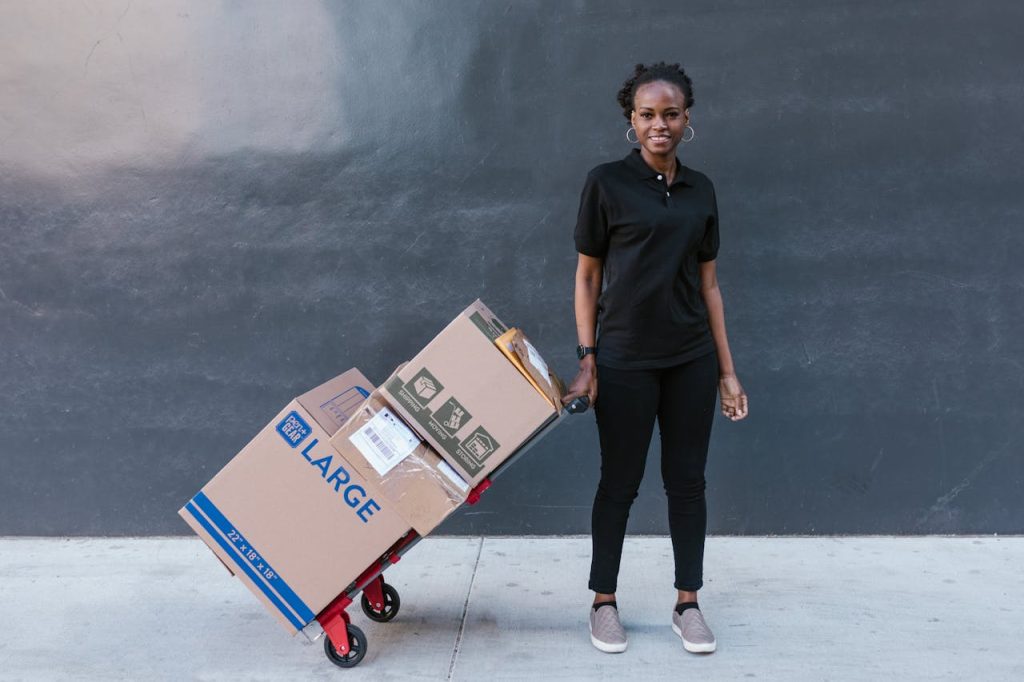
The improvements in companies’ internal logistics chains are also worth mentioning. In 2025, a growing number of SMEs are adopting computerised management systems for stock and orders, including in the agrifood sector. Simple tablet applications allow a mango exporter, for example, to track harvests village by village, organise collection by van via WhatsApp, and have instant visibility on their packed stock ready to ship to the airport.
This internal digitalisation boosts efficiency and reduces waste (collection routes are optimised, cardboard box requirements are anticipated, etc.).
At the customs level, training and equipment efforts are bearing fruit. Container scanners are multiplying at the ports of Abidjan, Lomé and Cotonou, speeding up inspections.
Customs officers now use mobile terminals for inspections, eliminating the long waits of the past. Electronic phytosanitary certificate procedures (e-Phyto) between pilot countries (Ghana, Senegal…) and the EU are being tested, which could eliminate delays caused by paper-based submissions.
Another step forward: the pooling of land border controls (juxtaposed posts) is beginning to take shape within ECOWAS to ease the flow of inter-state truck traffic.
| Logistics indicator | 2018 (approx.) | 2025 (target/progress) |
|---|---|---|
| Average export cost per container (20′) Abidjan–Europe | ~$2,200 (excluding inland costs) | Stable or slight ↓ (shipping competition + new terminals) |
| Average port dwell time (container clearance) | Lagos: >20 days Tema: ~7–10 days |
Lagos: 7–10 days (with Lekki) Tema: 5–7 days (modernised port) |
| Number of export documents (e.g. Nigeria) | >9 paper documents | 3–4 documents online (2025, with single window) |
| Inland road transport cost (€/km) | ~€2.5 per km (West Africa trucking) | ~€1.8 per km (with digital optimisation, better roads) |
| Cargo tracking | Manual / opaque | Real-time GPS traceability for clients (2025, via apps) |
West African logistics in 2025 is in the midst of a major shift. Investment in ports (such as Lekki in Nigeria and the Abidjan expansion) and road corridors is gradually reducing the region’s cost-time disadvantage.
Customs 2.0 and digital tools are bringing transparency and efficiency, benefiting above all the SMEs that were the first to suffer from the old bottlenecks.
There is still ground to cover before logistics standards match those of Asia or Europe, but momentum is building — and the most agile SMEs are already capitalising on it to deliver faster, at lower cost, from field to international shelves.
Export FAQ
What share of the West African economy does agriculture represent?
About 25% of West Africa’s GDP comes from the agricultural sector, which employs close to 45% of the region’s working population. It is a crucial economic and social pillar for countries such as Nigeria, Côte d’Ivoire and Ghana.
Which West African agrifood products dominate on the world market?
Cacao is the flagship product: Côte d’Ivoire and Ghana supply close to 60% of the world’s cacao. The region is also the world’s leading cashew (cajou) exporter, and is gaining market share in palm oil, cotton and tropical fruit (mango, pineapple).
What concrete advantage does organic (“Bio”) certification offer an exporting SME?
Organic Agriculture certification often allows producers to sell at a significantly higher price. On average, organic products can achieve +20% on the export price. It opens access to specialist markets (organic stores, premium segments) and improves the SME’s brand image.
What financing sources can an agrifood SME draw on in 2025?
SMEs can combine several sources: local banks (agricultural credit lines), public funds (e.g. the Development Bank of Ghana’s $32M programme), private investors and venture capital for agritech, and international programmes (AfDB, EU, etc.) offering grants, loan guarantees or technical support.
Is logistics genuinely improving for exporting from West Africa?
Yes, gradually. For example, the new Lekki port in Nigeria (opened in 2023) adds capacity for 1.2 million containers per year and reduces congestion. Customs clearance times are falling thanks to digital single windows. There is also a decline in container transport costs on some corridors.