HACCP for an African agrifood micro-enterprise: cost, timeline, where to start
You run a small agrifood processing unit in Africa. Your business clients are starting to ask for food safety guarantees. Supermarkets, hotels, and exporters want proof that risks are under control. HACCP keeps coming up as the benchmark standard.
Yet one question keeps surfacing: what will this actually cost? How long will it take? And above all, where do you start when resources are tight?
This article is written for owners and managers of African agrifood micro- and very small enterprises. The aim is straightforward: to give you a clear picture of realistic budgets, timelines, and first steps for putting in place a HACCP system suited to your situation, without unnecessary spending.
In this article:
- What to realistically budget for an appropriate HACCP system
- Concrete timelines based on your starting point
- Where to start without wasting your budget
- The spending that actually makes a difference
- The immediate business case for HACCP
What to realistically budget for an appropriate HACCP system
The HACCP budget varies considerably depending on your starting point and your goals. A micro-enterprise that simply wants to structure its internal practices will not spend as much as a unit targeting internationally recognised certification.
Available data for small processing units in West Africa puts the cost of full support, including external consultancy and audit, at between 2 and 5 million FCFA — roughly €3,000 to €7,600.
That said, lighter approaches focused on an internal plan without formal certification can be considered for between 200,000 and 1 million FCFA, depending on the level of support required.
Cost depends on three factors: your current level of readiness, the ambition of the project (internal or certified), and whether you bring in external support.
Cost ranges by level of readiness
A business that is already organised, with clean premises and staff who are aware of hygiene requirements, starts with a significant advantage. A unit with no documentation or formalised practices will need to budget considerably more.
500,000 – 2 M FCFA
1.5 M – 3.5 M FCFA
2.5 M – 5 M FCFA
Unavoidable cost items
Whatever your level, certain items come up consistently in any HACCP project.
- Staff training: between 50,000 and 200,000 FCFA per person for a 14-hour basic HACCP training course.
- Consultancy support: between 500,000 and 2 million FCFA depending on the duration and expertise of the consultant.
- On-site adjustments: cleaning equipment, thermometers, storage containers, signage. Variable cost, often underestimated.
- Documentation: creating procedures, control sheets, traceability records. Cost is mainly internal staff time.
- Laboratory analyses: between 30,000 and 150,000 FCFA per sample depending on the parameters tested.
Concrete timelines based on your starting point
The time needed to put an operational HACCP system in place depends directly on your initial situation. A well-prepared business can get there in three months. A unit starting from scratch will often need nine to twelve months.
Typical timeline by starting point
3 to 4 months
5 to 7 months
9 to 12 months
Priority actions to accelerate the project
Certain actions can save several weeks on the overall timeline.
- Appoint an internal quality manager from the outset, even on a part-time basis. This person coordinates actions and acts as the link with any external consultant.
- Start with good hygiene practices (GHP) before tackling hazard analysis. Without solid GHP in place, HACCP cannot hold.
- Document what already exists. Many practices are already in place but not written down. Formalising them takes less time than you might think.
- Train key staff first. Two or three well-trained people are enough to get started, and they can then train others internally.
What drags out the project
Conversely, several factors can double the project timeline if you do not plan for them.
- Premises requiring major works: flooring, drainage, separation of clean and dirty areas.
- No culture of documentation: if no one on the team is used to filling in control sheets, adoption will take time.
- Limited availability of the business owner: HACCP requires regular decisions. A project without management involvement stalls.
- Waiting for external funding: if you are counting on a grant, build the processing time into your schedule.
A HACCP project is never finished. The initial implementation is only the beginning. Plan from the start for recurring time dedicated to monitoring and continuous improvement.
Where to start without wasting your budget
The most common mistake is trying to do everything at once. A micro-enterprise does not have the resources of a large group. The approach must be gradual and targeted at what delivers the most results quickly.
Step 1: carry out an initial assessment
Before spending anything, take time to evaluate your current situation. This assessment can be done internally or with a consultant, but it must cover several essential points.
- Condition of premises and equipment
- Current cleaning and disinfection practices
- Staff training and hygiene awareness
- Existence or absence of documents (procedures, forms, records)
- Critical points already identified or suspected
This assessment will allow you to prioritise actions and avoid spending on areas that are already well managed.
Step 2: consolidate good hygiene practices
The FAO/WHO guides for small businesses make a fundamental point clear: HACCP cannot work without a solid foundation of prerequisite good hygiene practices.
These practices cover in particular:
- Personnel hygiene: handwashing, clean workwear, health status.
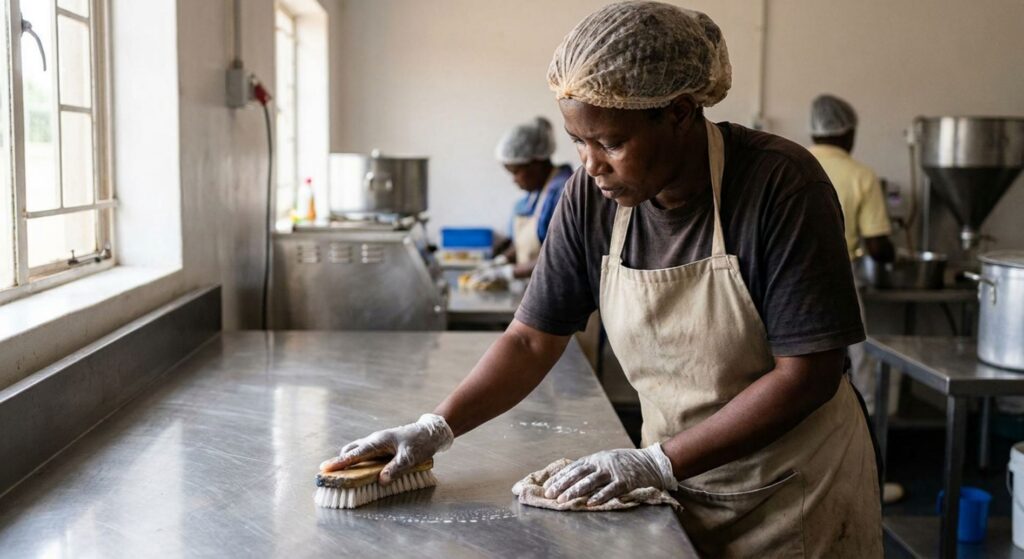
- Cleaning and disinfection: cleaning schedule, appropriate products, frequencies.
- Pest management: sealing openings, traps, regular inspections.
- Temperature control: maintaining the cold chain, adequate cooking temperatures.
- Water management: potable water for production, periodic testing.
Step 3: identify your critical areas
Focus your efforts on the steps in your process where a hazard can occur and where a control measure is possible. For a small unit, this is typically two to five critical control points, rarely more.
For example, for a fruit juice processing unit:
- Fruit intake (contamination by pesticides or mould)
- Washing (removal of surface contaminants)
- Pasteurisation (destruction of micro-organisms)
- Packaging (possible recontamination)
Step 4: put a simple traceability system in place
Traceability does not need to be complex to be effective. The goal is to be able to answer two questions: where did what I used come from, and where did what I produced go?
A notebook or a simple table is often enough at the start. The key is to systematically record:
- Raw material batches received (date, supplier, quantity)
- Batch numbers of finished products
- Customers or sales points supplied
Step 5: create minimal but useful documentation
Avoid producing dozens of documents that no one will read. Focus on what is actually used day to day.
- Cleaning plan posted in production areas
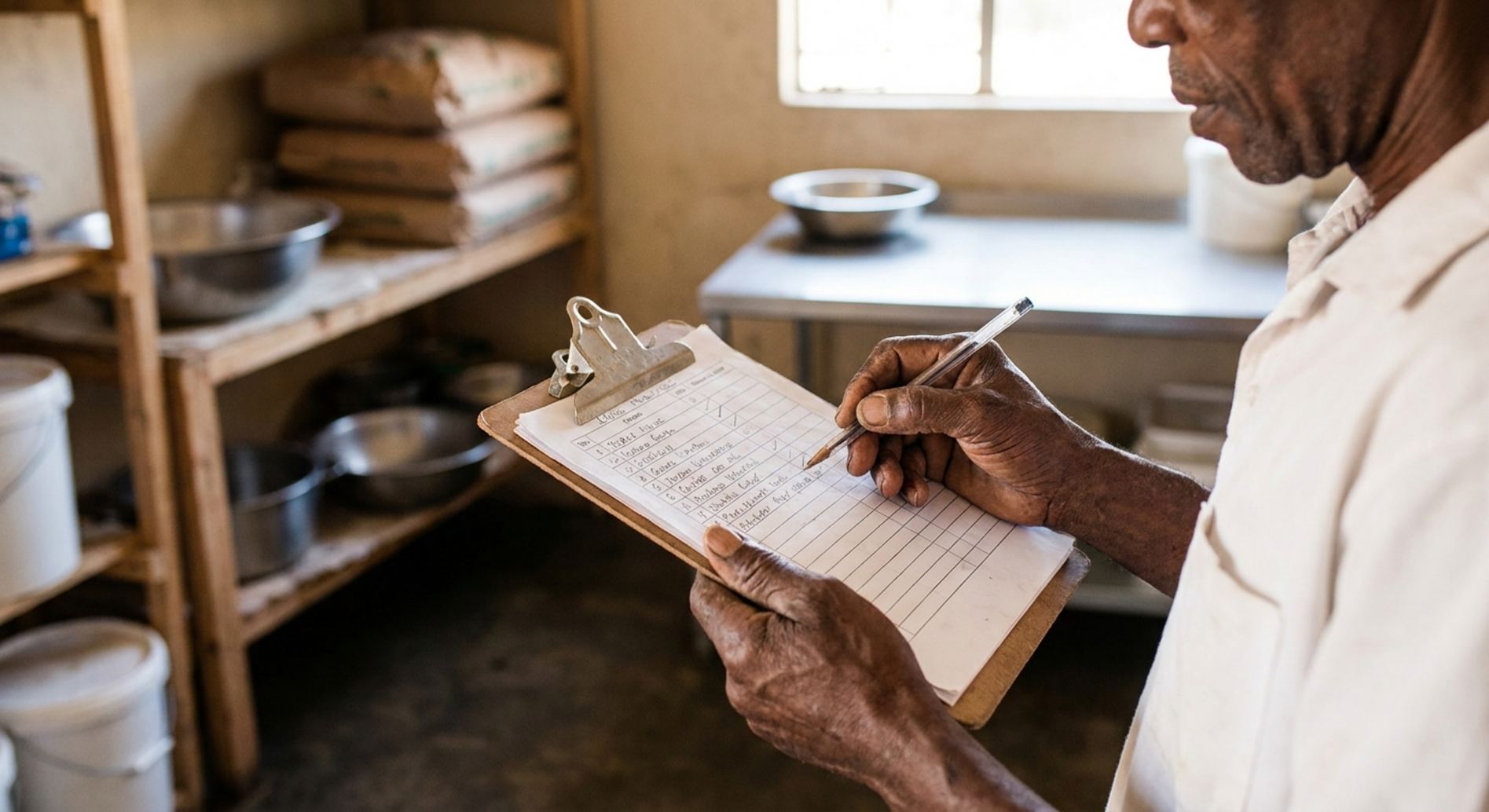
- Temperature control sheets completed every day
- Procedure for non-conforming products (what to do, who to notify)
- Traceability record checked at every goods-in and goods-out
A useful document is one that gets used. If a procedure sits in a drawer, it serves no purpose. Three practical forms are worth more than thirty pages no one ever looks at.
The spending that actually makes a difference
Not all spending has the same impact on your project’s success. Some investments deliver immediate benefits; others can be deferred without jeopardising the essentials.
Staff training: the item you cannot afford to skip
Training is often the best investment for a micro-enterprise. Well-trained staff follow instructions more consistently, spot problems earlier, and make fewer costly mistakes.
Basic 14-hour HACCP training courses typically cost between 50,000 and 200,000 FCFA per person for in-person delivery. Online options exist at lower cost, but their effectiveness depends on participants’ baseline knowledge.
Minimum fit-out: invest in what matters
Some fit-out work is essential to guarantee food safety. Other improvements can wait until the business generates more revenue.
High priority:
- Water point with soap close to workstations
- Reliable thermometer for temperature checks
- Containers or trays to keep products separated at different stages
- Work surface that is easy to clean
Can be deferred:
- Full wall tiling
- Air conditioning system in the production area
- Automated monitoring equipment
Laboratory analyses: useful but targeted
Analyses are expensive and not all of them are necessary at the outset. Target the analyses most relevant to your main risks.
- Basic microbiological analysis: useful for validating your processes (cooking, pasteurisation).
- Water analysis: essential if you use borehole or well water.
- Chemical analyses: worth considering if your raw materials carry specific risks (residues, heavy metals).
External consultancy: go it alone or get support?
The choice between working independently and bringing in external support depends on several factors.
Going it alone works if:
- You already have experience in quality or food safety
- You are targeting an internal system without external certification
- Your production process is simple and well under control
External support is recommended if:
- You are targeting recognised certification (IFS, BRC, FSSC 22000)
- Your buyers require an external audit
- You lack the time or internal quality expertise
- You want to move significantly faster
Hidden costs to anticipate
Beyond the obvious items, several costs are routinely underestimated during planning.
- Time spent by the owner and team: HACCP requires regular attention, not just a budget.
- Maintenance of monitoring equipment: an uncalibrated thermometer gives false reassurance.
- Renewal of audits: certification is never permanently granted.
- Non-conformities discovered along the way: the assessment may uncover unexpected problems.
The immediate business case for HACCP
Beyond regulatory compliance, HACCP opens concrete commercial doors. For an African agrifood micro-enterprise, these opportunities alone can justify the investment.
Access to formal local markets
Supermarkets, distribution chains, and formal wholesalers increasingly require documented food safety guarantees from their suppliers. A HACCP plan, even a simplified one, becomes a selection criterion.
In Côte d’Ivoire, Sénégal, or Ghana, large retailers systematically ask for proof of food safety control before listing a new supplier. Without documentation, you remain confined to informal channels.
Catering and institutional markets
Hotels, restaurants, school canteens, and public procurement represent stable and often better-paid outlets. These buyers have legal obligations around traceability and food safety.
Supplying an international hotel or a corporate canteen requires demonstrating that your products are made under controlled conditions. HACCP gives you that credibility.
Preparation for export
Export markets, particularly Europe and Gulf countries, impose strict food safety requirements. Research on export barriers facing African SMEs shows that the absence of a HACCP system is one of the primary obstacles.
Even if you are not targeting export right now, putting HACCP in place today positions you to seize those opportunities when they arise.
Competitive edge with demanding buyers
In a market where most micro-enterprises have no formalised quality system, having HACCP sets you apart immediately. That advantage can support higher prices and build loyalty among professional clients.
Fewer losses and fewer complaints
A well-applied HACCP system reduces quality incidents, product returns, and customer complaints. These savings, often invisible at first, gradually offset the initial investment.
A case study on a processing unit in Zimbabwe showed a significant reduction in microbial contamination levels after implementing a HACCP programme, resulting in fewer losses and better product shelf life.
HACCP is not an administrative expense. It is a commercial investment that opens markets, cuts losses, and strengthens your position with professional buyers.
Frequently asked questions
Is HACCP mandatory for an agrifood micro-enterprise in Africa?
Regulations vary by country. In most cases, HACCP principles are required under national legislation for any food processing activity, even if enforcement remains limited. In practice, it is often the requirements of professional buyers that make HACCP unavoidable.
Can HACCP be implemented without an external consultant?
Yes, this is possible for an internal approach without formal certification. The FAO/WHO guides provide