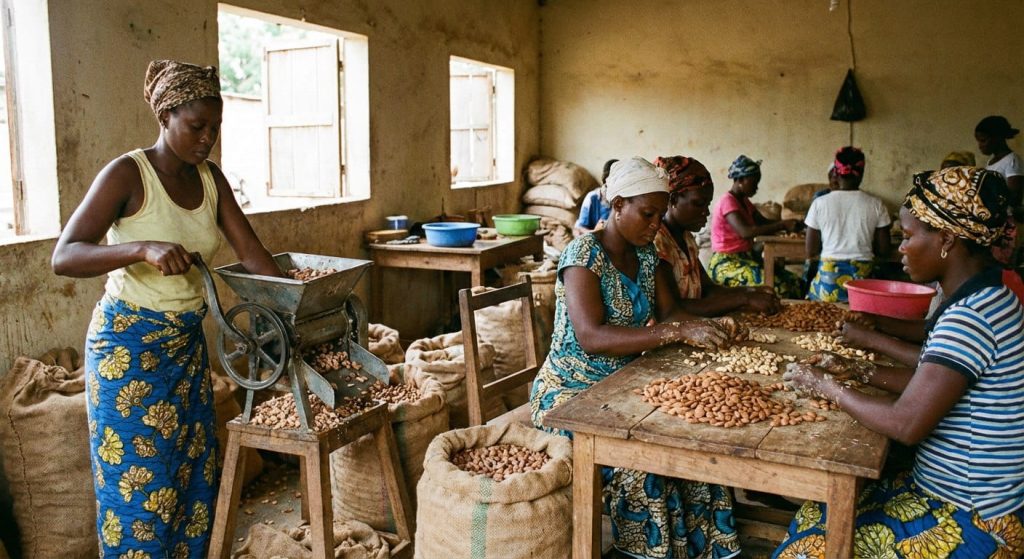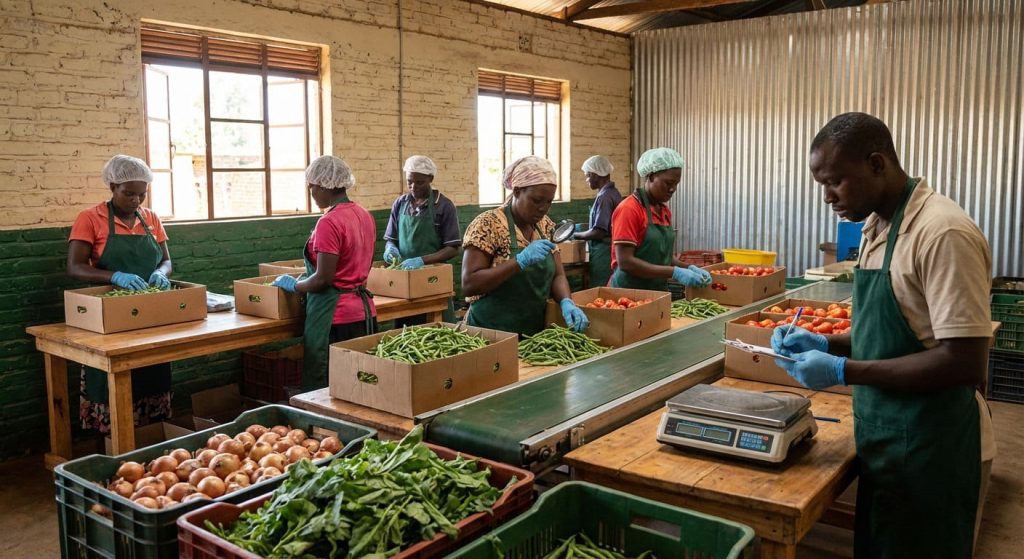
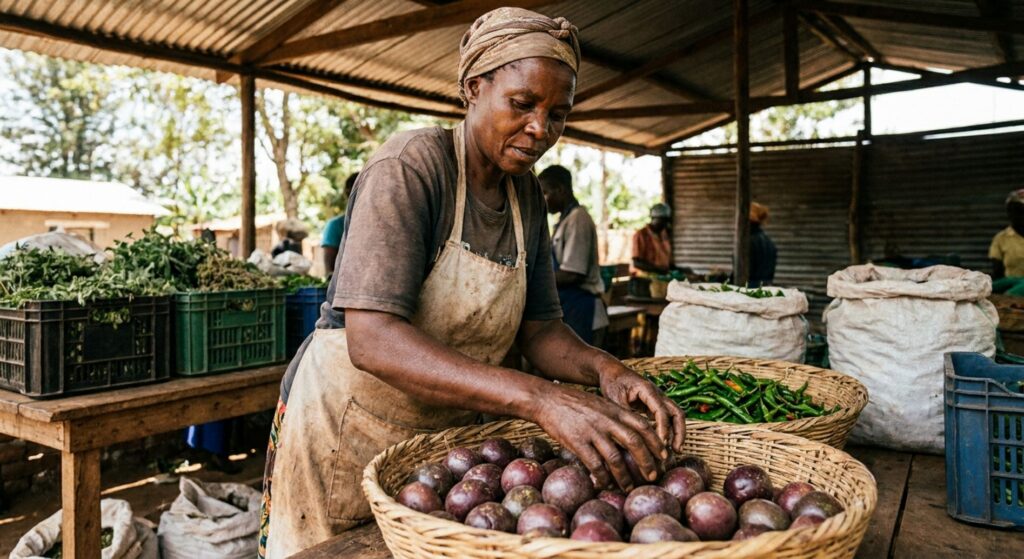
Four out of five batches of Senegalese groundnuts inspected at European Union borders are currently found non-compliant due to aflatoxins.
Africa accounts for nearly 30% of food non-compliance cases recorded at European borders.
These figures are not inevitable: they reflect, above all, a lack of familiarity with the precise rules that must be met before shipment — not an intrinsic quality problem with African products.
This article explains, step by step, what the owner of an African agrifood micro-enterprise or SME needs to know before sending a first container to the European Union: the regulatory framework, product- and country-specific enhanced controls, labelling, certifications that buyers actually require, costs, timelines, available funding, and the mistakes that get a shipment blocked.
- The legal framework for entering the EU: what to know before shipping
- Enhanced controls: which African products and countries are most closely monitored
- Labelling, residues and marketing standards to comply with
- Certifications required by buyers: HACCP, ISO 22000, GlobalG.A.P, organic
- The deforestation regulation (EUDR): what changes for cacao and coffee
- What accessing the European market actually costs
- Timelines to plan for, from certification to customs
- Support programmes and available funding
- Finding and securing buyers on the European market
- Mistakes that get a shipment blocked at the border
- FAQ: accessing the European market for an African agrifood product
Before getting into the regulatory detail, one simple principle to keep in mind: the European Union does not block African products as a matter of policy.
It blocks shipments that fail to comply with written, public and verifiable rules.
Each section below corresponds to a real checkpoint, with the relevant bodies, texts and associated costs.
The legal framework for entering the EU: what to know before shipping
Every agrifood product of plant origin entering the European Union is subject to Regulation (EU) 2017/625 on official controls.
This text governs the verification, at the customs border, of compliance with sanitary, phytosanitary and food safety rules (Direction générale des douanes et droits indirects).
In practice, three technical elements determine whether an African food product clears customs:
The EORI number. This is the mandatory customs identifier for the operator carrying out the import into the EU (usually the European buyer, and sometimes the African exporter if acting as importer).
Without this number, no customs declaration is possible.
Obtaining it is free and generally quick through the customs authority of the country of entry (douane.gouv.fr portal).
TRACES NT. For products subject to sanitary or phytosanitary control, the operator responsible for the shipment must notify its arrival via the European Commission’s TRACES NT system (Trade Control and Expert System New Technology).
This notification takes the form of a Common Health Entry Document (CHED), submitted at least 24 to 48 hours before the physical arrival of the goods at the border control post.
The border control post (BCP). Every shipment subject to control must pass through a designated entry point equipped with a BCP.
Three checks are carried out in sequence: a documentary check (consistency of certificates), an identity check (correspondence between the batch and the documents), and — depending on the frequency set for the product — a physical check involving the collection of samples for laboratory analysis.
Until the physical check result is available, the goods remain held at the port or airport of entry, at the importer’s expense.
This hold-up, more than the inspection itself, is what costs the most when the product is perishable.
The frequency of physical checks is not the same for all products.
It is set by the European Commission, based on alerts submitted through the RASFF (Rapid Alert System for Food and Feed) and data provided by the competent authorities of the member states.
A product that generates few RASFF alerts over several months will generally see its control frequency reduced at the next review; one that generates many will see its frequency rise, sometimes to the point where almost every batch is checked.
This is a two-way mechanism that few exporters use to their advantage.
Documenting internal analyses and sharing them with the European buyer — on top of the required official certificates — builds a compliance track record that works in the company’s favour over time.
Key points to remember
- EORI – mandatory customs identifier, free of charge, to be obtained before the first shipment.
- CHED via TRACES NT – mandatory notification 24 to 48 hours before arrival for controlled products.
- BCP – mandatory passage through a designated border control post, in three verification stages.
- Hold-up – goods remain immobilised at the importer’s expense until the analysis result is available.
Enhanced controls: which African products and countries are most closely monitored
Beyond the standard inspection, Implementing Regulation (EU) 2019/1793 imposes a temporary reinforcement of border controls for a list of products and countries of origin deemed to present a risk.
This list (Annexes I and II of the regulation) is reviewed at least every six months by the European Commission, based on alert data submitted by member states (EUR-Lex, consolidated text of Regulation 2019/1793).
The triggering risk is almost never the same: aflatoxins for oilseeds and tree nuts, salmonella for seeds, pesticide residues for fresh fruit and vegetables.
The table below brings together the best-documented African cases to date.
| Product | African countries concerned | Identified risk | Available data |
|---|---|---|---|
| Groundnuts and derivatives | Senegal, Gambia, Sudan, Nigeria | Aflatoxins | 80% non-compliance detected in Senegalese batches inspected (Agence Ecofin, 2025) |
| Sésame seeds | Nigeria, Uganda, Ethiopia | Salmonella, unauthorised chemical residues | Sector valued at over 1,000 billion nairas in exports in 2024, weakened by repeated rejections (Nigerian Export Promotion Council, cited by Daily Trust, 2025) |
| Tree nuts (cajou, eating groundnuts) | Several West and East African countries | Aflatoxins | Aflatoxins account for 88.5% of RASFF mycotoxin alerts; tree nuts remain a sensitive category in H1 2026 (82 notifications) |
| Various fresh fruit and vegetables | All African origins combined | Pesticide residues, documentary non-compliance | Precise control rate by product not given here — variable and available in real time on TRACES NT |
One contextual figure is worth repeating because it changes the way the subject should be approached: Africa accounts for around 30% of food non-compliance cases recorded at European borders, across all products — a share far higher than the continent’s actual weight in import volumes.
Between 2008 and 2013, at least 600 shipments of African origin had already been refused entry to the EU for contamination or documentary non-compliance.
A refused shipment is generally destroyed on the spot, at the expense of the exporter or importer depending on the contract, with no possibility of recovering the goods.
Beyond the direct financial loss, each refusal feeds into a track record attached to the product and country of origin, which raises the control frequency for subsequent shipments.
Two situations that exporters often confuse are worth distinguishing.
An emergency measure applies to a product or origin following a serious food safety incident and can go as far as a total suspension of imports pending investigation.
Enhanced control, which is more common, simply means a higher percentage of batches are physically analysed, without blocking the entire supply chain.
An exporter whose country or product comes under enhanced control can therefore continue to export, but must factor in an analysis delay and a higher individual rejection risk when planning commercially.
Labelling, residues and marketing standards to comply with
Even a batch that passes the sanitary check without difficulty can be rejected downstream — by the distributor or customs officer — for labelling non-compliance or for exceeding a maximum residue limit (MRL).
These two points are independent of Regulation 2019/1793 and apply to all products, whether or not they are subject to border controls.
| Requirement | Reference | What it means in practice |
|---|---|---|
| Food labelling | Regulation (EU) No 1169/2011 (FIC) | Name, ingredient list, allergens, net weight, use-by/best-before date and importer contact details, written in the language of the country of sale |
| Maximum residue limits | European Commission pesticide database | Thresholds set per active substance/product combination; a single exceedance is enough to get the batch rejected |
| Fresh fruit and vegetable marketing standards | Regulation (EU) No 543/2011 and associated UNECE standards | Sizing, colouration, tolerated defect rates by category (Extra, I, II) |
| Traceability | Regulation (EC) No 178/2002 | Ability to trace the batch one step back and one step forward in the chain |
For small businesses, the most commonly overlooked point is the label language: a product destined for the French market must be labelled in French, one for the Netherlands in Dutch — unless there is a specific contractual agreement with the distributor who takes charge of re-labelling.
Having the label artwork validated by the European buyer before printing avoids a costly rejection on receipt.
Certifications required by buyers: HACCP, ISO 22000, GlobalG.A.P, organic
Most certifications are not legally required to clear European customs.
They have, however, become a commercial condition imposed by the majority of distributors and importers, who refuse to list an uncertified supplier in order to limit their own risk.
The sanitary baseline expected by any serious buyer remains a functioning HACCP system, possibly formalised as ISO 22000 for businesses targeting the major retail chains.
Our dedicated article explains why HACCP and ISO 22000 concretely open the door to the European market, with the implementation steps.
For fresh fruit and vegetables sold through major retailers (Tesco, Carrefour, Whole Foods in particular), GlobalG.A.P has become a de facto prerequisite rather than an option.
The certification covers agricultural practices at production level: input traceability, water management, worker safety, and documented phytosanitary treatment.
Its cost varies considerably depending on the size of the farm and the country; several support programmes (see below) can reduce the net cost for a cooperative or SME (AvoTrace Chain, GlobalG.A.P guide for African cooperatives, 2026).
| Certification | Required by | Scope | Typical validity |
|---|---|---|---|
| HACCP | EU legal basis (obligation of result, no imposed standard), all buyers | Sanitary control of the processing operation | Ongoing system, no certificate with a fixed date |
| ISO 22000 | Major retailers, processed food sector | Food safety management system | 3 years, with annual follow-up audits |
| GlobalG.A.P | Fresh fruit and vegetable distributors | Good agricultural practices at production level | 1 year, annual audit |
| EU organic certification | Organic segment, generally higher margin | Production method, including plot conversion | 1 year, with a prior conversion period of 2 to 3 years |
Our guide on the real cost of agrifood certification and how to fund it breaks down what each process represents for a small business, item by item.
In practice, a certification audit always follows the same three-stage pattern: a pre-audit or self-assessment to identify gaps, a phase of bringing practices and documentation into compliance, and then the official audit carried out by an independent accredited body.
Skipping the pre-audit to save time is the most common mistake: it leads to a failed official audit, which has to be paid for a second time after the gaps are corrected.
The deforestation regulation (EUDR): what changes for cacao and coffee
For exporters of cacao, coffee, palm oil or rubber, an additional regulatory layer sits on top of the standard sanitary framework: Regulation (EU) 2023/1115 on deforestation-free products (EUDR).
It prohibits the placing on the European market of products from land deforested after 31 December 2020 (French Ministry of Ecological Transition).
The implementation timeline has been postponed twice since the text was adopted.
Following a further European Parliament vote in late 2025, the deadlines currently in place are 30 December 2026 for large and medium-sized companies, and 30 June 2027 for micro and small enterprises created before 31 December 2024.
This extension gives African supply chains genuine extra time, but does not remove the need to start building geolocated traceability now: collecting data by cooperative takes several months.
Côte d’Ivoire and Ghana, the EU’s main cacao suppliers, are the most directly affected.
For each batch, the regulation requires the geographic coordinates (polygons) of the production plots, proof of legality under the law of the producing country, and a due diligence statement submitted to the Commission’s information system.
Organised producer networks (Fairtrade-certified cooperatives in particular) receive support for collecting and transmitting this geolocated data.
What accessing the European market actually costs
The budget required depends heavily on the product, the volume and the certification status already in place.
The table below sets out the identifiable cost items, distinguishing what can be quantified precisely from what varies too much to generalise.
| Item | Amount or range | Who pays |
|---|---|---|
| EORI number | Free | Importer (usually the European buyer) |
| Enhanced control fee (documentary, identity, physical) | Amount set by decree (decree of 24 May 2024 amending that of 28 June 2017 in France), due whether the batch is accepted or rejected. Not stated precisely here due to the absence of a single published schedule for all products | Importer |
| Laboratory analyses in the event of a physical check | Variable depending on the parameter tested (aflatoxins, pesticides, salmonella); not stated precisely here | Importer, sometimes recharged to the supplier in the event of confirmed non-compliance |
| HACCP / ISO 22000 certification | Detail in our dedicated article on certification costs | Exporter |
| Annual GlobalG.A.P audit | Variable depending on farm size and certifying body; not stated precisely here | Exporter, often partially subsidised through a support programme |
| Loss in the event of border rejection | Full value of the batch, generally destroyed on the spot | Exporter or importer depending on the agreed Incoterms |
The main financial risk is therefore not the cost of the administrative process, which remains broadly manageable, but the outright loss of an entire batch if non-compliance is discovered on arrival.
That is what justifies investing upfront in self-monitoring and certification rather than shipping blind.
Timelines to plan for, from certification to customs
An exporter who discovers EU requirements only when preparing their first shipment will consistently lose time.
The table below sets out the timelines to build into commercial planning, from production to shelf.
| Stage | Typical timeline | Key watch point |
|---|---|---|
| Obtaining a national phytosanitary certificate | Variable depending on the country and competent authority; not stated precisely here — to be verified with the local phytosanitary authority | Must be requested before shipment, never after |
| Setting up a functioning HACCP system | Several weeks to a few months depending on the starting point | Requires staff training, not just documentation |
| First GlobalG.A.P audit | Several months of preparation before the initial audit | Includes bringing practices into compliance, not just the audit itself |
| CHED notification via TRACES NT | 24 to 48 hours before arrival at the border control post | Incomplete or late notification = automatic hold |
| Documentary and identity check at the BCP | A few hours to one day | Strict consistency required between documents and actual batch contents |
| Physical check with laboratory analysis | Several days, with the batch held in the meantime | Critical for perishable products: build in a freshness margin at the point of departure |
Working with an experienced freight forwarder or customs broker on Africa-Europe flows allows most of these timelines to be anticipated and avoids back-and-forth on documentation.
Our article on the role of freight forwarders and customs in securing a shipment to Europe explains how to choose a reliable service provider.
Support programmes and available funding
Several organisations fund all or part of the compliance process, which significantly reduces the net cost borne by the SME.
These programmes are too little known among small businesses, which often fund the entire process themselves when it could be partially subsidised.
| Programme | Lead organisation | Area covered | What it funds |
|---|---|---|---|
| Fit For Market | COLEACP, co-funded by the European Union | 50 countries in Africa, the Caribbean and the Pacific | Sanitary and phytosanitary compliance, access to international and local markets for SMEs in the fruit and vegetable sector; 773 intervention requests received, 494 converted into joint support projects (COLEACP) |
| Export Coaching Programme | CBI (Centre for the Promotion of Imports from developing countries), Dutch Ministry of Foreign Affairs | Selected developing countries, including several African countries | Connecting exporters with European buyers, market intelligence, capacity building for exporters (CBI) |
| SME competitiveness envelope, Central Africa | European Union | Central Africa (CEMAC) | 26 million euros over the period February 2025 to January 2029 to strengthen SME competitiveness, including in the agrifood sector |
The practical approach is to submit an intervention request directly on the relevant programme’s platform, describing the product, the target volume and the specific barrier encountered (sanitary, certification, buyer access).
National professional organisations (chambers of commerce, sector trade bodies) generally relay these calls and can help put together an application.
A useful point of method for small businesses: these programmes almost always operate on active application, not automatic identification of eligible companies.
An SME that never submits an intervention request will not be identified by any of these schemes, even if its product and country fit the eligibility criteria perfectly.
Finding and securing buyers on the European market
Being compliant is not enough: the right buyer still has to be identified.
Three types of players buy African agrifood products in Europe, with very different requirements and volumes.
Specialist importers and wholesalers buy in bulk, hold stock and redistribute to delicatessens, the foodservice sector or ethnic retail channels.
Their documentary requirements are real but often more flexible than major retailers for initial volumes.
Major retail buying departments systematically require the certifications mentioned above, regular volumes and a stable production capacity over time.
Getting listed takes longer, but once achieved it generates recurring business.
Specialist organic and fair-trade buyers pay a price premium in exchange for more demanding specifications on traceability and agricultural practices.
Our guide on agrifood export opportunities to Europe and Asia explains how to identify these buyers, particularly through specialist trade shows (Anuga, SIAL, Fruit Logistica) where most first listings are negotiated.
A first meeting at a trade show almost never results in an immediate order.
Its main purpose is to qualify the buyer: actual volumes sought, precise certification requirements, listing timeline, expected payment terms.
Preparing a concise product sheet in English — listing certifications already obtained and volumes available by season — noticeably speeds up these exchanges.
Mistakes that get a shipment blocked at the border
The majority of EU border refusals do not stem from fraud or a dangerous product, but from avoidable errors repeated from one exporter to the next.
Shipping without a prior TRACES NT notification. A batch that arrives without a CHED submitted within the required timeframe is held by default, regardless of its actual quality.
Underestimating the hold period for a perishable product. Fresh fruit that has to wait several days for an analysis result may arrive unsaleable, even if it is ultimately declared compliant.
Label in the wrong language or incomplete. A frequent and easily avoidable mistake — have the artwork validated by the buyer before printing.
Ignoring the six-monthly update of enhanced control lists. A product or country can move in or out of the Annex I or II list of Regulation 2019/1793 from one review to the next; checking the current status before each export campaign avoids unwelcome surprises.
Approaching a buyer without the certification they require. Many SMEs discover the GlobalG.A.P or ISO 22000 requirement during commercial negotiations, when it should have been anticipated a year in advance given audit lead times.
FAQ: accessing the European market for an African agrifood product
Is certification mandatory to export to the European Union?
No, no private certification is legally required to clear European customs. Compliance with the sanitary rules of Regulation 2017/625, however, is mandatory — and most professional buyers (major retailers in particular) require in practice a certification such as HACCP, ISO 22000 or GlobalG.A.P before listing a supplier.
How do I know whether my product is subject to enhanced controls at the EU border?
The list of products and countries concerned appears in the annexes of Implementing Regulation (EU) 2019/1793, reviewed at least every six months by the European Commission. It can be consulted directly on the TRACES NT system or via the consolidated text of the regulation.
What happens if my batch is refused at the border?
The batch is generally destroyed on the spot, at the expense of the importer or exporter depending on the agreed Incoterms. The refusal is recorded and may raise the control frequency for subsequent shipments of the same product or from the same country of origin.
Does the deforestation regulation (EUDR) apply to all African agrifood products?
No, it covers seven specific commodities: coffee, cacao, rubber, palm oil, soy, beef and wood, as well as certain derived products. Other agrifood products are not affected by this specific regulation.
Is there funding to help an African SME achieve compliance?
Yes. The Fit For Market programme run by COLEACP and co-funded by the European Union, as well as the export coaching programmes of the Dutch CBI, fund part of the sanitary, phytosanitary and commercial compliance process for African agrifood SMEs.
How much time should be allowed before a first compliant shipment to the EU?
There is no single answer: it depends on the company’s starting point. Setting up a HACCP system takes several weeks to a few months, preparing for a first GlobalG.A.P audit takes several months, and the TRACES NT notification itself requires only 24 to 48 hours before the batch arrives once all prerequisites are in place.