West Africa’s agrifood exports are on the rise, driven by a young population and rapid urbanisation.
In 2023, Africa’s agricultural exports reached $65 billion, up 85% over ten years. West African SMEs play a key role in this growth, but must adapt to international market requirements and high quality standards.
This article is aimed at leaders of West African agrifood SMEs looking to break into emerging Asian markets.
In 2024–2025, Asian demand for West African products (cacao, cashew, mango, sesame, etc.) is growing strongly.
You will find sourced, up-to-date data (volumes, market shares, key figures), comparative tables and charts illustrating current trends. Each major figure is backed by a reliable source link, opening in a new tab, to ensure credibility.
This article is organised into 5 thematic sections:
1 – Opportunities & standards in Asian markets
Asian markets are becoming a new frontier for West African exporters. Since the 2000s, Asia has emerged as a major destination for African agricultural products.
In 2024, Asia absorbed 68.2% of Benin’s total exports, compared with 10.8% for Europe. This eastward shift is confirmed by the fact that developing Asian ports now handle 61% of global container traffic.
Asian demand is driven by demographics and urbanisation.
The chocolate market in China is expected to reach ~$3.99 billion in 2024, growing at ~4.7% per year over the medium term. India and Vietnam have established themselves as processors of cashew and other African raw materials, supplying their domestic industries and re-exporting to Asia and the West.
To seize these opportunities, exporters must comply with strict sanitary and phytosanitary standards, meet quality and grading requirements, and use local labelling (Chinese, Hindi, Vietnamese).
Since 2022, China has required GACC registration (Decree 248) for all foreign agrifood facilities before export. Adapting packaging and recipes to local tastes is often decisive (sugar content, format, origin storytelling).
Support organisations help SMEs through these processes. In Côte d’Ivoire, Agence Côte d’Ivoire Export advises companies on regulatory requirements, target markets and business matchmaking. SME tip: check import protocols early and arrange registration and certificates (HACCP, ISO 22000, phytosanitary) before any prospecting or sample shipments.
2 – Certifications & financing for export
Entering Asian markets often requires quality certifications and labels. If you are targeting premium segments (specialty grocers, major retailers), organic, Fairtrade or geographical indication labels carry significant added value.
For example, certifying West African cacao as organic or Fairtrade appeals to urban consumers in India or Japan who seek sustainable products. Similarly, exporting dried mango or shea butter to South Korea or China will often require HACCP/ISO 22000 certification to meet food safety requirements.
Look into national labels as well: China has its own Organic Food China label, while Japan enforces JAS standards.
Beyond standards, export financing is a major challenge for SMEs. Cash flow cycles are long — from production through several weeks of sea freight to payment terms.
International programmes (USAID, EU) also finance exporting agrifood value chains. Compliance costs (certifications, audits, factory upgrades) are high. Some West African governments partially subsidise quality certifications or equipment purchases (cold rooms, laboratories).
Partnerships with foreign buyers can also ease financing: a Vietnamese cashew importer may offer a cash advance or supply equipment in exchange for an exclusive contract.
SME tip: do not overlook export credit insurance to protect against non-payment.
Finally, think digital to streamline financing and procedures. Online platforms connect exporters with investors, and fintech companies offer tailored international payment solutions (advance payment, escrow).
3 – Product focus: cacao, cashew, mango… what prospects in Asia?
Several flagship products from West Africa stand out in Asian markets, whether through current demand or growth potential.
The table below summarises four key value chains in 2024–2025:
| Flagship product | Annual production (2024) | Share exported to Asia | Key facts 2024–2025 |
|---|---|---|---|
| Cacao (beans) | Côte d’Ivoire: ~2.1 Mt (world’s largest producer) | Minority share (Europe is the main destination; Malaysia & Indonesia process a portion) | Consumption rising in Asia (China chocolate market +4.8%/year). Sino-Malaysian investment in local processing (PK24 plant in Abidjan). |
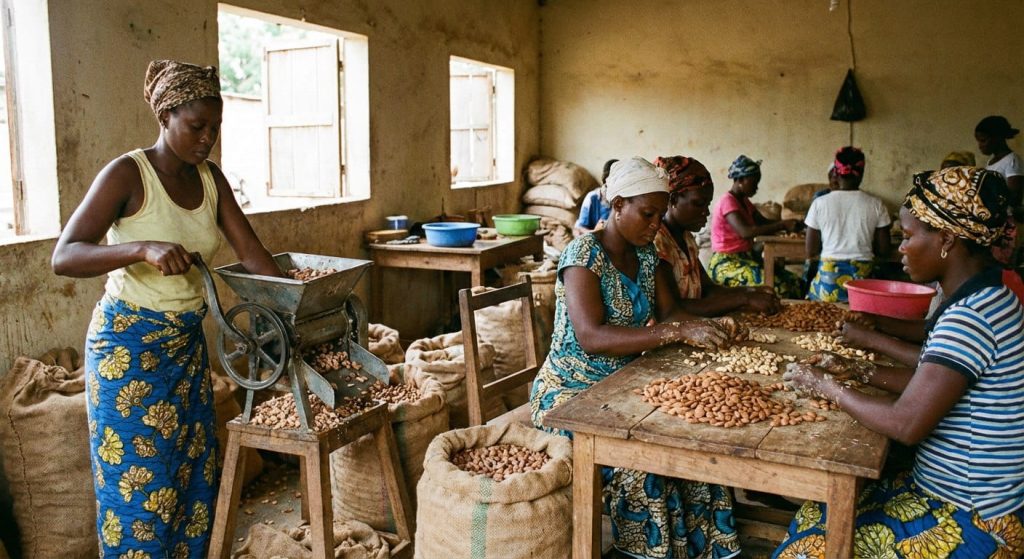
| Cashew (raw cashew nuts) | West Africa: ~1.25 Mt | ~83% to Asia (Vietnam, India, China) | Sustained demand in Asia. Asia dominates processing, but Africa is scaling up (Côte d’Ivoire: 30% processed locally in 2024). |
| Sesame (seeds) | Nigeria: ~613,000 t | Asia is the main outlet (China & Japan: ~₦141 billion in Q1 2024) | Chinese imports rising sharply (+23% in 2024). Sesame became Nigeria’s top agricultural export in early 2024 (+123% year-on-year). |
| Mango (fresh & dried) | Côte d’Ivoire: ~45,000 t fresh exports (2024) | Low for fresh (abundant local production in Asia); dried segment developing | Fresh value chain focused on Europe. Processed product potential: Burkina Faso quintupled its dried mango production (3,800 t in 2020), exported to Europe and Asia. |
Note: Nigeria’s sesame production has increased for four consecutive years (FAO).
Analysis: Asia is already an essential import destination for certain value chains. Cashew is the clearest example: in 2024, nearly 5 in every 6 raw nuts harvested in West Africa went to Asia for shelling.
India and Vietnam have specialised in processing African cashew, then re-export the kernels. Côte d’Ivoire, the leading producer, raised its processing capacity to 350,000 t (30% of its harvest) in 2024, with an ambition to reach 50% by 2025.
For cacao, Asia is still an emerging market compared to Europe. Chocolate consumption is growing in China (already accounting for >4% of the global market) and India.
Asian industrialists are investing in Africa: Olam (Singapore) and Guan Chong (Malaysia) are expanding Ivorian processing capacity. In 2024, Nigeria exported quality cacao beans to Malaysia worth ₦48 billion, a clear sign of Asian interest.
On the tropical fruit side, Asian markets still need to be won. Fresh West African mango faces stiff competition from Indian, Pakistani and Thai suppliers. In 2024, Côte d’Ivoire exported 32,000 t to Europe, against near-zero volumes to Asia. But dried mango, purées and juices are gaining ground.
Through drying, Burkina Faso has increased its export revenues by 50% in just a few years. Other products such as pineapple and shea (cosmetics) also have potential, particularly in China.
Finally, sesame deserves mention: highly valued across Asia for oil and condiments. Nigeria became the world’s 4th largest exporter in 2024, driven by Chinese demand.
China imported nearly 960,000 t in ten months (+23%). West African producers are benefiting from this windfall, with firm prices. The next step: local processing (oil, tahini) to capture more value and tap into the growing specialty food sector in Asia.
4 – Logistics & customs: getting your products to Asia
Exporting to Asia from West Africa is a logistical challenge that requires careful planning.
The distance is significant: by sea, allow around 30 to 40 days in transit to Southeast Asia or China, compared with roughly ten days to Europe. The choice of transport mode must therefore match the product type.
- Sea freight: the default option for non-perishable goods (cacao, raw cashew, sesame, cotton). After the 2021 rate spike, container costs stabilised in 2025. Singaporean shipping line PIL now operates 7 weekly services between Asia and Africa, covering 40 ports, with 30% of its Asian cargo destined for the African continent. Book your containers well in advance, especially during peak season (cashew harvests from January to June).
- Air freight: essential for high-value fresh produce (mango, pineapple, cut flowers, samples). West Africa to Asia takes just 1 to 2 days — ideal for ultra-fresh shipments to Dubai or Hong Kong. However, costs are high (>€2–3/kg). Tip: use air freight for test shipments or special orders where the client covers logistics. Cargo carriers such as Emirates SkyCargo or Ethiopian Airlines Cargo offer suitable Africa–Asia routes.
- Groupage & logistics hubs: useful for SMEs without enough volume to fill a full container. Freight forwarders consolidate multiple shippers heading to the same Asian region. Using hubs such as Dakar or Abidjan (with direct services to Asia) cuts costs. The new Lekki economic zone in Nigeria, with its deep-water port financed by Chinese investors, is set to expand export capacity to Asia.
On the customs side, China has applied a zero-tariff policy for 53 African countries (mainly LDCs) since late 2024, covering 98% of tariff lines. This benefits products such as cacao, cashew, sesame and coffee.
Bear in mind: zero tariffs do not mean zero requirements. Exporters must still provide the required sanitary and phytosanitary certificates. For example, China requires a certificate confirming the absence of pathogenic bacteria in imported sesame.
Optimise your incoterms during negotiations.
Many SMEs go with FOB (Free On Board), where the buyer manages sea freight. This limits your liability, but make sure your FOB price covers all your costs to port. If you have reliable logistics partners, offering CIF (Cost, Insurance, Freight to the Asian port) can set you apart by giving the client a turnkey solution.
An experienced freight forwarder or customs broker is also essential. They will handle documentation (bill of lading, certificate of origin, customs invoice) and keep you informed of local rules (wood fumigation requirements in India, contaminant controls in Indonesia).
Sound logistics planning and mastery of customs formalities ensure on-time, compliant deliveries — which are essential for building trust with your Asian partners.
Frequently asked questions
Which West African products are most in demand in Asia?
The most sought-after products are raw cashew (processed in India and Vietnam), sesame seeds (bought by China, Japan and Turkey), and to a lesser extent cacao and cotton. About 83%
of West Africa’s cashew harvest goes to Asia. Nigerian sesame is particularly prized in China (nearly 1 million tonnes imported in 2024) and Japan.
Cacao remains predominantly exported to Europe, but Asian consumption is catching up fast. Niche products are also emerging: Nigerian ginger, Sahelian hibiscus, and shea for natural cosmetics.
Does China import cacao from West Africa?
In volume terms, China still imports relatively little cacao compared with the Netherlands or the United States. But the trend is shifting: test shipments of Ivorian and Ghanaian cacao have already been sent.
In 2025, a grinding complex backed by Guan Chong Berhad (Malaysia) was inaugurated in Côte d’Ivoire, reflecting Asian interest in local processing.
China could import more — whether as semi-finished products (paste, butter) made in Africa, or raw beans for its own factories. With chocolate consumption rising across Asia, China is on track to become a major buyer of West African cacao by 2030.
What steps does an SME need to take to export to Asia?
The key steps: study your target market (e.g. dried mango in South Korea, shea in China). Meet the standards: phytosanitary certificate, export licence, organic certification if required. Find a reliable local importer through trade fairs, B2B platforms or embassies.
Negotiate terms (price, incoterm, volumes) and plan your logistics (container booking or air freight, customs documents). Get insured: transport, documentary credit, export credit insurance.
Organisations such as AfricInvest or Apex can support SMEs from market research through to financing.
What are the main logistics obstacles for exporting to Asia?
The first challenge is distance (30–40 days by sea). This creates difficulties for perishables (cold chain).
Beyond that, container availability and service frequency remain limited for some destinations.
Transport costs are higher than to Europe, despite falling since 2021.
Add to this complex customs procedures: quotas, restrictions, strict pesticide tolerances in Japan, and sudden policy changes in China (as seen with Sudanese sesame).
Finally, the language barrier and time difference make coordination harder.
To overcome these hurdles: plan well ahead, work with experienced freight forwarders, and diversify your routes (via Mombasa if the Gulf of Guinea is congested).
Are there trade agreements that facilitate Africa–Asia exports?
There is no comprehensive Africa–Asia trade agreement comparable to the EPAs with Europe.
But several unilateral initiatives ease trade. China runs the Zero Tariff programme for African LDCs, covering 98% of tariff lines.
India offers the Duty Free Tariff Preference scheme to LDCs such as Burkina Faso and Liberia.
Forums such as FOCAC (Forum on China-Africa Cooperation) and the India-Africa Summit are working on standardisation and compliance.
The AfCFTA also allows African countries to consolidate their exports and compete more effectively in Asian markets.
These initiatives should continue to ease Africa–Asia trade flows.
In short, Asian markets offer West African agrifood SMEs real and growing opportunities.
The key is to choose the right market, meet the standards, secure your logistics and adapt your offer to local expectations. With a quality product and a clear strategy, Asia can become West Africa’s new export frontier as early as 2025.
Which export market should you target for your cocoa?
Our free Top Export Markets tool gives you, in under 60 seconds, the 3 best export markets for your product — demand, tariff regime and logistics.
Which export market should you target for your mango?
Our free Top Export Markets tool gives you, in under 60 seconds, the 3 best export markets for your product — demand, tariff regime and logistics.