A European importer does not buy from random contacts. They source from suppliers they met at a trade show, found on a B2B platform they check every week, or referred by an export support programme.
Most small African agrifood companies that fail at export do not lack good products. They look for buyers in the wrong places, with the wrong message, without understanding what actually triggers a purchase decision on the buyer’s side.
This article covers the channels that genuinely bring in qualified buyers, how to get found without cold prospecting, the criteria that move or stall a negotiation, and how to secure a buyer before shipping them a container.
- The 5 channels that reach qualified European buyers
- Getting found by buyers without approaching them
- The criteria that move or block a negotiation
- Qualifying and securing a buyer before signing
- The high-ROI prospecting method
The 5 channels that reach qualified European buyers
Not all channels are equal. A general directory yields hundreds of cold contacts. A trade show or support programme yields fewer contacts, but ones that are already in buying mode.
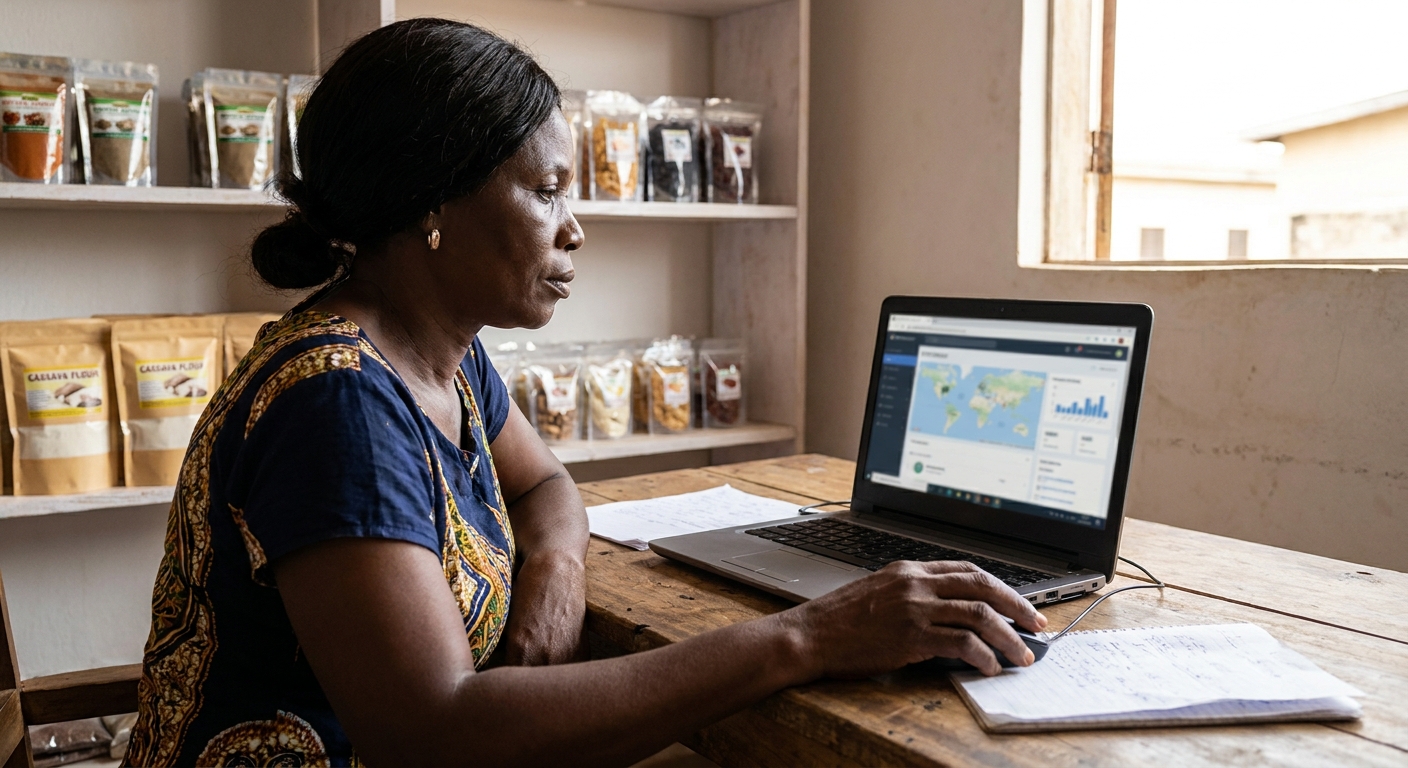
Here are the five channels that convert best for a small African agrifood company, from the most structured to the most direct.
| Channel | Type of buyer reached | Typical cost | Frequency |
|---|---|---|---|
| Agrifood trade shows (SIAL Paris, Anuga, Fruit Logistica) | Wholesalers, distributors, buying groups, foodservice buyers | Stand: €346 to €376/m² + mandatory organiser package of around €1,260 excl. tax (SIAL Paris 2026) | Biennial or annual depending on the show |
| Export support programmes (CBI, national agencies) | Importers pre-qualified by the programme | Free or heavily subsidised | 1 to 3-year cycle |
| B2B platforms (Europages, Tridge, Espace Agro) | Importing SMEs, brokers, small distributors | Free basic listing; premium subscriptions at variable rates (not precisely disclosed) | Ongoing |
| Trade missions run by export promotion agencies (ASEPEX, APEX-CI, GEPA) | Country-targeted buyers during organised missions | Often subsidised by the national agency | Occasional, several times per year |
| Direct outreach (LinkedIn, email, phone) | Named purchasing decision-maker at an importer | Free (time cost) | Ongoing |
Trade shows remain the most effective channel for a first qualified contact. SIAL Paris runs from 17 to 21 October 2026; stand rental costs €346/m² for bookings made before 28 February 2026, rising to €376/m² at the late rate, with a mandatory organiser package of around €1,260 excl. tax per exhibitor (SIAL Paris, 2026).
Anuga, in Cologne, brings together more than 7,000 exhibitors and visitors from over 201 countries at its next edition from 9 to 13 October 2027 (Anuga, 2027). Fruit Logistica, in Berlin, gathers more than 3,000 exhibitors and 80,000 trade visitors from 3 to 5 February 2027, with 7.6% coming from Africa — proof that European buyers already expect to meet African suppliers at this show (Fruit Logistica, 2027).
The right show depends on the sector. A fresh fruit, vegetable, or horticultural company is better served by Fruit Logistica, where fresh produce dominates. A company dealing in processed, dried, or speciality products (shelled cajou, karité, roasted coffee, juices) will find a wider audience at Anuga or SIAL Paris, which cover all food categories. Exhibiting at the wrong show wastes the budget without producing a single relevant contact.
B2B platforms serve a different purpose: they do not replace the human contact of a trade show, but they continuously capture buyers who are actively searching for a specific supplier. Europages lists tens of thousands of agrifood suppliers and buyers across Europe, with a free basic listing and paid premium options to boost visibility (Europages). Tridge works on a similar principle, focused on agricultural commodities and processed products, connecting producers and international buyers directly.
The second most cost-effective channel — often overlooked — is an export support programme funded by a European government. The CBI (Centre for the Promotion of Imports from developing countries), funded by the Dutch Ministry of Foreign Affairs since 1971, provides free export coaching and connects supported companies directly with European importers at shows such as Fruit Logistica or Biofach (CBI).
A recent example shows the scale of these programmes. On 17 July 2026, the Ghanaian export promotion agency GEPA signed an agreement with the Dutch CBI to develop Ghana’s non-traditional exports to the Netherlands and the European Union. Francis Kojo Kwarteng Arthur, CEO of GEPA, stated that the agreement aims to bring Ghana’s non-traditional exports to $10 billion by 2030, by helping local companies understand importer requirements and improve product quality (GEPA, 2026).
National export promotion agencies play the same role elsewhere on the continent. ASEPEX in Senegal organises prospecting missions and supports Senegalese companies at European trade shows, including its participation in the Seafood Expo Global in Brussels (ASEPEX). A small company that ignores these schemes pays out of pocket for what others access at subsidised rates.
In practice, none of these channels works sustainably on its own. A company that combines a B2B platform listing, an application to a national support programme, and trade show participation every two years builds a more stable buyer pipeline than one relying on a single channel. The cost of acquiring a buyer drops naturally once several channels overlap: a contact made on Europages may confirm their purchase decision at a face-to-face meeting at a trade show a few months later.
Key takeaways
- Trade shows pre-filter buyers – a trade visitor at an agrifood show is already actively looking for suppliers, unlike a cold contact found online.
- Support programmes are underused – CBI, GEPA, ASEPEX and their equivalents provide access to pre-qualified importers, often at no cost.
- B2B platforms complement, not replace – they generate contact volume but rarely reach large-scale buyers.
- Combining channels reduces acquisition cost – a contact made through a subsidised trade mission costs far less than a stand booked independently.
Getting found by buyers without approaching them
A European buyer looking for a new supplier rarely types the name of an unknown company. They type the product name, the required certification, and sometimes the country of origin. If the company’s listing does not appear at that exact moment, the sale never begins.
A company listing on a B2B platform (Europages, Tridge, Espace Agro) must contain the keywords buyers actually use: the product name, variety, grade, packaging type, and certification held. A vague listing titled “African agricultural products” never appears in buyers’ specific searches.
The product catalogue must display concrete data: monthly production capacity, available grades, packaging formats, shelf life, and proposed incoterm (FOB, CIF). A European buyer immediately eliminates suppliers whose actual capacity to deliver a given volume within a given timeframe cannot be assessed.
Proof of capacity matters as much as the product itself. Dated photos of the production facility, copies of certifications held, and ideally a short video of the packaging line reassure a buyer who has never visited the site. Many European buyers decide to make first contact before any physical visit, based solely on these elements.
Contact details must be visible and responsive: a professional email address checked daily, an up-to-date LinkedIn profile, and a phone number reachable during European business hours. A buyer who waits more than 48 hours for a reply moves on to the next supplier on their list.
| Listing element | Insufficient version | Version that converts |
|---|---|---|
| Product name | “African agricultural products” | “Raw cashew nuts, grade W240, 50 kg bag” |
| Capacity | Not specified | Monthly volume stated in figures, with seasonality indicated |
| Certifications | “Quality guaranteed” | Copy of HACCP or ISO 22000 certificate, with validity date |
| Proof of production | No photos | Dated photos of the facility, short video of the packaging line |
| Contact | Generic website form | Direct email, active LinkedIn profile, stated response time |
The language of the listing also matters. A presentation in French only limits the audience to francophone buyers (France, Belgium); adding an English version opens the listing to the Netherlands, Germany, and the Scandinavian countries — markets where import volumes of tropical products are particularly high.
The choice of which certification to feature first depends directly on the requirements described in our guide on HACCP and ISO 22000 certifications, which remain the most requested entry point by European food importers.
Three mistakes appear most often in company listings that generate no contacts. The first is the absence of any indicative price, even approximate: a buyer who has to write in just to get a ballpark figure will often move on to the next supplier. The second is the absence of the shipping port or production lead time — two pieces of information buyers systematically compare across suppliers. The third is a listing not updated in over a year, which suggests the company is no longer actively exporting.
Fixing these three points costs nothing and takes an hour. Yet a large proportion of African company listings on B2B platforms fail on all three counts, which explains much of the commercial silence that many business owners wrongly attribute to a lack of interest in their products.
The criteria that move or block a negotiation
A European buyer never discusses price before verifying a set of non-negotiable criteria. Missing any one of them blocks the negotiation, even if the product and price are excellent.
| Criterion | Typical requirement | Reference |
|---|---|---|
| Food safety | Integrated HACCP system, with flexibility provided for small businesses | Regulation (EC) No 852/2004 |
| Traceability | Identification of supplier and recipient at every stage of the chain | Regulation (EC) No 178/2002 |
| Sanitary control at EU entry | Official certificate signed by an official veterinarian in the country of origin, verified at the border inspection post | SIVEP (France) and equivalent posts in each member state |
| Customs duties | Duty-free access for most West African products upon entry into force of the agreement | West Africa–EU Economic Partnership Agreement (EPA) |
| Supply regularity | Stable monthly volumes across several seasons, not just a single harvest peak | Not precisely disclosed (varies by buyer) |
| Organic or label added value | Average export price premium of +20% for certified organic products | Into the Minds, organic market study, 2026 |
Traceability is a frequent sticking point. European regulation 178/2002, in force since 1 January 2005, requires every food business — including the importer — to be able to identify at minimum the farm or company that supplied each foodstuff (EUR-Lex, regulation 178/2002). Without a clear traceability record from the field or processing unit to the container, no serious importer will take the risk.
The sanitary inspection at the European border is a second mandatory step. In France, the SIVEP (Service d’inspection vétérinaire et phytosanitaire aux frontières) systematically checks the official certificate accompanying each shipment of regulated animal or plant products before authorising entry into the territory (Ministère de l’Agriculture). An incomplete file holds the goods at the port, at the exporter’s expense.
The value of a certification compounds over time. Morocco has multiplied its certified organic farmland eightfold since 2010, reaching 13,300 certified hectares in 2025 — a progression directly linked to a national certification strategy aimed at European export markets (Into the Minds, organic market study, 2026). An African agrifood SME that invests early in organic or equivalent certification positions itself within this same trend, with an immediate export price premium.
One further administrative point occasionally blocks otherwise compliant shipments: the European importer must hold an EORI (Economic Operators Registration and Identification) number to clear goods on arrival in the EU. Confirming that the buyer already has this number before shipping avoids an administrative hold at the port, entirely unrelated to product quality or health compliance.
On the tariff side, the Economic Partnership Agreement between West Africa and the European Union opens the European market to West African products upon its entry into force, without requiring full reciprocity on the African side (Access2Markets, European Commission). This framework directly lowers the final price paid by the importer — a commercial argument to raise from the very first exchange.
The cost of meeting these requirements varies considerably by country and chosen certification body; our article on the cost of agrifood certification and how to finance it breaks down the actual figures and available funding options.
Key takeaways
- Traceability is checked before price – a European buyer will not discuss rates until the traceability record has been presented.
- Sanitary control happens at the port – a missing or incorrectly completed certificate holds the cargo, not just the negotiation.
- The West Africa EPA already reduces entry costs – duty-free access is an immediate price argument, not a future promise.
- Organic commands a higher price – an average 20% premium justifies the investment in organic certification for sectors where it applies.
Qualifying and securing a buyer before signing
Finding an interested buyer is only the first step. Many African exporters lose money not from a shortage of clients, but from failing to verify a buyer’s solvency and reliability before shipping.
Solvency checks are carried out through specialist export credit insurance organisations. Coface, for example, offers a service that queries the recommended maximum credit exposure and solvency level for a given prospect or client abroad, along with a country risk assessment (Coface). This type of report costs a few tens of euros per company checked — a negligible amount against the risk of non-payment on a full container.
Ellisphere offers a comparable service, with a platform providing visibility into the solvency of companies across more than 230 countries and territories, including payment behaviour history (Coface / Ellisphere). These checks can be ordered on demand, company by company, before committing to a significant volume.
For a first order with an unknown buyer, the documentary credit (letter of credit) remains the most widely used payment security tool in international trade. The buyer’s bank commits to paying the exporter upon presentation of compliant documents — commercial invoice, bill of lading, certificate of origin — regardless of the buyer’s own willingness to pay (BNP Paribas).
The mechanism runs in four steps: the commercial agreement sets the terms between both parties, the buyer asks their bank to issue the documentary credit, that bank notifies the exporter’s bank, and payment is triggered upon submission of compliant documents (commercial invoice, bill of lading, certificate of origin, health certificate). This tool involves bank charges on both sides, but eliminates the risk of non-payment for a first order with an unknown buyer.
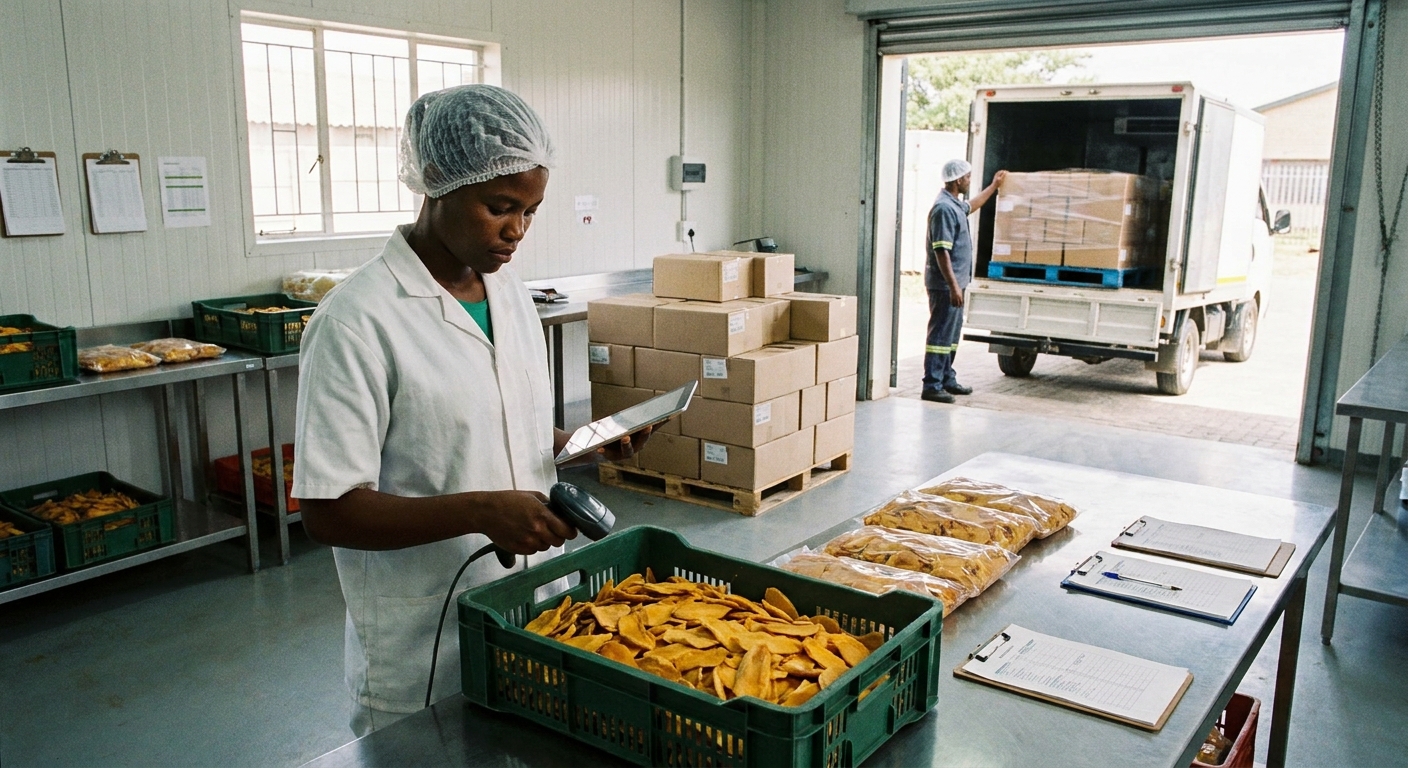
Before committing to a large volume, sending a sample or a small test order allows two things to be verified simultaneously: whether the product meets the buyer’s expectations, and whether the buyer can actually pay within the agreed timeframe. This step, often skipped out of commercial impatience, prevents the majority of disputes seen in export transactions.
Checking a buyer’s commercial track record also involves simple, free steps: the company’s age in the local commercial register, an active website, reviews from other suppliers on B2B platforms, and whether the volume ordered is consistent with the company’s apparent size. A buyer ordering a volume disproportionate to their size warrants enhanced verification before shipment.
The high-ROI prospecting method
Prospecting without a method scatters commercial energy across hundreds of cold contacts for marginal results. A structured approach, targeted by country and sector, produces measurable results within a few weeks.
The first step is to focus on a small number of countries and sectors rather than canvassing all of Europe at once. A Dutch importer specialising in tropical fruits does not have the same criteria as a German distributor of organic speciality foods. Tailoring the message to each profile significantly increases the response rate.
Direct outreach to identified importers — by professional email followed by LinkedIn — works better than a generic mass send. A message that names the exact product the buyer sources, states the certification held, and gives a specific volume figure gets a far higher response rate than a general company introduction.
Structured follow-ups often make the difference between a contact that goes nowhere and a signed order. A European buyer receives dozens of solicitations per week; a polite follow-up seven to ten days after the first contact, then a second after three weeks with a new piece of information (a new sample, a newly obtained certification), keeps the company visible without becoming intrusive.
| Step | Timing after initial contact | Message content |
|---|---|---|
| First contact | Day 0 | Specific product, available volume, certification held, one direct question |
| First follow-up | Day 7 to 10 | Brief reminder, offer to send a sample |
| Second follow-up | Week 3 | New information: certification obtained, new harvest available |
| Follow-up contact | After a trade show or commercial mission | Reference to the in-person meeting, proposal for a call or meeting |
An effective first-contact message fits in a few sentences: it names the exact product the buyer sources, states a specific available volume, mentions the certification held, and ends with a precise question rather than a general introduction. A buyer responds more readily to a direct question (“What grade of cajou are you currently buying?”) than to a company overview.
Regular participation in the same trade shows, year after year, builds progressive recognition among buyers. An exhibitor appearing at SIAL Paris or Fruit Logistica for the first time rarely leaves with a signed contract; conversion typically happens at the second or third participation, once a trust relationship has begun to form.
Specialist platforms such as Europages complement this approach by capturing buyers who are actively searching for a specific supplier — provided the company listing is optimised as described above. This channel works alongside trade shows and support programmes, never as a sole substitute.
To place these channels within a broader export strategy, our guide to agrifood export opportunities in Europe and Asia covers the leading sectors and markets by region.
Frequently asked questions
What is the fastest channel for finding a first European buyer?
B2B platforms such as Europages or Tridge deliver the quickest results because they are continuously browsed by active buyers. Trade shows require more preparation but produce higher-quality contacts, which are often decisive for a first significant contract.
Do you have to pay to exhibit at a European agrifood trade show?
The direct cost of a stand ranges from €346 to €376 per square metre depending on the show and the booking date, with an additional organiser package that often exceeds €1,000. National or international export support programmes, such as CBI or export promotion agencies, cover all or part of these costs for selected companies.
How do you know whether a European buyer is reliable before shipping?
Check the company’s age and commercial history, request a solvency report from a specialist organisation such as Coface, and always start with a sample or small test order before committing to a large volume.
Which certifications are essential for selling in Europe?
The HACCP system is the non-negotiable baseline, required by European regulation 852/2004 for any food business. Depending on the sector, additional certifications such as ISO 22000, the EU organic label, or Fair Trade significantly strengthen credibility and often enable a better price.
Do customs duties apply to African agrifood products exported to Europe?
For West African countries that have signed the Economic Partnership Agreement with the European Union, the vast majority of products access the European market duty-free. This tariff advantage should be raised in every price negotiation with a European buyer.
How long does it take to land a first contract with a European buyer?
A first contact made through a B2B platform can turn into a test order within a few weeks if the company listing is complete. A contact made at a trade show more often converts into a significant contract after a second or third participation — a timeframe of one to two years in most cases.